Steve McCroskey and the 10x Lie

In Airplane! (1980), Lloyd Bridges plays Steve McCroskey, an air-traffic controller running a disaster on the ground while a single pilot with food poisoning tries not to kill everyone on the plane above. McCroskey is on two phones at once. He’s barking at his wife. He’s pivoting to a subordinate mid-sentence. He’s drinking coffee, then cigarettes, then amphetamines, then glue, in that order. Every fifteen minutes or so, the camera cuts back to him and he delivers the same line with a slightly different noun: ...

April 24, 2026 · 8 min · 1556 words · Gonzalo Contento

The Chestnut Tree as Modern Diagnosis

In Enlightenment and Madness I argued that José Arcadio Buendía wasn’t mad in the way Macondo thought he was — that the patriarch tied to the chestnut tree was another face of the same transcendence that lifts Remedios la Bella into the sky. Two exits from ordinary consciousness, one serene, one savage. A reader — my mother, actually — pushed back on that with a sharp question. If he had lived today, she asked, would you still call it wisdom, or would you just put him on a medication and send him home? ...

April 23, 2026 · 7 min · 1480 words · Gonzalo Contento

Enlightenment and Madness: Rereading One Hundred Years of Solitude

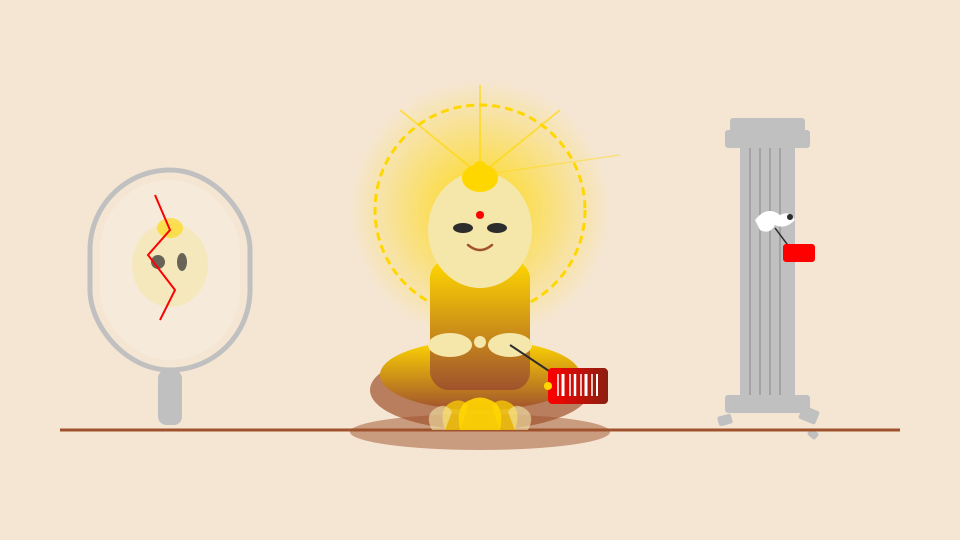
Rereading Cien años de soledad after many years, I found myself less drawn to the Buendía dynasty’s epic sweep than to two characters at opposite poles of the novel: Remedios la Bella, who ascends bodily into the sky while folding sheets, and José Arcadio Buendía, the patriarch who dies tied to a chestnut tree, speaking Latin to the ghosts only he can see. Both escape Macondo. Both leave ordinary reality behind. But they do so from diametrically opposite directions — one upward into serenity, the other downward into madness. The more I thought about it, the more this looked like a question Buddhism has wrestled with for centuries: what separates enlightenment from craziness, and are they really opposites at all? ...

April 22, 2026 · 6 min · 1095 words · Gonzalo Contento

The Realities of Marxism, Capitalism, and Socialism

The concepts of Marxism, capitalism, and socialism often dominate discussions about economics and politics. While each represents a distinct approach to organizing society, their real-world implementations often deviate significantly from their ideals. To understand their realities, it’s crucial to examine their theoretical foundations and how they’ve played out historically. Marxism: The Revolutionary Ideal Marxism, rooted in the works of Karl Marx and Friedrich Engels, envisions a classless society where workers control the means of production. Its core critique is of capitalism’s tendency to exploit labor for profit. Marx predicted that this exploitation would inevitably lead to class struggle, culminating in a revolutionary overthrow of capitalist systems. ...

December 19, 2024 · 3 min · 583 words · Gonzalo Contento

The Allegory of the Tightrope Walker: Exploring 'Zarathustra’s Prologue' by Nietzsche

Friedrich Nietzsche’s Thus Spoke Zarathustra is a philosophical masterpiece rich with allegorical imagery. In “Zarathustra’s Prologue,” particularly sections 5 and 6, Nietzsche introduces three potent symbols: the rope, the tightrope walker, and the jester. These elements collectively serve as a metaphor for the human condition and the arduous journey toward the Übermensch (Superman). This pivotal scene encapsulates Nietzsche’s vision of self-overcoming, struggle, and transcendence. Summary of the Chapter In the prologue, Zarathustra descends from the mountains after a decade of solitude and philosophical contemplation. He arrives in a bustling town where a crowd has gathered to witness a tightrope walker. Zarathustra seizes the moment to introduce his philosophy, describing humanity as a precarious state between the animal and the Übermensch. ...

December 11, 2024 · 5 min · 904 words · Gonzalo Contento