
The Price of Fire — Prometheus, Nietzsche, and the Cost of Creating Values

The Price of Fire — Prometheus, Nietzsche, and the Cost of Creating Values

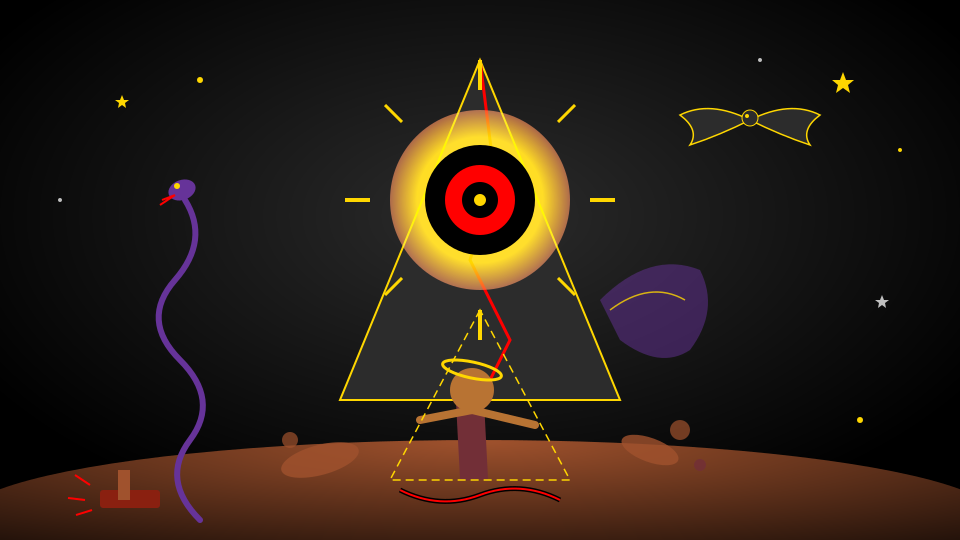
We have made Prometheus into a mascot for progress. The Titan who stole fire and gave it to a shivering humanity now lends his name to prizes, foundations, rockets—anything that wants to sound bold. But the myth does not end with the gift. It ends—or refuses to end—at the rock. Chained to a crag in the Caucasus, Prometheus has his liver torn out by an eagle each day and grown back each night, so that the wound is always fresh and the punishment never finishes. The fire was given once. The price is paid forever. To read the myth honestly is to keep your eyes on the rock, not the flame. …
May 31, 2026 · 7 min · 1352 words · Gonzalo Contento
The Allegory of the Tightrope Walker: Exploring 'Zarathustra’s Prologue' by Nietzsche

The Allegory of the Tightrope Walker: Exploring 'Zarathustra’s Prologue' by Nietzsche

Friedrich Nietzsche’s Thus Spoke Zarathustra is a philosophical masterpiece rich with allegorical imagery. In “Zarathustra’s Prologue,” particularly sections 5 and 6, Nietzsche introduces three potent symbols: the rope, the tightrope walker, and the jester. These elements collectively serve as a metaphor for the human condition and the arduous journey toward the Übermensch (Superman). This pivotal scene encapsulates Nietzsche’s vision of self-overcoming, struggle, and transcendence. Summary of the Chapter In the prologue, Zarathustra descends from the mountains after a decade of solitude and philosophical contemplation. He arrives in a bustling town where a crowd has gathered to witness a tightrope walker. Zarathustra seizes the moment to introduce his philosophy, describing humanity as a precarious state between the animal and the Übermensch. …

December 11, 2024 · 5 min · 895 words · Gonzalo Contento