The Second Reading of Troy — From Homeric Denotation to the Ego of War

The Second Reading of Troy — From Homeric Denotation to the Ego of War

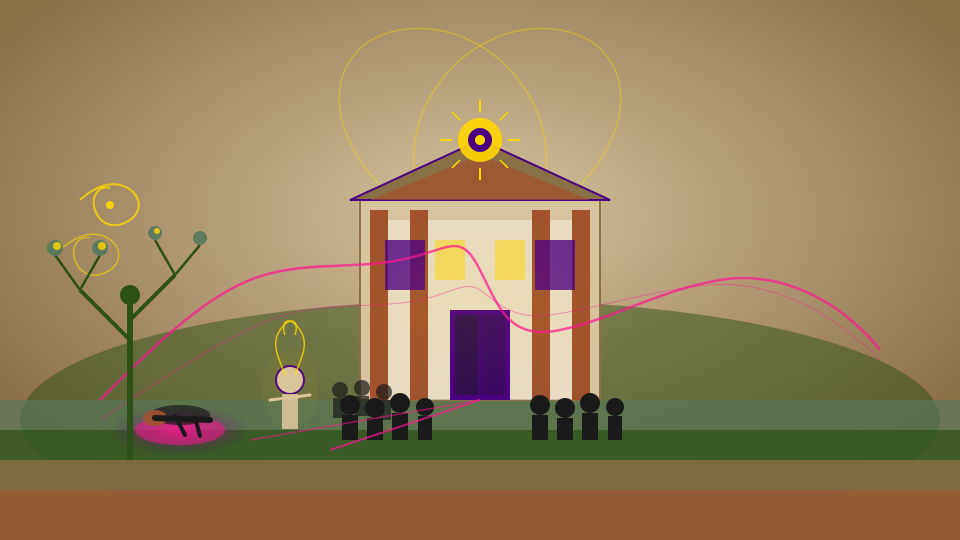
Christopher Nolan’s Odyssey has already opened, and I still haven’t gone to see it. I probably won’t reread The Iliad or The Odyssey beforehand either, and I certainly won’t reread Ulysses — Joyce’s hundred-year-old rewrite of the same walk home — just because a director spent a reported quarter billion dollars and two years of 70mm IMAX film getting the wine-dark sea right. I’ll do what most adults do with the classics: let the adaptation take the first pass. But the more useful confession isn’t about the film. Even without a fresh reading, I already know what’s changed in how I encounter Troy. It isn’t the plot. It’s the algorithm I run over it. …

July 24, 2026 · 5 min · 927 words · Gonzalo Contento
Resurrection Machine — Why the Public Always Asks for an Encore

Resurrection Machine — Why the Public Always Asks for an Encore

You cannot kill a narrative by killing its bearer. This is the oldest lesson in the history of power, and it is still not learned. The jester speaks a truth the throne cannot tolerate. Power silences him. But the moment the silencing happens—the arrest, the exile, the execution—something shifts. The jester is no longer a living person you can contradict or embarrass. He becomes a martyr. He becomes untouchable. The public, having witnessed the drama, begins to resurrect him. In protest signs. In whispered stories. In the coded language of the oppressed. The throne meant to kill the jester. Instead, it created an eternal symbol. …

June 23, 2026 · 6 min · 1198 words · Gonzalo Contento
After Adolescence, Repair Becomes a Miracle

After Adolescence, Repair Becomes a Miracle

Almost everyone past forty knows the type. The man still operating, in some quiet operative sense, as if he were twenty-four. The woman whose romantic life consists of the same three patterns it consisted of in 2009. The friend whose career has had the right surface motion — promotions, titles, perfectly photographed dinners — but whose inner question, who am I when no one is watching, has not seriously been asked since adolescence. They are not failures. Some of them are extraordinarily successful. They are simply, in the part that matters, not yet adults. …

April 30, 2026 · 9 min · 1746 words · Gonzalo Contento
Enlightenment and Madness: Rereading One Hundred Years of Solitude

Enlightenment and Madness: Rereading One Hundred Years of Solitude

Rereading Cien años de soledad after many years, I found myself less drawn to the Buendía dynasty’s epic sweep than to two characters at opposite poles of the novel: Remedios la Bella, who ascends bodily into the sky while folding sheets, and José Arcadio Buendía, the patriarch who dies tied to a chestnut tree, speaking Latin to the ghosts only he can see. Both escape Macondo. Both leave ordinary reality behind. But they do so from diametrically opposite directions — one upward into serenity, the other downward into madness. The more I thought about it, the more this looked like a question Buddhism has wrestled with for centuries: what separates enlightenment from craziness, and are they really opposites at all? …

April 22, 2026 · 6 min · 1086 words · Gonzalo Contento
Capitalism: The Minotaur or Kirtimukha?

Capitalism: The Minotaur or Kirtimukha?

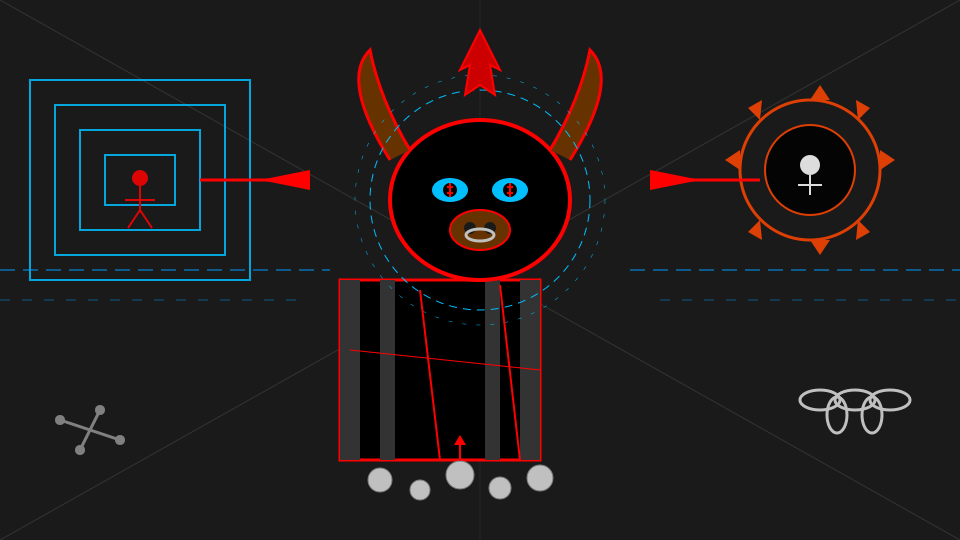
The book Technofeudalism: What Killed Capitalism by Yanis Varoufakis got me into thinking about the Minotaur, but at the same time I couldn’t help but think about Kirtimukha. I decided to write a piece comparing the two myths and how they relate to capitalism. Capitalism: A Labyrinthine Monster or an Eternal Hunger? Throughout history, economic systems have been compared to great forces of nature, war machines, or living organisms. But if we turn to mythology, two figures stand out as powerful metaphors for modern capitalism: the Minotaur, a monster lurking in an inescapable labyrinth, and Kirtimukha, a self-consuming face that never disappears. …

February 7, 2025 · 3 min · 452 words · Gonzalo Contento