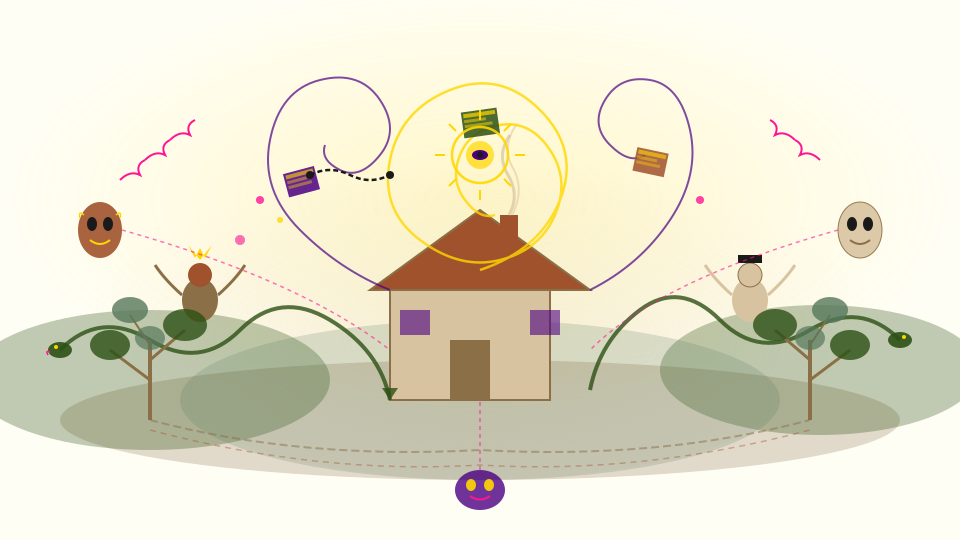
The Story Under the Story — Adaptation, Disguise, and the Violence of Origins

The Story Under the Story — Adaptation, Disguise, and the Violence of Origins

Most people who grew up on the Disney Cinderella believe they know how the story ends: midnight, the glass slipper, the wedding. That belief is not wrong so much as it is late. It arrives already several centuries and several continents downstream of where the story starts, and the version that feels most original is usually just the version we happened to receive first. Underneath a great many familiar characters sits an older, stranger engine — one the polished surface was built to manage rather than replace. …

September 24, 2026 · 7 min · 1465 words · Gonzalo Contento |  AI-likeness: 17%
Fernanda del Carpio — Righteousness, Order, and the Cost of Being Right

Fernanda del Carpio — Righteousness, Order, and the Cost of Being Right

Readers of One Hundred Years of Solitude tend to file Fernanda del Carpio under the unbearable one and move on. It is an understandable reflex and a small act of cowardice, because she is the character in the book whose conduct is most easily defended on paper. She keeps the house clean. She protects the family name. She enforces mourning, decency, schedules, prayer. Almost everything she does can be justified by a principle, and almost everything she does causes damage. Gabriel García Márquez built her as a machine for demonstrating that those two facts are compatible. …

September 21, 2026 · 7 min · 1380 words · Gonzalo Contento |  AI-likeness: 43%
The Godfather as a Business Class — Power, Favors, and the Cost of an Offer

The Godfather as a Business Class — Power, Favors, and the Cost of an Offer

The Godfather keeps coming up in my business conversations. Not because of the blood, but because of the scenes where people negotiate, read a room, exchange favors, protect a reputation, and discover that a decision they thought was professional was carrying an entire moral order inside it. Mario Puzo’s novel and Francis Ford Coppola’s films should be treated as related but distinct instruments rather than rivals for the same crown. Puzo gives the world breadth and backstory; Coppola gives it ritual, faces, and lines that have become almost proverbial. Together they dramatize the informal curriculum every organization runs alongside its formal one — who can ask for what, which obligations get remembered, how trust is priced, when a refusal becomes an insult. The Corleone family is not a model to imitate. It is a pressure chamber in which ordinary organizational mechanisms become impossible to look away from. …

September 18, 2026 · 5 min · 1064 words · Gonzalo Contento |  AI-likeness: 74%
Amaranta's Shroud — Certainty, Announcement, and the Relief of Death

Amaranta's Shroud — Certainty, Announcement, and the Relief of Death

In One Hundred Years of Solitude, Gabriel García Márquez stages one of literature’s strangest domestic visits. Death arrives at Amaranta Buendía’s door not as a specter or a car crash but as a courteous woman with a specific piece of information: Amaranta will die the day she finishes weaving her own shroud. Amaranta does not panic. She weaves by day and unravels her work by night, buying herself time not out of fear but to settle her affairs, and when the cloth is finally allowed to be finished, she bathes, dresses in it, lies down, and dies without drama. The scene is often read as magic for its own sake. It is closer to a thought experiment: what happens to the fear of death when the one variable we assume drives that fear — not knowing when — is removed. …

September 15, 2026 · 6 min · 1172 words · Gonzalo Contento |  AI-likeness: 31%
Rereading Pedro Páramo — Ghost Story, Social Grammar

Rereading Pedro Páramo — Ghost Story, Social Grammar

I read Pedro Páramo decades ago and thought I had understood it: a haunted town, the dead murmuring to each other across timelines, memory rendered as fog. Returning to it now, a second book sits underneath the first one. Juan Rulfo’s novel is not only a feat of atmosphere. It is a social diagnosis — abuse, incest, patriarchal impunity, and the mechanism by which private violence hardens into public order. The setting is unmistakably Mexican. The grammar it describes is not. …

July 17, 2026 · 6 min · 1218 words · Gonzalo Contento |  AI-likeness: 24%
Marcela — The Woman Who Refused to Be the Story

Marcela — The Woman Who Refused to Be the Story

Cervantes wrote about women’s rights in the sixteenth century with an angle so sharp it cuts through four hundred years. A beautiful woman, financially independent, who dares to say no—and a man who feels so entitled to her love that his suicide becomes her crime. The most appalling part? His friends, and society, agree. The story comes from Don Quijote, Part I, Chapters 12–14. A young woman named Marcela, orphaned and wealthy, decides to live as a shepherdess in the wilderness rather than marry any of the countless men who pursue her. She is free, self-sufficient, answerable to no one. One of her suitors, Grisóstomo—a brilliant, educated man—becomes consumed by his unrequited love. He follows her into the shepherd’s life, writes melancholic verses, and eventually dies, apparently by his own hand. …

July 6, 2026 · 7 min · 1367 words · Gonzalo Contento |  AI-likeness: 77%
Context Matters — The Reader Is the Other Half of Every Book

Context Matters — The Reader Is the Other Half of Every Book

A book is not finished when the author stops writing. A film is not finished when the credits roll. The work is only half of the circuit; the other half is the life that meets it. Meaning is not stored inside the text waiting to be extracted. It is completed at the point of contact—between the work and everything the reader already carries: their geography, their history, their language, their dead. Hand the same novel to two people and you have produced two different novels. Context is not decoration on the art. It is the other half of the art. …

June 7, 2026 · 10 min · 2004 words · Gonzalo Contento |  AI-likeness: 4%
The Miserable Bedspread — On Mistaking Marketing for Science

The Miserable Bedspread — On Mistaking Marketing for Science

In One Hundred Years of Solitude, when the gypsies bring a flying carpet to Macondo, José Arcadio Buendía stands unmoved. “Let them dream,” he says. “We’ll do better flying than they are doing, and with more scientific resources than a miserable bedspread.” He is the rationalist in a village of magic—the one man insisting on understanding how things actually work rather than being dazzled by how they appear. Then he ties himself to a chestnut tree and never recovers. …

May 29, 2026 · 6 min · 1244 words · Gonzalo Contento |  AI-likeness: 21%
The 1:1 map — Borges, attention, and what LLMs actually are

The 1:1 map — Borges, attention, and what LLMs actually are

I. The parable In 1946, Jorge Luis Borges published a six-sentence parable. He attributed it to a fictional traveler — Suárez Miranda — and buried it in El Hacedor, a collection his admirers would later call Dreamtigers. The parable describes an empire whose cartographers, unsatisfied with every previous map, built one at the only scale that could not lie: one province to one province, point for point. The map was complete. It was also useless. Subsequent generations, with more practical priorities, let it decay in the western deserts. …

May 13, 2026 · 6 min · 1162 words · Gonzalo Contento |  AI-likeness: 56%
The Chestnut Tree as Modern Diagnosis

The Chestnut Tree as Modern Diagnosis

In Enlightenment and Madness I argued that José Arcadio Buendía wasn’t mad in the way Macondo thought he was — that the patriarch tied to the chestnut tree was another face of the same transcendence that lifts Remedios la Bella into the sky. Two exits from ordinary consciousness, one serene, one savage. A reader — my mother, actually — pushed back on that with a sharp question. If he had lived today, she asked, would you still call it wisdom, or would you just put him on a medication and send him home? …

April 23, 2026 · 7 min · 1471 words · Gonzalo Contento |  AI-likeness: 10%