Work Is an Artificial Imposition — Survival, Narrative, and the Architecture of Labor

Work Is an Artificial Imposition — Survival, Narrative, and the Architecture of Labor

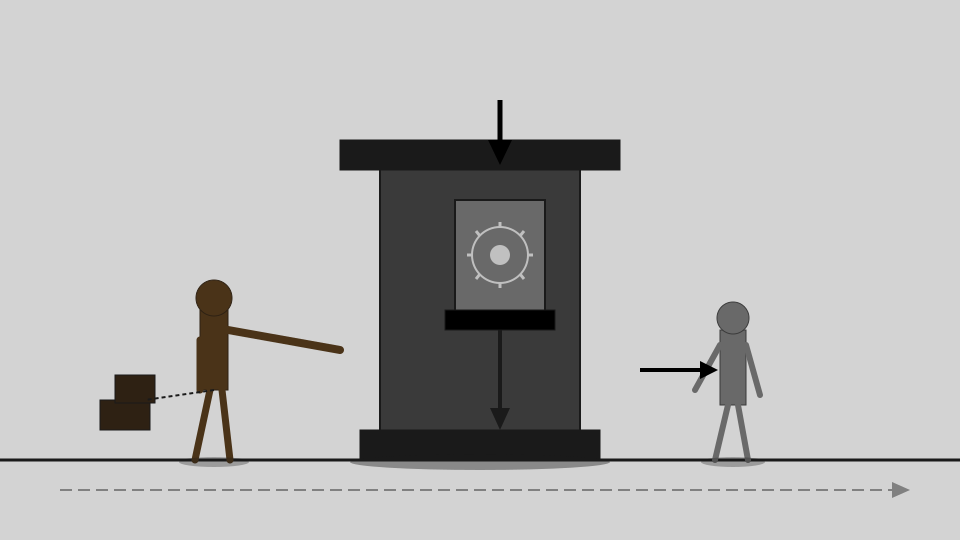
In 1966, at a symposium called “Man the Hunter,” the anthropologist Marshall Sahlins stood up with data other people had already collected — Richard Lee’s fieldwork among the Dobe Ju/‘hoansi of the Kalahari, the Arnhem Land studies from Australia — and said the quiet part out loud. Foragers routinely described as living at the ragged edge of subsistence were, in fact, meeting their needs on something like fifteen to twenty hours of work a week, and spending the rest of their waking hours resting, talking, and doing nothing in particular. Sahlins published the argument, expanded, in Stone Age Economics (1972) under a title designed to sting: “the original affluent society.” Not affluent because foragers had much, but affluent because they wanted little and got it without the compulsion the word “work” now implies. The finding embarrassed a whole civilizational story in which agriculture and industry had liberated humanity from want. They hadn’t. They had invented a new way of being busy, and then made the busyness feel like fate. …

July 15, 2026 · 8 min · 1500 words · Gonzalo Contento
The Plumber Paradox — Why 'Learn a Trade' Is Not the Safety Net You Think It Is

The Plumber Paradox — Why 'Learn a Trade' Is Not the Safety Net You Think It Is

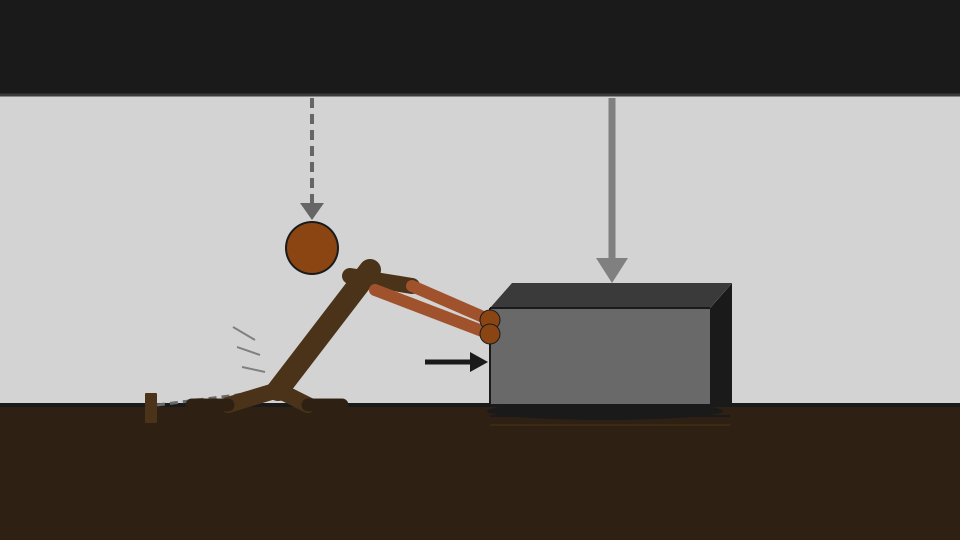
The reassurance has become a reflex: “Don’t worry about AI replacing your job. Learn a trade. Become a plumber. You’ll always be needed.” It’s not false. But it’s not entirely true either—probably about 75% correct, which is the most dangerous place for an argument to land. I. Three Hidden Variables The advice works until you account for three things that never make it into the conversation: saturation, incompetence, and structural obsolescence. …

June 10, 2026 · 6 min · 1162 words · Gonzalo Contento
The Changing Face of Creativity in the Modern World

The Changing Face of Creativity in the Modern World

In today’s world, technology is evolving at an unprecedented pace. This evolution is challenging our traditional notions of creativity, redefining its role in society, and prompting new questions about where and when creativity is essential. While creativity has long been heralded as a uniquely human attribute, there are areas where its necessity diminishes in favor of consistency and reliability, particularly in a world increasingly dominated by automation and robotics. Creativity: A Definition Creativity can be described as the ability to generate new, original ideas or to perceive connections between seemingly unrelated concepts. It involves thinking outside the box, innovating, and finding solutions or expressions that aren’t immediately obvious. While essential in fields like the arts, problem-solving, and design, creativity is not always the key driver of success in every professional or industrial context. …

December 8, 2024 · 3 min · 611 words · Gonzalo Contento