The Command Line and the Button — Interfaces, Agency, and the Lost Superpower

The Command Line and the Button — Interfaces, Agency, and the Lost Superpower

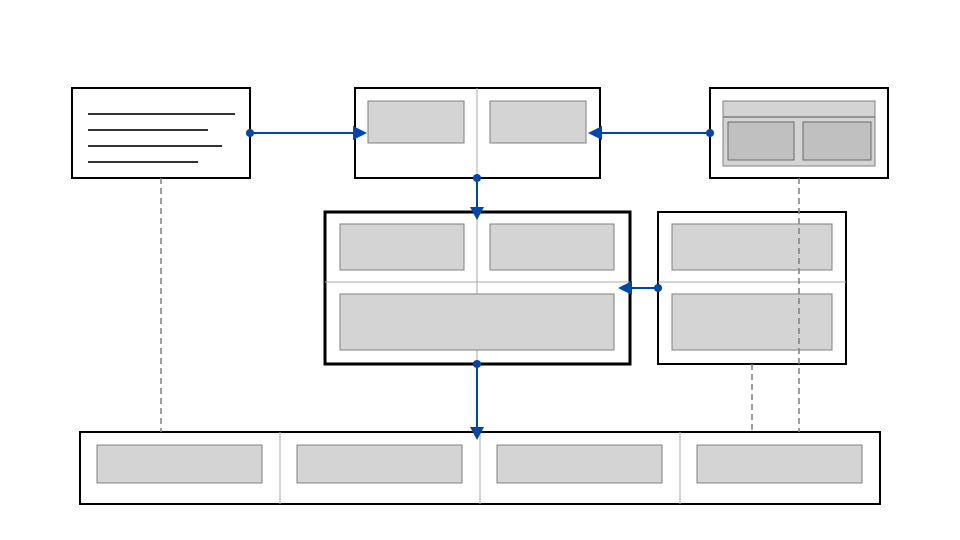
Most people did not enter computing through a single door. Depending on when and where they arrived, there was a console, a command line, a graphical desktop, or several of these at once, layered on top of each other like geological strata. For the ordinary user, the graphical interface was an act of hospitality: it made the machine legible without requiring a vocabulary of commands, paths, flags, and permissions. You pointed, you clicked, the machine answered in pictures. …
September 14, 2026 · 6 min · 1189 words · Gonzalo Contento |  AI-likeness: 48%
Why Learn the Unix Shell — Bash, Zsh, Fish, and the Interface That Runs the World

Why Learn the Unix Shell — Bash, Zsh, Fish, and the Interface That Runs the World

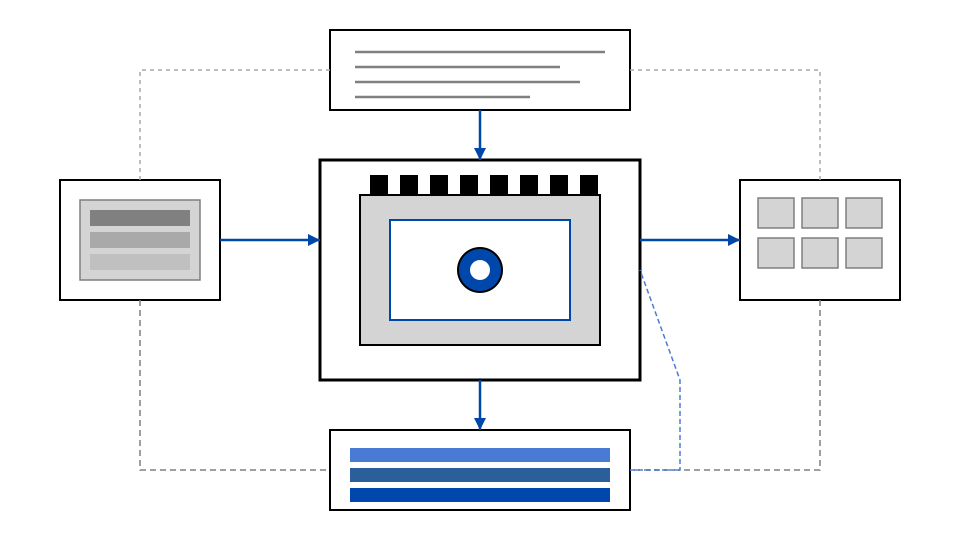
The Unix shell is not the best tool for every job. But it is the most portable standard we have. When an LLM is asked to reason, it writes bash. When a container starts, it runs a shell script. When a CI pipeline executes, it runs shell commands. When a server boots, init runs a shell. The shell is not elegant—it is ubiquitous. And ubiquity, in systems engineering, is a kind of elegance. …

July 2, 2026 · 5 min · 1015 words · Gonzalo Contento |  AI-likeness: 82%
Roman Sanitation — The Discontinuity

Roman Sanitation — The Discontinuity

By the first century CE, Rome supplied its citizens with water through eleven aqueducts. The Cloaca Maxima, the great sewer, still stands—the oldest working infrastructure in the world. Frontinus, appointed superintendent of aqueducts in 97 CE, left behind a technical manual on water management that reads like a modern utility document. The Romans understood that filth and disease traveled together. They built public latrines with running water. They regulated waste disposal. They organized the collection of garbage in the streets. …

June 30, 2026 · 7 min · 1473 words · Gonzalo Contento |  AI-likeness: 41%