The Breakfast That Wrecks Me — On Glucose, Sequence, and the First Vote of the Day

The Breakfast That Wrecks Me — On Glucose, Sequence, and the First Vote of the Day

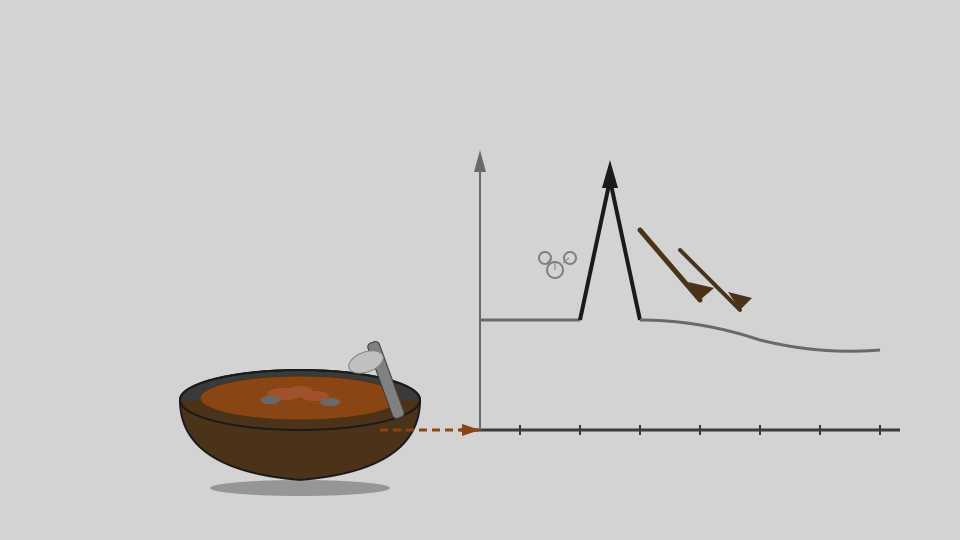
I keep calling it “healthy” out of habit. A banana, a bowl of cereal with a reassuring claim printed on the box, coffee sweetened once with sugar and once more with an artificial sweetener for good measure, a glass of orange juice because it looks like the vitamin section of the meal. Nothing on that table would fail a food pyramid inspection from 1995. And it destroys me in real time — not morally, metabolically. An hour after eating it I am foggier than before I ate, hungrier than I was on an empty stomach, reaching for something else before ten o’clock. The problem was never that I lacked discipline at that table. The problem is that the table was never mine to control. It was built to move fast, and speed is exactly what it delivers. …

Food, Fear, and the Evolutionary Body — On Eating Without a Sacred Menu

Food, Fear, and the Evolutionary Body — On Eating Without a Sacred Menu

We do not only eat food. We eat stories about food. Fat is the enemy, or sugar is poison, or breakfast is sacred, or meat is ancestral, or grains were civilization’s original mistake, or the answer is buried in whatever a grandparent ate before anyone thought to write it down. The stories rotate. The anxiety they produce does not. Every meal becomes a small referendum on whether the body is being cared for or betrayed, and the referendum never quite closes. …

When Illness Becomes Normal — Metabolic Breakdown, Pseudoscience, and the Cost of Calling Pathology Progress

When Illness Becomes Normal — Metabolic Breakdown, Pseudoscience, and the Cost of Calling Pathology Progress

Ask a surgeon why the gallbladder came out, and the answer arrives fast, almost cheerful: you don’t really need it. That’s true in the narrow sense that a person can live, eat, and digest fat well enough without one. It’s also one of the most quietly revealing sentences in modern medicine. Cholecystectomy — removal of the gallbladder — is now among the most common abdominal operations performed in the country doing the most of them, and the organ is coming out almost always because of gallstones that track, closely, with obesity and insulin resistance. Nobody is treating a design flaw in the gallbladder. They are treating the downstream damage of a metabolic environment the organ was never built to survive, and calling the removal a fix rather than a receipt. …

The Workout Is a Fiction — On Movement, Survival, and the Life We Forgot to Live

The Workout Is a Fiction — On Movement, Survival, and the Life We Forgot to Live

Try to picture an ancestor from ten thousand years ago — before agriculture, before cities, before the concept of leisure time — doing bicep curls. The image collapses immediately. Not because they lacked biceps; they had better ones than most of us. The image collapses because the question is wrong. They did not exercise. They moved, constantly, because stillness was failure. Hunting, carrying, building, walking to water, running from danger, kneeling to tend a fire. Movement was not a habit they cultivated. It was the texture of being alive. …

We Are Not Cattle — Inflammation, BMI, and What Modern Medicine Keeps Missing

We Are Not Cattle — Inflammation, BMI, and What Modern Medicine Keeps Missing

The body in front of the doctor is easy to measure. Weight goes on a scale. Height goes on a chart. Divide one by the square of the other and you have a number — a BMI — that gets entered into a database and flagged if it falls outside a range established in the 1830s by a Belgian astronomer named Adolphe Quetelet who was studying the statistical distribution of soldiers, not the metabolic health of individuals. Quetelet called his formula the Indice de Corpulence. He did not intend it as a clinical tool. He was doing population statistics. …

From 'Healthy' to Healthy

From 'Healthy' to Healthy

I am not a physician, nutritionist, or licensed healthcare practitioner, and I am not selling a medication, a supplement, or a diet. Nothing here is medical advice, diagnosis, or treatment — it is part anecdote, part working hypothesis, part established science, and a personal map of authors I find worth taking seriously. For anything concerning your own health, consult a qualified professional who knows your case. Updated 2026-08-13 — rewrote the page as an essay tying insulin resistance, food, sleep, movement, stress, isolation, and status together as one argument; added a section on legal drugs, social connection, and status/health; the presentation built from this essay is coming soon; the working reading list below now sits under Further reading, extended with the new sources the essay cites. …