Cortisol Is Not the Villain — When Survival Outlives the Tiger

Cortisol Is Not the Villain — When Survival Outlives the Tiger

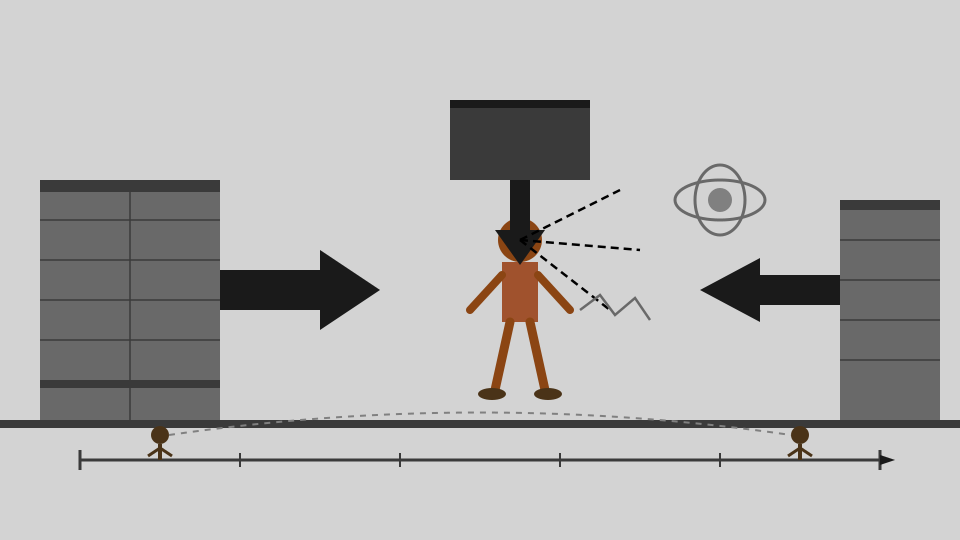
We speak about cortisol as if it were a contaminant: the chemical residue of a bad life, the hormone responsible for belly fat, insomnia, anxiety, and the general collapse of modern existence. The language is too simple. Cortisol is not an invader. It is one of the oldest emergency systems in the body, an evolutionary gift that helped an animal survive the moment when survival became uncertain. Somewhere in that inheritance is the plain fact that someone, somewhere, was not eaten by a tiger. …
September 8, 2026 · 7 min · 1284 words · Gonzalo Contento |  AI-likeness: 73%
Ten Thousand Years of Bread, Wine, and Disease

Ten Thousand Years of Bread, Wine, and Disease

Agriculture is the oldest technology we never stopped using. Ten thousand years after the first cultivated grain, we still eat bread, still ferment wine, still brew beer — the same three inventions that let hunter-gatherers become villagers, villagers become cities, and cities become empires. It is tempting to call this progress and move on. But a civilization built on a handful of domesticated grasses has also produced, at a scale our ancestors never approached, obesity, chronic inflammation, insulin resistance, metabolic syndrome, and a mental health crisis that abundance was supposed to prevent. Ten millennia is long enough to ask a blunt question: did we learn anything, or did we just get better at building the trap? …

September 4, 2026 · 5 min · 1048 words · Gonzalo Contento |  AI-likeness: 12%
Food, Fear, and the Evolutionary Body — On Eating Without a Sacred Menu

Food, Fear, and the Evolutionary Body — On Eating Without a Sacred Menu

We do not only eat food. We eat stories about food. Fat is the enemy, or sugar is poison, or breakfast is sacred, or meat is ancestral, or grains were civilization’s original mistake, or the answer is buried in whatever a grandparent ate before anyone thought to write it down. The stories rotate. The anxiety they produce does not. Every meal becomes a small referendum on whether the body is being cared for or betrayed, and the referendum never quite closes. …

August 26, 2026 · 6 min · 1158 words · Gonzalo Contento |  AI-likeness: 30%
The Opportunistic Nature of Humans: The Most Sophisticated and Dangerous Animal

The Opportunistic Nature of Humans: The Most Sophisticated and Dangerous Animal

Throughout history, humans have displayed an unrivaled ability to adapt, exploit, and manipulate their environment. Unlike other animals bound by instinct, we leverage intelligence, creativity, and ruthlessness to ensure our survival and dominance. This opportunism has led to incredible advancements—but also immense destruction. The Evolutionary Edge of Opportunism Opportunism is not unique to humans; many animals take advantage of favorable circumstances. However, what sets us apart is the scale and sophistication of our strategies. From early humans using fire to hunt more efficiently to modern corporations exploiting global markets, our ability to seize opportunities is limitless. …

February 6, 2025 · 3 min · 566 words · Gonzalo Contento |  AI-likeness: 91%