The Post-Compression Social Contract — Four Institutions for a World That Stopped Hiring

The Post-Compression Social Contract — Four Institutions for a World That Stopped Hiring

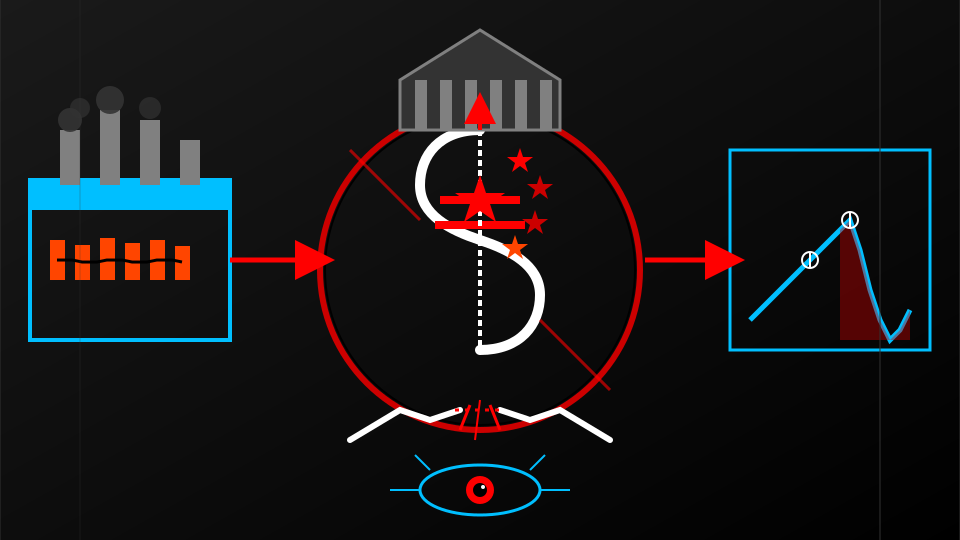
The case that labor demand compression is real has already been made, and not as a single event but as a pattern of absences: the hiring round that quietly never happens, the department that absorbs a product line without growing, the middle layer of a company that thins out one retirement and one AI subscription at a time. An earlier piece named the mechanism, another dismantled the reassurance that a trade is a safety net, and a third traced the whole idea of wage labor back to a fifteenth-century invention rather than a law of nature. None of them proposed what replaces the wage once it stops doing the job it was invented to do — handing a person access to food, housing, and a reason to get up. This is not another brief for universal basic income; Dauphin, Manitoba already supplied that evidence, and repeating it adds nothing. It is a taxonomy of the institutional shapes that already exist, in some working form, for coordinating a society whose labor market has permanently stopped clearing. …

The Best Things Money Can't Buy — What Markets Cannot Price, and Why That's the Point

The Best Things Money Can't Buy — What Markets Cannot Price, and Why That's the Point

The cliché says the best things in life are free. That’s not quite right, and the imprecision matters. Trust, respect, a friend’s attention, a stranger’s blood freely given — none of these are free in the sense of costing nothing to produce; they cost reputation, time, restraint, years of behaving well when no one was checking. What they share is something sharper than “free”: they are goods whose value depends on their not being for sale. Attach a price, and the thing on the other side of the transaction stops being the thing you wanted. …

Work Is an Artificial Imposition — Survival, Narrative, and the Architecture of Labor

Work Is an Artificial Imposition — Survival, Narrative, and the Architecture of Labor

In 1966, at a symposium called “Man the Hunter,” the anthropologist Marshall Sahlins stood up with data other people had already collected — Richard Lee’s fieldwork among the Dobe Ju/‘hoansi of the Kalahari, the Arnhem Land studies from Australia — and said the quiet part out loud. Foragers routinely described as living at the ragged edge of subsistence were, in fact, meeting their needs on something like fifteen to twenty hours of work a week, and spending the rest of their waking hours resting, talking, and doing nothing in particular. Sahlins published the argument, expanded, in Stone Age Economics (1972) under a title designed to sting: “the original affluent society.” Not affluent because foragers had much, but affluent because they wanted little and got it without the compulsion the word “work” now implies. The finding embarrassed a whole civilizational story in which agriculture and industry had liberated humanity from want. They hadn’t. They had invented a new way of being busy, and then made the busyness feel like fate. …

Connotation vs Denotation — What We Buy and Sell When We Trade in Meaning

Connotation vs Denotation — What We Buy and Sell When We Trade in Meaning

Joseph Campbell, in The Power of Myth (the Bill Moyers interviews), makes a passing remark about connotation vs denotation that cuts deeper than most full-length treatises on economics or politics. The distinction is simple, but its implications are not. Denotation is what something is — its factual, measurable, dictionary-definition reality. Connotation is what it means — the associations, the emotional weight, the story that clings to it. A rock is a rock. But the Rock of Gibraltar, the Stone of Destiny, the Black Stone of the Kaaba — these carry connotations so heavy they bend the world around them. This is not metaphor. This is the actual engine of human civilization. …

The Plumber Paradox — Why 'Learn a Trade' Is Not the Safety Net You Think It Is

The Plumber Paradox — Why 'Learn a Trade' Is Not the Safety Net You Think It Is

The reassurance has become a reflex: “Don’t worry about AI replacing your job. Learn a trade. Become a plumber. You’ll always be needed.” It’s not false. But it’s not entirely true either—probably about 75% correct, which is the most dangerous place for an argument to land. I. Three Hidden Variables The advice works until you account for three things that never make it into the conversation: saturation, incompetence, and structural obsolescence. …

The Shapes of Extraction — and the Big Lie About China

The Shapes of Extraction — and the Big Lie About China

The argument that keeps failing is not the argument about which system is better. It is the assumption, buried inside that argument, that the categories are stable — that capitalism, socialism, mercantilism, feudalism refer to four distinct, mutually exclusive arrangements, and that the story of modern history is one of them winning. They have not been stable for five centuries. What has been stable is something more basic: there is a surplus, and someone claims it. The form the claiming takes has changed. The claiming has not. …

It's Not Jobs Disappearing. It's Jobs Not Being Created.

It's Not Jobs Disappearing. It's Jobs Not Being Created.

The public conversation about AI and work is stuck on the wrong question. “Will my job be replaced?” is the framing everyone reaches for, because it has a clean visual: a robot taking a specific seat. The headlines love it. Goldman: AI to replace 300 million jobs. McKinsey: half of all work activity automatable. The displacement frame promises an event — an announcement, a layoff, a press release — and the policy answers it suggests are familiar: retraining, universal basic income, regulation. …

Capitalism: The Minotaur or Kirtimukha?

Capitalism: The Minotaur or Kirtimukha?

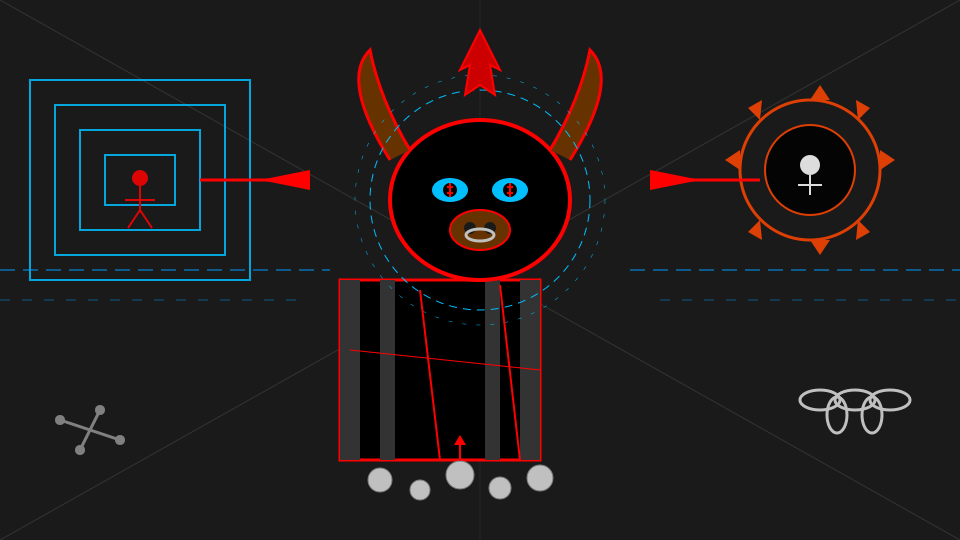
The book Technofeudalism: What Killed Capitalism by Yanis Varoufakis got me into thinking about the Minotaur, but at the same time I couldn’t help but think about Kirtimukha. I decided to write a piece comparing the two myths and how they relate to capitalism. Capitalism: A Labyrinthine Monster or an Eternal Hunger? Throughout history, economic systems have been compared to great forces of nature, war machines, or living organisms. But if we turn to mythology, two figures stand out as powerful metaphors for modern capitalism: the Minotaur, a monster lurking in an inescapable labyrinth, and Kirtimukha, a self-consuming face that never disappears. …

Made in China vs. The 'Evil' China: The Global Hypocrisy

Made in China vs. The 'Evil' China: The Global Hypocrisy

In the modern world, China occupies an undeniable space in the global economy. The phrase “Made in China” is stamped on everything from smartphones to sneakers, a symbol of the country’s manufacturing prowess. At the same time, “China” often evokes harsh criticism, with terms like “communist regime” and “authoritarian state” frequently making headlines. This juxtaposition exposes a glaring hypocrisy: the world decries China’s politics but thrives on its economic output. …

The Realities of Marxism, Capitalism, and Socialism

The Realities of Marxism, Capitalism, and Socialism

The concepts of Marxism, capitalism, and socialism often dominate discussions about economics and politics. While each represents a distinct approach to organizing society, their real-world implementations often deviate significantly from their ideals. To understand their realities, it’s crucial to examine their theoretical foundations and how they’ve played out historically. Marxism: The Revolutionary Ideal Marxism, rooted in the works of Karl Marx and Friedrich Engels, envisions a classless society where workers control the means of production. Its core critique is of capitalism’s tendency to exploit labor for profit. Marx predicted that this exploitation would inevitably lead to class struggle, culminating in a revolutionary overthrow of capitalist systems. …