Scheherazade's Contract — The Job as a Story That Cannot End

Scheherazade's Contract — The Job as a Story That Cannot End

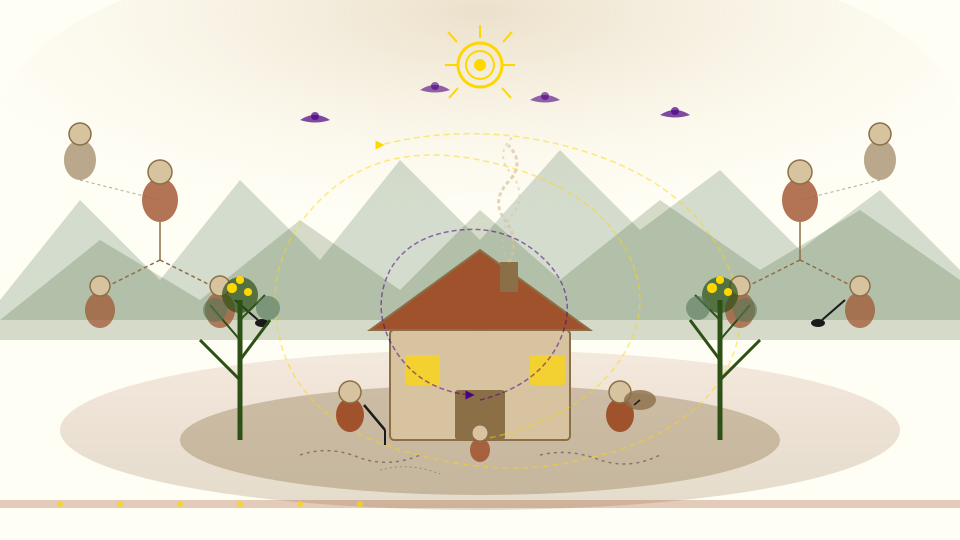
The modern job is not only a contract for labor. Increasingly, it is a story that has to be kept alive from one day to the next. The image is Scheherazade in The Thousand and One Nights. She survives by telling the king a story so compelling that he postpones her execution to hear the ending. The story is never allowed to close. Each night buys another morning. No employee is literally Scheherazade, and a layoff is not an execution — the analogy would collapse if pushed that far. But the structure of uncertainty transfers cleanly: survival depends on keeping an authority interested in a future that has not yet arrived. The new project, the strategic initiative, the quantified productivity gain, the skills acquired in a spare evening, the enthusiastic email to a manager — all of it functions as an installment in the same ongoing narrative. The worker is not merely doing the job. The worker is continuously proving there will still be a reason for the job tomorrow. …
September 17, 2026 · 7 min · 1471 words · Gonzalo Contento |  AI-likeness: 47%
The Low-Hanging Fruit — AI, Office Automation, and the Next Job Shock

The Low-Hanging Fruit — AI, Office Automation, and the Next Job Shock

The public imagination tends to place the danger of artificial intelligence at the far end of the scale: autonomous weapons, a machine that surpasses human intelligence, something with a chassis walking down a street. Those scenarios deserve the attention they get. But the first large social shock is more likely to arrive through a route with no cinematic value at all — the ordinary work already performed inside email, spreadsheets, ticket queues, and the small in-house tools that run a modern office. …

September 16, 2026 · 6 min · 1143 words · Gonzalo Contento |  AI-likeness: 38%
Game Theory and Modern Artificial Intelligence

Game Theory and Modern Artificial Intelligence

Game theory and modern artificial intelligence (AI) are closely intertwined, as both involve making decisions in strategic, interactive environments. Here’s how they relate and draw from history: The Historic Foundations of Game Theory The development of game theory is rooted in the work of several key contributors whose ideas have shaped not only the field but also its application to modern AI: John von Neumann John von Neumann is one of the founders of game theory. His minimax theorem established that in zero-sum games, there exists an optimal strategy where players minimize their maximum possible losses. This insight laid the groundwork for strategic decision-making in adversarial settings, which is crucial in AI applications like competitive gaming and adversarial learning. …

December 29, 2024 · 3 min · 597 words · Gonzalo Contento |  AI-likeness: 72%