Flaws in Communication: When Belief Overrides the Message

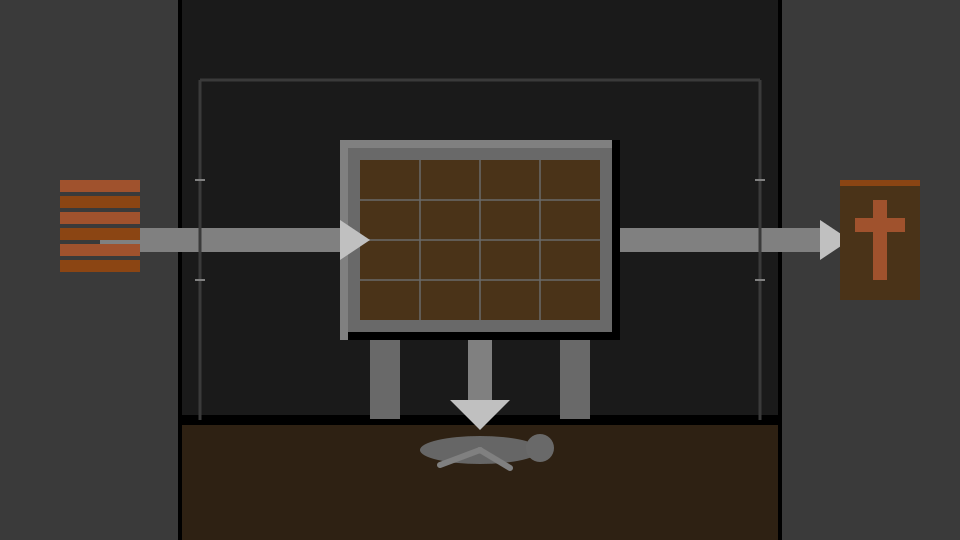
Communication is often seen as a straightforward exchange between an emitter and a receptor—a sender and a receiver. But what if the real issue lies not with the participants but within the system of beliefs that frames the entire exchange? The Power of Belief Over Message At its core, communication depends on a shared understanding of words, concepts, and intentions. However, what often determines the success or failure of a message isn’t its clarity or truth, but the beliefs of the audience. People tend to interpret information in ways that align with their preexisting worldview, often disregarding contradictory evidence. This cognitive bias ensures that even the most carefully crafted messages can be ignored, misinterpreted, or rejected outright. ...

January 6, 2025 · 4 min · 688 words · Gonzalo Contento

Transformers as the Lingua Franca of AI: Revolutionizing Communication in the Machine Learning Era

In the rapidly evolving field of artificial intelligence, the ability for systems to communicate efficiently and process massive volumes of data has become paramount. Much like language allowed early humans to build complex societies and advance technology, certain architectures in machine learning are now serving as foundational tools to drive AI progress. One such architecture is the transformer. For approximately 70,000 years, human evolution has been closely tied to advancements in language and cooperation. These abilities allowed us to share knowledge, organize, and innovate, enabling the development of civilizations and technological milestones. Similarly, modern AI systems rely on mechanisms for processing and sharing data. Unlike humans who communicate through spoken and written language, AI systems communicate through algorithms and encoded data. ...

December 12, 2024 · 5 min · 934 words · Gonzalo Contento

Flying Carpets and AI: Lessons from García Márquez’s One Hundred Years of Solitude

Gabriel García Márquez’s One Hundred Years of Solitude offers a vivid moment when José Arcadio Buendía dismisses a fantastical flying carpet, claiming he could achieve superior results with science: “Una tarde se entusiasmaron los muchachos con la estera voladora que pasó veloz al nivel de la ventana del laboratorio llevando al gitano conductor y a varios niños de la aldea que hacían alegres saludos con la mano, y José Arcadio Buendía ni siquiera la miró. «Déjenlos que sueñen», dijo. «Nosotros volaremos mejor que ellos con recursos más científicos que ese miserable sobrecamas.»” ...

December 10, 2024 · 4 min · 643 words · Gonzalo Contento

Kissinger: From Cowboy to Genesis

Henry Kissinger’s name is synonymous with global diplomacy. His legacy spans decades, marked by his role as a strategist, statesman, and, later in life, a thought leader on the challenges shaping humanity’s future. Comparing the brash, image-conscious figure interviewed by Oriana Fallaci in the 1970s to the reflective author of The Age of AI: And Our Human Future reveals a fascinating evolution of thought—one that underscores why Kissinger’s insights remain vital. ...

December 3, 2024 · 4 min · 700 words · Gonzalo Contento

The New Age of Digital Exclusion: Is AI Creating a New Form of Illiteracy?

As artificial intelligence (AI) becomes increasingly integrated into every aspect of our lives, a new kind of digital exclusion is emerging—one that goes beyond the traditional concepts of alphabetism and lack of internet access. This exclusion stems from a lack of understanding and ability to interact with AI technologies, creating a modern form of illiteracy: AI illiteracy. In the same way that traditional illiteracy prevents individuals from accessing education, employment, and opportunities, AI illiteracy threatens to leave many people behind in a rapidly evolving world. The widespread adoption of AI tools—from automated customer service bots and predictive algorithms to advanced machine learning models—requires a baseline level of knowledge to utilize effectively and responsibly. Without this understanding, individuals may find themselves excluded not just from using these tools, but from making informed decisions in a society increasingly shaped by AI. ...

October 25, 2024 · 4 min · 777 words · Gonzalo Contento

Breaking the Chains of Modern Inequalities: Alphabetism, Internet Access, and Digital Literacy

In the twenty-first century, access to information, connectivity, and digital tools are critical to individual success and societal growth. Yet, despite technological advances and widespread communication networks, many people remain excluded due to modern forms of inequalities. Let’s explore three primary barriers: alphabetism, lack of internet access, and digital illiteracy—each representing different levels of exclusion and the limitations they impose on millions around the globe. Level One: Alphabetism — The Foundation of Understanding Alphabetism, or the inability to read and write, is the most fundamental form of exclusion. In many parts of the world, illiteracy limits personal development and access to opportunities. Without the ability to read or write, individuals are deprived of the basic means to communicate, learn, and navigate the world. Alphabetism restricts people’s ability to participate in society, perpetuating cycles of poverty and marginalization. ...

October 24, 2024 · 4 min · 740 words · Gonzalo Contento

Conversations with LLMs

Welcome to Exploring the Mind of the Machine, a blog series where I engage in deep conversations with some of the most advanced language models available today—ChatGPT, Claude, Gemini, and Grok. In these dialogues, I’m not just testing their capabilities; I’m pushing the boundaries of what it means to discuss complex philosophical ideas with artificial intelligence. From the paradoxes of ancient Greek philosophy to the existentialism of the 20th century, and from the moral dilemmas of modern ethics to the nuances of Eastern wisdom, this series will probe the models’ understanding, reasoning, and contextual adaptation across diverse philosophical frameworks. ...

October 10, 2024 · 1 min · 161 words · Gonzalo Contento