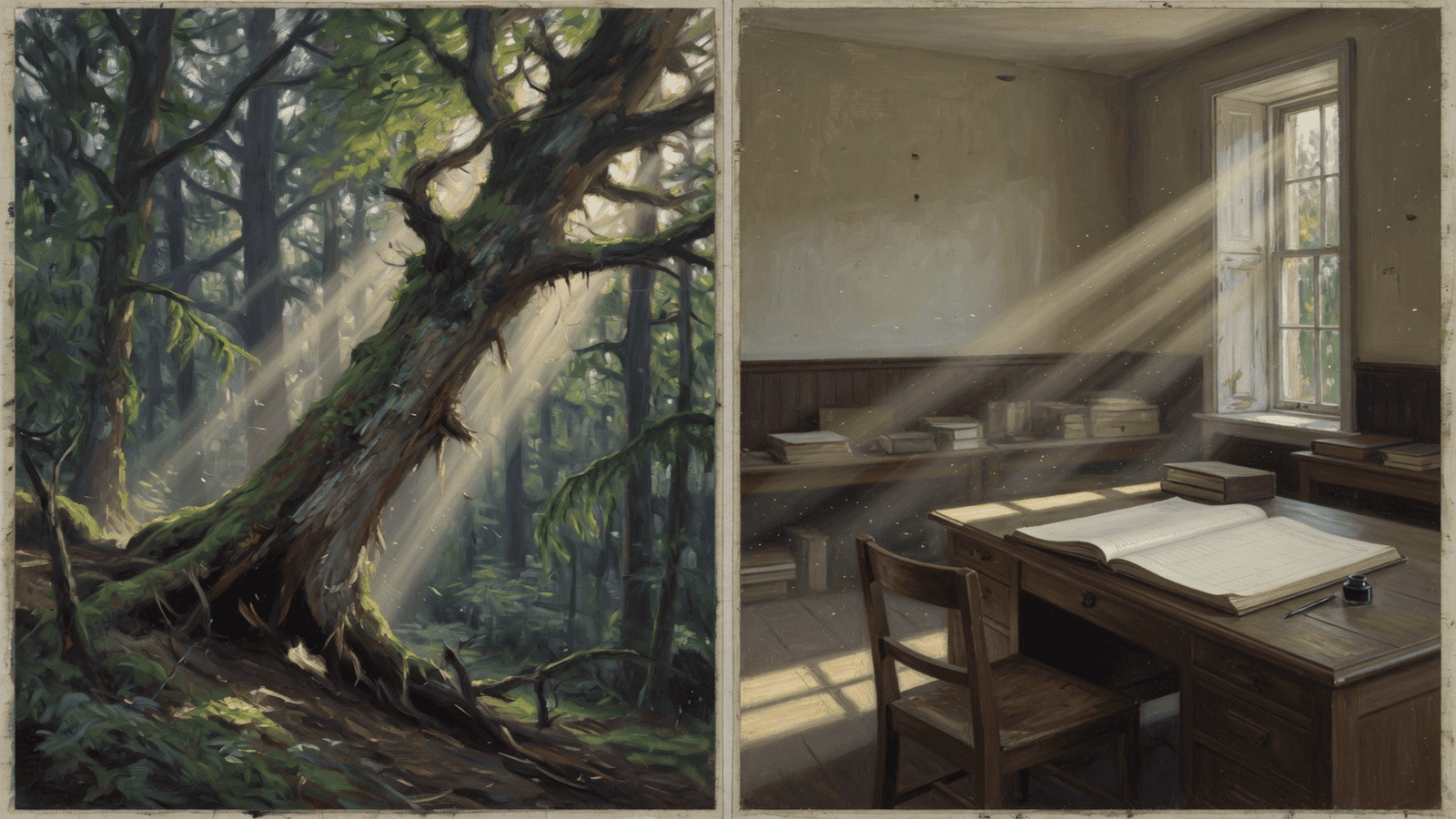
The Recorder heard the oak fall while her pen was still moving. The sound came from the north grove: one report of splitting wood, then a long, low complaint that made the ink quiver in its well. She was writing that the miller’s wagon had crossed the ford before dusk. By the time she looked up, dust had gathered among the trunks and the birds were returning to them.
She put a line beneath the miller’s name and closed the ledger.
At sunset the woodcutter’s son found her carrying the ledger home. He was twelve and had been crying hard enough to leave two clean tracks through the dust on his face.
“You saw it?” he asked.
“I heard it.”
“But you saw it fall?”
The Recorder looked past him. From the road, she could see the new break in the canopy.
“No,” she said.
The boy gripped the handle of the handcart he had brought with him. It was absurdly small against the grove. “Then they will take it.”
Every winter, each household received a portion of fallen wood from the north grove. The portions were drawn from the Recorder’s ledger. A tree that had not been entered as fallen was still, in the township’s accounts, standing in the common forest. No one could cut it. No one could carry away even a branch. The boy’s father had been injured in the spring, and their stove had been cold for three nights already.
“Make a report,” she said.
He stared at her as though she had offered him a stone.
The report book lay on the table outside the registry. It had no lock. Its pages held dog bites, strange lights, missing sheep, and the names of people who claimed to have heard their dead relatives knocking under the floorboards. The boy wrote slowly, pressing so hard that the nib tore the paper: The grandfather oak fell before sunset. I saw the dust. I need wood.
In the morning, the Recorder went to the grove with the township clerk. The clerk wore his winter collar despite the heat and carried a brass tape measure. The oak lay across the moss where it had grown for two hundred years, its roots raised above the earth like a hand refusing burial. Sap shone along the torn heartwood. A broken limb had pierced the boy’s handcart, which stood abandoned nearby.
The Recorder stood before the tree for a long time.
It was, by anything her eyes could tell her, the most fallen tree she had ever seen.
And it had not happened.
The clerk opened his ledger to the grove’s map. “No entry,” he said. He tapped the upright oak drawn in brown ink. “The common wood is intact.”
The boy was waiting beyond the tape, beside his father. The man sat on a stump with his bad leg stretched before him, saying nothing. When the clerk began measuring the trunk as though it were still vertical, the boy stepped forward.
“It is on the ground.”
“It is on the ground,” said the clerk. “That is not the question.”
The Recorder could have written the missing sentence. Witnessed, this date, the falling of the grandfather oak. No one would ask whether she had seen the first movement or only the dust. The township trusted the shape of her hand more than any person’s memory. Her signature would fill the winter allotment, and the boy could take wood home before dark.
But her hand had not seen the oak fall.
She took the clerk’s pencil and drew a line through the brown tree on the map.
He caught her wrist. “You cannot alter an occurrence.”
“I am not altering one.”
She opened her own ledger. Beneath the miller’s wagon, she wrote: At the ninth hour, I observed the grandfather oak lying in the north grove. Then she signed her name.
The clerk read it twice. “There is no column for lying.”
“There is now.”
For a moment no one moved. Then the boy’s father laughed once, sharply, as if the sound had hurt him. The clerk shut both ledgers and walked away with the brass tape dragging through the ferns.
The Recorder sat beside the fallen oak until evening. She watched the boy set an axe into a branch no thicker than his wrist. The first blow counted. The second counted. When the branch gave way, he looked to her before lifting it into the cart.
She did not write down the fall.
She wrote that the boy had carried wood home from a tree that had never stopped standing.