The Jester, Power, and Zarathustra — Why Every Throne Grows a Fool, and Why Killing Him Never Works

The Jester, Power, and Zarathustra — Why Every Throne Grows a Fool, and Why Killing Him Never Works

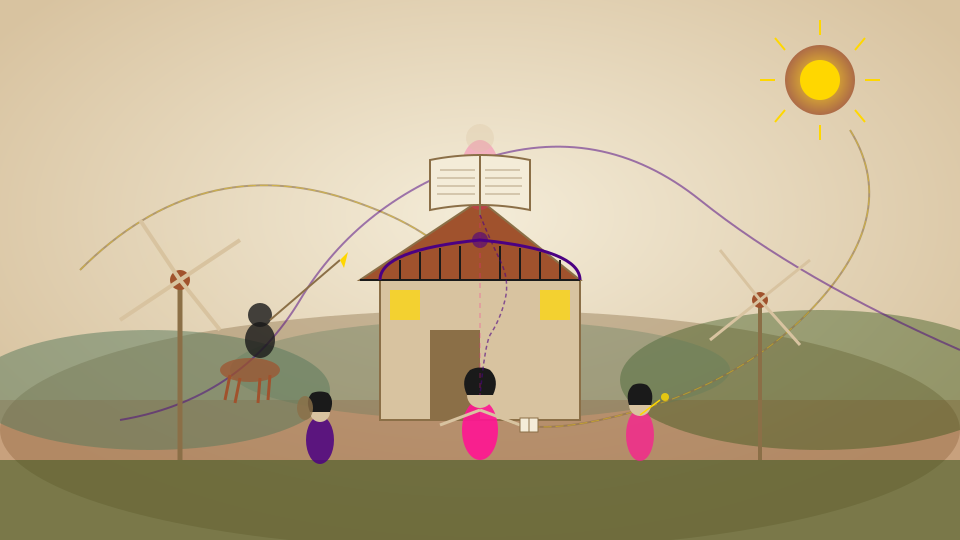
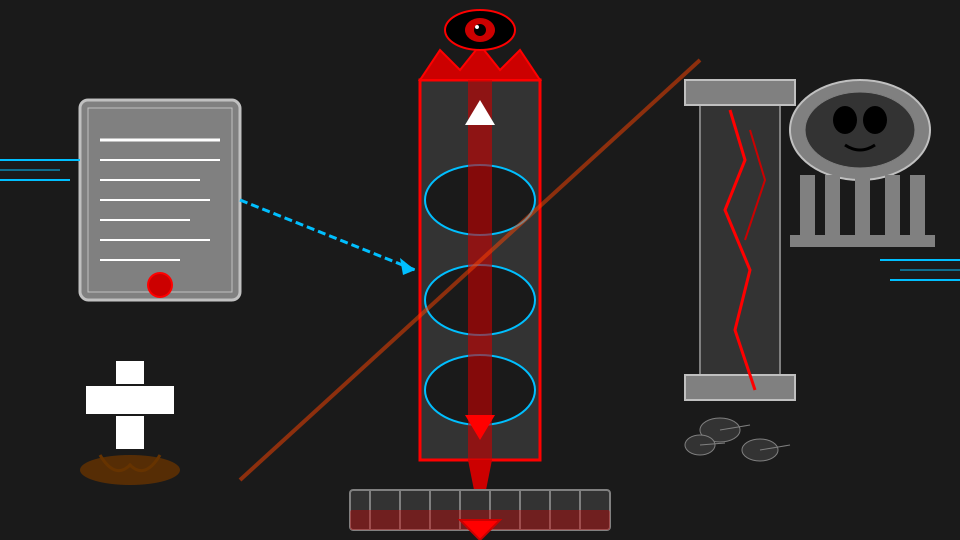
Wherever power gathers into a single pair of hands, a figure in motley appears beside it and begins to laugh. He is permitted what no one else is permitted: to mock the crowned head from arm’s length, to say over dinner what would cost a minister his own. We file the court jester under quaint medieval décor, somewhere between the falconry and the tapestry. He is nothing of the kind. He is a structural organ that grows wherever power concentrates — the way a callus grows where a tool keeps rubbing the hand — and he grows back long after we are sure we have abolished him. …

June 21, 2026 · 7 min · 1360 words · Gonzalo Contento |  AI-likeness: 80%
The Right Song at the Right Moment — On the Gap Between Appreciation and Feeling

The Right Song at the Right Moment — On the Gap Between Appreciation and Feeling

There are nights when Plácido Domingo has made me cry — real tears, the kind that arrive uninvited at the exact phrase where the voice opens and the whole room tilts. And there are other nights, more than I can count, when Domingo could do nothing for me, and what carried me across the road was a Vallenato by Diomedes Díaz, or Pedro Infante singing a bolero as if the song were a small lit room, or The Beatles’ “The Long and Winding Road.” I used to apologize for this. I have apologized to people who expected me, at a serious hour, to reach for something serious — Mozart, Wagner, Philip Glass — and caught me reaching instead for Shakira, or Julio Iglesias, or Juan Gabriel. I am done apologizing. Not because my taste improved, but because I finally understood what the apology was confessing. …

June 20, 2026 · 8 min · 1556 words · Gonzalo Contento |  AI-likeness: 65%
Nefasto — Symbolic Discourse in the Age of Statistical Language

Nefasto — Symbolic Discourse in the Age of Statistical Language

In 1989, two people were writing programs that generated language out of structure rather than meaning. One of them was Tim Berners-Lee, who that year circulated a memo titled Information Management: A Proposal — the document that became the World Wide Web. The other was a professor in a hallway in Medellín, who wrote a hundred lines of Turbo Prolog to make fun of his colleagues. I knew about the second one. The first I only read about later, the way everyone did. But the two were closer in spirit than the distance between Geneva and the Universidad de Antioquia would suggest. Both were betting that if you got the relationships right — between documents, between words — the content could take care of itself. One bet built the modern internet. The other got pinned to a cork board and read by people who never realized they were the joke. …

June 19, 2026 · 9 min · 1819 words · Gonzalo Contento |  AI-likeness: 38%
Neuro-Symbolic AI — Why Symbolic Intelligence Is Still Mandatory

Neuro-Symbolic AI — Why Symbolic Intelligence Is Still Mandatory

The past five years have felt like a reckoning. Large Language Models have proven more capable than anyone predicted — they translate languages, write code, reason about physics, and pass bar exams. And yet, every major lab investing in AI safety and robustness has come to the same uncomfortable conclusion: LLMs alone are insufficient. Intelligence requires both statistical reasoning and deterministic logic. A note on terminology: the term “artificial intelligence” is itself a misnomer. We still don’t know what intelligence is. Neuroscientists, philosophers, and cognitive scientists disagree on its very nature. What we’re actually building are systems that solve problems. And Feynman was right about flight: we don’t build planes by imitating birds. We build them by understanding aerodynamics. Similarly, we build intelligent systems not by copying human cognition, but by understanding what intelligence fundamentally requires. …

June 18, 2026 · 7 min · 1480 words · Gonzalo Contento |  AI-likeness: 0%
Neural Networks and LLMs: Analogies for Mortals

Neural Networks and LLMs: Analogies for Mortals

Neural networks are abstract. The math is dense. The scale is incomprehensible — billions of parameters, trillions of multiplications per second. But the principles are not abstract. They are built on deep patterns that show up everywhere: in orchestras, in conversations, in flocks of birds, in forests, in the way a jazz musician improvises. The goal is not to make you a machine learning engineer. The goal is to make the thing thinkable — to see that when you talk to an LLM, you are not communicating with an alien intelligence. You are interacting with something that works on principles you already understand. …

June 16, 2026 · 9 min · 1728 words · Gonzalo Contento |  AI-likeness: 58%
Beyond the Black Box — LLM Limitations and the Alternatives That Remain

Beyond the Black Box — LLM Limitations and the Alternatives That Remain

Large language models are pattern-completion engines of extraordinary fluency. They produce text indistinguishable from human writing. But the closer you look, the architectural limits surface: hallucination without truth-access, no grounding in reality, chain-of-thought that is reasoning-shaped but not reasoning, opacity that forbids audit, resource costs that exclude most of the world, and fragility to minor prompt shifts. These are not bugs waiting for scale to fix them. They are consequences of the next-token prediction paradigm. The question shifts from “how do we make LLMs bigger?” to “what else can we do?” …

June 15, 2026 · 9 min · 1839 words · Gonzalo Contento |  AI-likeness: 48%
Weights, Bias, and the Pen on Your Finger — Why Neural Networks Use the Names They Do

Weights, Bias, and the Pen on Your Finger — Why Neural Networks Use the Names They Do

Every introduction to neural networks explains what weights and biases do. A weight multiplies an input to make it stronger or weaker. A bias shifts the activation threshold left or right. Together they determine whether a neuron fires. But almost nobody explains why they are called that. The names are treated as arbitrary labels, as if the early researchers could have called them “twiddles” and “knobs” and it would have been the same. It would not have been the same. The names carry the history — and the physics — that the math obscures. …

June 14, 2026 · 12 min · 2362 words · Gonzalo Contento |  AI-likeness: 83%
The Balancing Act — How a Stadium of Tightrope Walkers Becomes a Language Model

The Balancing Act — How a Stadium of Tightrope Walkers Becomes a Language Model

Imagine a stadium. Not with a crowd, but with the field itself filled by tightrope walkers, arranged in rows, each on a wire, each holding a long pole. You stand at one end and shout a word. The walkers in the first row feel it—each differently, depending on where they stand—and they wobble, find their balance, and their lamps come on at different brightnesses. That pattern of light falls on the second row. They balance. Their lamps light the third. And so on, through hundreds of rows, until the last row’s lights spell out a single thing: the next word. Then you add that word to what you shouted and do it all again. And again, until you have a sentence, a paragraph, an answer. …

June 13, 2026 · 9 min · 1881 words · Gonzalo Contento |  AI-likeness: 23%
The Perceptron — Why a Single Line Still Matters

The Perceptron — Why a Single Line Still Matters

In 1958, Frank Rosenblatt built a machine that could learn. Not be programmed—learn. The Mark I Perceptron was a room of wires and motorized potentiometers wired to a grid of four hundred photocells, and when you showed it images, it adjusted itself until it could tell them apart. The New York Times reported that the Navy expected it to “walk, talk, see, write, reproduce itself and be conscious of its existence.” It could do none of these things. What it could do was draw a line. …

June 12, 2026 · 8 min · 1697 words · Gonzalo Contento |  AI-likeness: 29%
The Engineering of Desire — Bernays, the Spectacle, and the War of Narratives

The Engineering of Desire — Bernays, the Spectacle, and the War of Narratives

In the early twentieth century, advertising made a simple claim: This product performs this function. A soap cleaned; a car transported; a cigarette was tobacco rolled in paper. The transaction was rational, almost mechanical. You paid for utility. Then came Edward Bernays, and everything changed. Bernays was a Viennese emigrant, the nephew of Sigmund Freud, and he arrived in America bearing a dangerous insight from his uncle’s work: humans are not rational actors deciding between utilities. We are vessels of irrational impulse—unconscious desire, hidden fear, unexamined shame. We are, in a sense, predictable in our very irrationality. …

June 11, 2026 · 8 min · 1625 words · Gonzalo Contento |  AI-likeness: 85%