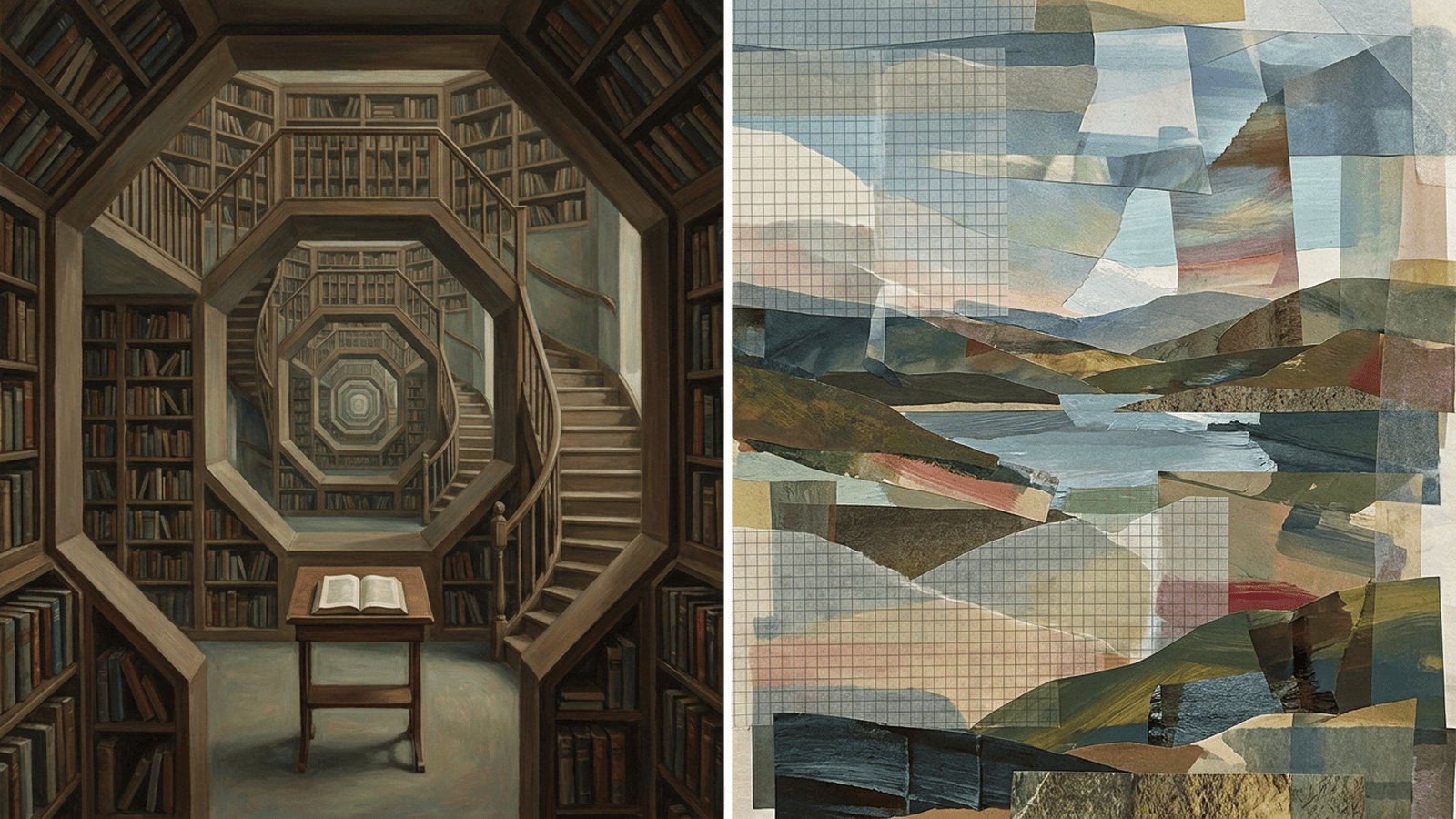
In the prologue to The Garden of Forking Paths (1941), the first half of what became Ficciones, Jorge Luis Borges wrote that composing vast books is “a laborious and impoverishing madness”: setting out in five hundred pages an idea that can be told perfectly well in a few minutes. “The better course of procedure,” he went on, “is to pretend that these books already exist, and then to offer a résumé, a commentary.” Several of the stories that follow do exactly that. They review novels nobody wrote, annotate encyclopedias that were never printed, and give a bibliography for an author who never lived.
Ask a language model for sources on an obscure subject and it will sometimes do the same thing: a plausible author, a plausible title, a year, a summary, occasionally a page number, for a book that does not exist. Borges did it on purpose, signed it, and called the book Ficciones. The model does it without a signature and without a purpose. Between the two lies most of what I want to think through here.
I have been returning to Borges for months, and I am not sure why he appeals to me more now than when I first read him. It may be age. It may be that I am looking for a different kind of literary experience. Or it may be that the world has started producing the kind of object his stories were always about.
I. Two Kinds of Strange
Latin American fiction has a famous strangeness, and Borges’s is not that one. When Alejo Carpentier named lo real maravilloso in the prologue to The Kingdom of This World (1949), he located the marvelous in Haitian history itself, in Henri Christophe’s citadel and Mackandal’s transformations, not in the writer’s invention. Gabriel García Márquez said something close in his Nobel lecture of 1982: the problem was never a shortage of imagination but “the lack of conventional means to render our lives believable.” In Pedro Páramo (1955), Juan Rulfo’s dead speak to one another in Comala because the Revolution and the Cristero War had emptied the towns of Jalisco of the living. The strangeness in these books is testimony. History is the source, and the impossible is how it gets told.
Borges starts somewhere else. He starts with an idea: a man who cannot forget, a library containing every possible book, a lottery that has absorbed the whole of chance. Then he follows its consequences with the patience of a proof. His prologue to his friend Adolfo Bioy Casares’s The Invention of Morel (1940) defends exactly this kind of book, the novel of reasoned imagination, against the psychological novel; of Bioy’s plot he says that it would be neither imprecise nor hyperbolic to call it perfect.
This is not a contest, and the writers do not sort neatly into two schools. García Márquez read Borges closely, and Rulfo’s Comala is as carefully built as any Borgesian labyrinth. The difference is in where the story begins. One begins with something that happened and looks for a form strange enough to hold it. The other begins with something that could be thought and shows, step by step, what follows from it. Borges also leaves the machinery in view: the footnotes, the false erudition, the narrator who mentions dinner with Bioy before the encyclopedia opens onto another planet. The scaffolding stays visible, and the building stands anyway.
II. What May Happen
Aristotle drew a line in the Poetics that still helps. The historian, he wrote in chapter 9, says what happened; the poet says what may happen, what is possible according to probability or necessity. For that reason poetry is more philosophical than history: it speaks of universals, history of particulars. Later in the same treatise he adds a rule that sounds like a description of Borges avant la lettre: a probable impossibility is to be preferred to an improbable possibility.
Borges was no Aristotelian, and he would have smiled at the label. But the criterion explains why his impossibilities convince. Nobody has met a man who remembers every leaf of every tree he has seen; once the premise is granted, though, every consequence in “Funes the Memorious” follows with necessity, down to Funes’s inability to think, since thinking requires forgetting differences. The probability is internal. It does not come from matching the world; it comes from the rigor with which the world of the story obeys its own rule. In “Tlön, Uqbar, Orbis Tertius,” Borges turns the criterion into a joke about philosophy: the metaphysicians of Tlön “seek neither for truth nor for verisimilitude, but rather for astonishment,” and they judge metaphysics to be a branch of fantastic literature.
III. The World as Representation
The other philosopher behind Borges is Arthur Schopenhauer, whom Borges named more than once as the one he would keep if he had to choose. The World as Will and Representation (1819) opens with the sentence “The world is my representation.” Everything we know arrives already shaped by the knower: in space, in time, under causality. Borges took the idea and made it into a method. At the end of “Avatars of the Tortoise” (1932), after following Zeno’s paradoxes through twenty-three centuries of philosophy, he proposes that “we (the undivided divinity operating within us) have dreamed the world,” and dreamed it resistant, mysterious, visible, firm in time, “but we have allowed slight and eternal interstices of unreason in its architecture so as to know that it is false.”
The stories put that sentence on stage. In “The Circular Ruins,” a man sets out to dream another man into existence, organ by organ, over many nights, and succeeds. At the end, when the fire comes for him and does not burn him, he understands “with relief, with humiliation, with terror” that he too is an appearance, and that someone else is dreaming him. In the essay “Partial Magic in the Quixote” (1952), Borges asks why it unsettles us that Don Quixote reads the Quixote, or that Scheherazade one night begins to tell the story of the Thousand and One Nights. His answer: such inversions suggest that if the characters of a fiction can be its readers, we, its readers, can be fictitious.
None of this is a thesis about the world. It is a discipline of reading. Borges does not tell us that reality is a dream; he builds objects that let us feel the mechanism of representation working, and then shows us the seams.
IV. A Third Kind of Fiction
An image generator produces a harbor at dusk that no one photographed, in a city that does not exist, lit the way a certain decade of painters lit harbors. A language model produces a paragraph in the voice of a jurist who never wrote it. These outputs are fictions in a precise sense: constructed representations. They are not reality, and they are not nothing. They are not lies either, since a lie needs someone who knows the truth and hides it. They are closer to Schopenhauer’s representation doubled. The model was trained on what people wrote and photographed, so its harbor is a representation of our representations of harbors, the map that is not the territory assembled from all our previous maps.
For a while the interstices of unreason were easy to find: a sixth finger, a clock with fourteen numerals, a citation to a journal that never existed. Those flaws did what Borges said the dreamed world’s flaws were for. They let us know the thing was false. As they close, the fiction stops announcing itself, and the reader has to supply the frame the object no longer carries.
That is the real difference between Borges and the machine. The content is not the difference: Borges invented countries, books, and authors as freely as any model. The difference is the contract. Every Borges story arrives inside a volume called Ficciones, and its machinery is visible on the page. The fabricated citation arrives in the same font as the real one. Borges also imagined that case. At the end of “Tlön,” the invented world begins to replace the actual one, not because it is true but because it is orderly: “any symmetry with a semblance of order” was enough to entrance people, and reality, Borges adds, “longed to yield.”
V. Living Among Representations
Two easy responses are available, and Borges refuses both. One declares the new fictions harmless, since everything was always representation anyway. The other treats them as a contamination of a reality that used to be clean. Borges’s readers learn a third posture: hold the fiction and the knowledge that it is fiction at the same time, and enjoy the first without losing the second. A reader of “The Circular Ruins” does not believe a man can be dreamed into being, and does not dismiss the story as false. The story is an instrument for thinking about authorship, dependence, and the fragility of whoever believes himself the origin.
Aristotle’s distinction also applies to the machines. A generated image says nothing about what happened. It says, with considerable fidelity, what the archive it learned from considers possible and probable: what a harbor usually looks like, which faces get lit and which stay in shadow, how a jurist is expected to sound. Read that way, these fictions are poor history and unusually good evidence about us. Like any fiction, they show what a culture can imagine, and what it cannot.
Perhaps that is why Borges reads differently now. When I first read Ficciones, the stories seemed to be about libraries, labyrinths, and mirrors, elegant puzzles at a safe distance from ordinary life. Now they read like a manual written in advance for a world full of plausible texts and images that have no author standing behind them.
In the epilogue to El hacedor (1960), Borges describes a man who sets out to draw the world. Over the years he fills a space with images of provinces, kingdoms, mountains, bays, ships, islands, fish, rooms, instruments, stars, horses, and people. Shortly before he dies, he discovers that the patient labyrinth of lines traces the image of his own face. We have spent a few years feeding machines everything we ever drew. What they draw back, line by line, is beginning to show a face, and we have not yet learned to recognize it as ours.
Further reading
- Jorge Luis Borges — Ficciones (1944): “Tlön, Uqbar, Orbis Tertius,” “The Circular Ruins,” “Funes the Memorious,” and the prologue to The Garden of Forking Paths
- Jorge Luis Borges — “Avatars of the Tortoise,” in Discusión (1932); “Partial Magic in the Quixote,” in Other Inquisitions (1952)
- Jorge Luis Borges — epilogue to El hacedor (1960), published in English as Dreamtigers
- Adolfo Bioy Casares — The Invention of Morel (1940), with Borges’s prologue
- Alejo Carpentier — The Kingdom of This World (1949), see Alejo Carpentier
- Gabriel García Márquez — “The Solitude of Latin America”, Nobel lecture (1982)
- Juan Rulfo — Pedro Páramo (1955)
- Aristotle — Poetics, chapters 9 and 24–25
- Arthur Schopenhauer — The World as Will and Representation (1819)