On February 14, 1990, Voyager 1 was about six billion kilometres from the Sun, beyond the orbit of Neptune and leaving the planets behind, when its camera was turned around for one last series of pictures. Carl Sagan had pushed for the shot for years, against engineers who saw no scientific value in it and some risk to a camera pointed so close to the Sun. In the frame that came back, Earth occupies less than a pixel: a point of pale light caught in a scattered sunbeam. Nothing could be measured in the Pale Blue Dot that had not been measured better from closer up. The picture existed to be seen, and then to be shown.
That second purpose is the subject of this essay. A machine built by one arrangement of matter looked back at the planet that made it, and the image was taken so that everyone on that planet could look too. Seeing was not enough. The seeing had to be passed on.
I. A Question Moved
In the conversations with Bill Moyers published as The Power of Myth (1988), Joseph Campbell said: “People say that what we’re all seeking is a meaning for life. I don’t think that’s what we’re really seeking. I think that what we’re seeking is an experience of being alive, so that our life experiences on the purely physical plane will have resonances within our own innermost being and reality, so that we actually feel the rapture of being alive.”
Meaning in the first sense is an answer: something outside life that would justify it, the way a theorem justifies the steps that lead to it. Douglas Adams parodied that version when his supercomputer, Deep Thought, returned after seven and a half million years with the Answer to the Ultimate Question of Life, the Universe, and Everything: forty-two. The joke works because the answer is exact and useless; nobody had understood the question. Campbell declines the question. Life is not a riddle to be solved before we are allowed to live it. Whatever meaning it has is made of how fully it is lived, of the resonance between what happens to a body and what that body takes in.
He meant it about myth. The old stories, for Campbell, were instruments for producing that resonance, not explanations of the cosmos, which is why their wisdom so often goes unlived once they harden into doctrine. But the sentence leaves something out. It locates the experience in “our own innermost being.” The rapture it describes happens to one person at a time.
II. The Second Life of an Experience
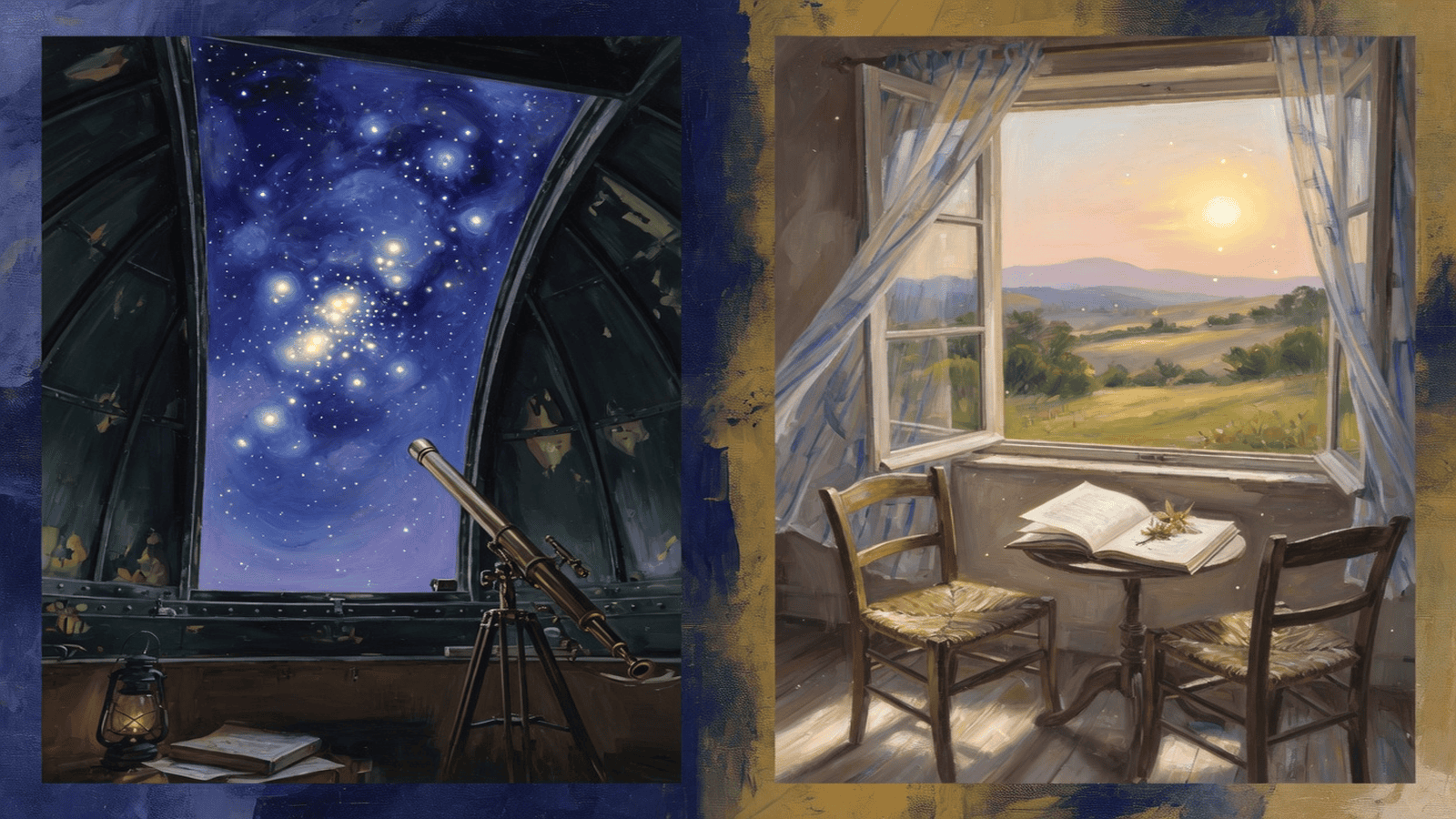
A colleague once answered the quotation in a way I have not been able to put down: the experience matters, and so does sharing it with someone. A view can be beautiful when seen alone. Told to another person, it becomes something else, a memory held between two lives that neither fully owns.
Hannah Arendt built a political philosophy on something close to this. In The Human Condition (1958) she wrote that “the presence of others who see what we see and hear what we hear assures us of the reality of the world and ourselves.” For Arendt the purely private was, in the old sense of the word, deprived: what no one else witnessed led an uncertain, shadowy existence, like a feeling never spoken. An experience becomes fully real when it appears before others.
Psychology offers a humbler version of the claim. Daniel Wegner’s work on transactive memory in the 1980s found that couples divide remembering between them, one keeping the dates and the other the names, so that a long marriage is partly a single memory spread across two heads. The theory has a hard corollary: when one partner dies, the survivor loses access to part of their own past. The habit starts early. Joint attention, the precondition of pointing, shows up in infants who look at a dog, then at a parent, then back at the dog, checking that someone else has seen it too.
Arendt took the epigraph for her chapter on action from Isak Dinesen: “All sorrows can be borne if you put them into a story or tell a story about them.” A grief that is witnessed is not a smaller grief. It is carried differently, because someone else now knows where it sits.
III. What Does Not Cross
Dinesen’s sentence is generous and not quite true, and the gap matters. Some experiences do not survive the trip into language. Elaine Scarry opens The Body in Pain (1985) with the claim that physical pain “does not simply resist language but actively destroys it,” driving the sufferer back to the cries that come before words. The person in pain cannot doubt it; the person beside them can only believe it. Thomas Nagel’s “What Is It Like to Be a Bat?” (1974) stated the general problem: the subjective character of an experience is exactly what any outside description leaves behind.
Sharing, then, is not transfer. Two people at the same window do not have the same view. They have two views and the knowledge that the other is looking, and sometimes that knowledge is all there is. A story can be told and received without being understood; a grief can be witnessed by someone who has no idea what it weighs. Sharing can fail, be refused, or come too late, and some people go through long stretches of life with no one to tell. None of this cancels the colleague’s point. It marks its limit. What sharing gives an experience is not completion but company: a second place to exist, in someone else’s attention and memory, partial and sometimes wrong.
IV. Matter That Looks Back
In the first episode of Cosmos (1980), Sagan said: “We are a way for the cosmos to know itself.” On a poster the line turns sentimental, so it helps to state what it claims and what it does not. It does not say that the universe intended us, or that it watches through us the way a person watches through a window. It says something closer to a description: the atoms in an eye were made in stars, and they are now arranged so that they register the light of other stars.
The physicist John Wheeler drew the idea as a diagram: a thick letter U, one arm the early universe, the other ending in an eye that looks back across the curve at where it began. He used it to illustrate a “participatory” reading of quantum mechanics that few physicists accept, and the drawing is best taken as a metaphor, not a result. The metaphor still points at something real. As I wrote about the arrow of time, the universe began in a state of extraordinarily low entropy, and everything since, galaxies, chemistry, cells, eyes, is that improbable beginning running down. Looking is one of the things the running down has produced.
No plan is required for this to matter. The seeing is already part of what the universe does, and so is the telling. Voyager’s image crossed six billion kilometres to people who passed it to millions more. Each life sees from one place, for a limited time, through one pair of eyes. By telling one another, we make a wider and unfinished act of perception that no single observer could hold.
V. Alive With Others
Here Campbell’s question and the colleague’s correction meet. If meaning is a cosmic answer, sharing is beside the point: the answer would hold whether anyone heard it or not. If meaning is enacted, made of attention, relationship, and the return of experience to other people, then sharing is one of the places where it is made. The question moves a second time, from whether life has a meaning outside itself to what it means to be alive among people who see part of what we see and tell us what they saw.
Campbell’s own sentence reached most of its audience this way. The conversations with Moyers were filmed in 1985 and 1986, much of them at George Lucas’s Skywalker Ranch. Campbell died on October 30, 1987, before any of it aired. When public television broadcast the series the following year, millions of people heard him describe the rapture of being alive in a voice that no longer belonged to anyone living. Whatever he felt at that table now had only its second life, and it has been living there ever since.
And sometimes the experience asks us to tie ourselves to the mast, as Odysseus did, so that we can enjoy and suffer the song of the sirens without dying of it. But that belongs to another part of this journey.
Further reading
- Joseph Campbell with Bill Moyers — The Power of Myth (1988)
- Hannah Arendt — The Human Condition (1958)
- Isak Dinesen — see Karen Blixen
- Daniel Wegner — transactive memory
- Elaine Scarry — The Body in Pain (1985), see Elaine Scarry
- Thomas Nagel — “What Is It Like to Be a Bat?” (1974)
- Carl Sagan — Cosmos: A Personal Voyage (1980); Pale Blue Dot (1990)
- John Archibald Wheeler — see John Archibald Wheeler
- Homer — Odyssey, Book XII; see Siren
- Douglas Adams — The Hitchhiker’s Guide to the Galaxy (1979)