On Monday, January 27, 2025, Nvidia lost close to six hundred billion dollars of market value in a single session, the largest one-day loss any company had ever recorded. The cause was not a failed product or a scandal. It was good news about efficiency: a Chinese laboratory, DeepSeek, had published a model that matched the frontier while reporting a fraction of the usual training compute. If intelligence could be had for less hardware, the reasoning went, the world would need less hardware. Within hours Satya Nadella, whose company was spending tens of billions a year on GPUs, had posted a two-word diagnosis with a nineteenth-century name attached: “Jevons paradox strikes again!”
He was right, and the market came to agree with him. Twenty months later, memory is scarce, storage is scarce, and the chips that turn electricity into matrix products are reserved years ahead by the few companies able to pay for them. The efficiency that was supposed to relieve the demand fed it. That loop deserves a closer look than a stock chart can give it, because it says something about the kind of machine we are building and the kind of reasoning that builds it.
I. A Machine That Only Multiplies
A graphics processor was designed to shade pixels: millions of small, identical calculations done at once rather than one after another. The same property made it ideal for neural networks, whose central operation is the multiplication of large matrices. As I wrote about the perceptron, GPUs did not make deep learning possible; the algorithms had existed for decades. They made it cheap enough to try, and then cheap enough to scale.
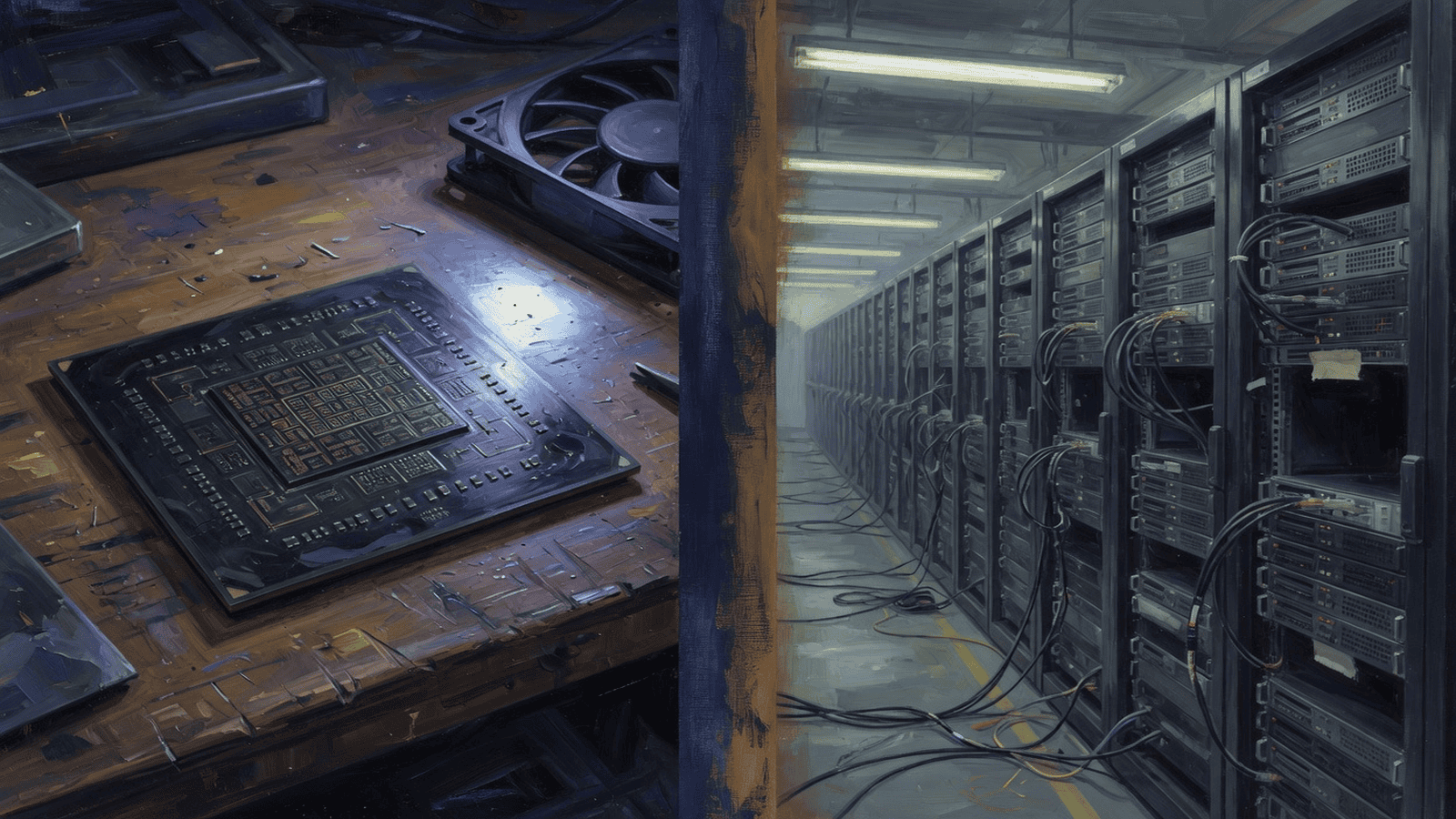
What the GPU does, it does with extreme specialization. A modern accelerator performs on the order of a quadrillion low-precision multiplications per second, and nearly every engineering decision in it, from the memory stacked beside the die to the precision of its arithmetic, serves that one operation. It does not reason, remember, or want. It multiplies, adds, and moves numbers between memory and arithmetic units, and most of its cost goes into the moving.
None of this disqualifies what runs on top. A system built from multiplication can still produce useful behavior, as a system built from neurons firing or not firing produces ours. But the word AI invites us to picture a mind inside the machine, and the hardware tells a plainer story. What we have built is an enormous capacity for one kind of calculation, and we have agreed to call its output intelligence when it performs well on the tests we chose. Capability is a measured relation between a system and a task. Intelligence, whatever it turns out to be, is a claim about what lies behind the measurement. The GPU sells the first and gets credited with the second.
II. The Felicific Engine
Jeremy Bentham proposed in 1789 that moral questions could be settled by arithmetic. Pleasures and pains had measurable dimensions (intensity, duration, certainty, propinquity, extent), and the right act was the one that produced the greatest sum. He called the method the felicific calculus. Its power came from reducing everything to a single quantity that could be compared and maximized. Its critics, beginning with John Stuart Mill, Bentham’s own heir, objected that some goods differ in kind and not merely in amount: “better to be Socrates dissatisfied than a fool satisfied.” A single scalar cannot hold that sentence.
The training of a neural network is a felicific calculus in the most literal sense the phrase has ever had. Every model is shaped by a loss function, one number that measures how wrong it is, and the whole apparatus of GPUs, memory, and power exists to push that number down. Whatever the loss does not measure, the training does not see. This is not a flaw peculiar to machine learning; it is the price of optimization. You can only maximize what you have first reduced to a quantity.
Max Horkheimer gave the attitude a name in Eclipse of Reason (1947): instrumental reason, the reason that asks how to reach an end efficiently and treats the question of which ends are worth reaching as beyond its competence. Max Weber had already described the same drift as the spread of means-end rationality through institutions that slowly forget what the means were for. The GPU may be the most utilitarian object of our moment, in that precise sense: an instrument of extraordinary competence whose only built-in value is throughput. Progress measured as scale, power measured as operations per second, intelligence measured as the score on a benchmark. Each of these is a fair measurement. Together they form a ledger with a column missing.
III. Scarcity Made of Abundance
The missing column shows up first as a price. The memory that sits beside an AI accelerator, high-bandwidth memory or HBM, is built from stacked DRAM dies and consumes roughly three times the wafer area per gigabyte of ordinary memory. When the three manufacturers that make nearly all of the world’s DRAM shifted their lines toward it, the rest of the market starved. By 2026 HBM output was sold out a year in advance, and Bloomberg reported some ordinary memory prices at more than ten times their level of January 2025. Solid-state storage followed. A laptop, a phone, a hospital’s imaging server: all now compete for the same wafers as a training cluster, and lose.
The second sign is the energy. The International Energy Agency’s Energy and AI report estimated that data centres used about 415 terawatt-hours in 2024, around one and a half percent of the world’s electricity, and projected roughly 945 by 2030, about as much as Japan consumes today, with AI-optimized facilities the main driver. The figures come with wide error bars, as the IEA itself stresses. The direction does not.
The third sign is time. A GPU’s silicon can run for many years, but its economic life is shorter, because each new generation makes yesterday’s capacity less competitive for the most demanding work. How short is now an accounting dispute worth hundreds of billions of dollars: the largest cloud providers depreciate servers over five or six years, while critics argue that frontier accelerators earn their keep for two or three. Both sides can be right, since a chip retired from training can go on serving cheaper inference. But the dispute itself is revealing. An industry built on measurement cannot agree on how long its central instrument lasts.
Put the three together and the shape of the loop appears. The infrastructure exists to accelerate computation; the demand for acceleration outruns the supply of memory, storage, energy, and chips; the answer is more capacity, which raises the demand it was meant to meet. More capacity becomes the solution to a problem created in part by the assumption that more capacity is always the solution.
IV. Jevons on the Trading Floor
William Stanley Jevons noticed the pattern in 1865. In The Coal Question he observed that James Watt’s more efficient steam engine had not reduced Britain’s coal consumption; it had multiplied it, because cheaper work found new uses faster than the savings accumulated. “It is wholly a confusion of ideas,” he wrote, “to suppose that the economical use of fuel is equivalent to a diminished consumption. The very contrary is the truth.” The Jevons paradox is not a law; it holds when demand is elastic and fails when it saturates. Lighting and computation are the textbook cases where it has held, and Nadella’s tweet was a bet that AI would join them.
So the seed’s question, when does the cycle end, cannot be answered by efficiency alone. Efficiency per operation has improved enormously and will keep improving: lower-precision arithmetic, sparser models, distillation into smaller networks, chips designed for inference rather than training. But the easy gains are behind us. Dennard scaling, the rule that let transistors shrink without using more power per area, broke down in the mid-2000s, and the growth in computations per joule that Jonathan Koomey documented has slowed since. The physical floor, Landauer’s limit on the energy needed to erase a bit, sits far below current hardware, so there is room left. A human brain runs on about twenty watts, which proves that very different trade-offs between power and capability exist without telling us how to build them.
Even a breakthrough would not end the cycle on its own. If tomorrow’s chip delivered ten times the computation per watt, the Jevons logic says we would spend the savings on ten times the computation. The cycle ends in one of two ways. Either a constraint binds that money cannot dissolve (a grid that cannot be extended, water a region cannot spare, capital that stops expecting a return), or the demand changes because someone decides that some computation is not worth doing.
V. What We Choose to Compute
That second ending is the one instrumental reason cannot reach, because it is not a question about means. Efficiency as a technical achievement asks how much computation we can get per watt. Efficiency as a social choice asks which computations deserve the watt at all, and that question has no loss function. It requires a value that is not throughput: what a task is for, who pays for its by-products, what else the wafer and the megawatt could have done.
I have argued before for the least powerful model that serves the question: a small model on a laptop, adequate to most of what we ask, against a frontier system whose reach we rarely use. That was a personal preference. At the scale of an industry it becomes a test of whether a system organized around measurable output can recognize the costs it leaves outside the metric. Charles Goodhart warned that a measure pressed into service as a target stops measuring well. The GPU economy is a vast demonstration of the corollary: a target pursued at enough scale begins to set the prices of everything around it, including the memory in a schoolchild’s computer and the electricity in a town that happens to sit near a data centre.
Bentham, at his own request, was dissected after death, and his skeleton, dressed in his clothes and topped with a wax head, still sits in a cabinet at University College London. The auto-icon was meant to show that a life could be put to use to the very end. It shows something else as well: a philosophy so confident in its sum that it never asked what the sum was for. The machines we are building will run that sum faster than anything before them. Whether they run it toward anything worth wanting was never a question the machines could answer.
Further reading
- Jeremy Bentham — An Introduction to the Principles of Morals and Legislation (1789); see felicific calculus and auto-icon
- John Stuart Mill — Utilitarianism (1863)
- Max Horkheimer — Eclipse of Reason (1947)
- Max Weber — instrumental and value rationality
- William Stanley Jevons — The Coal Question (1865); Jevons paradox
- International Energy Agency — Energy and AI (2025)
- Bloomberg — “Why AI-Driven Memory Chip Shortage Is Making Technology More Expensive” (2026)
- DeepSeek; Dennard scaling; Koomey’s law; Landauer’s principle
- Goodhart’s law