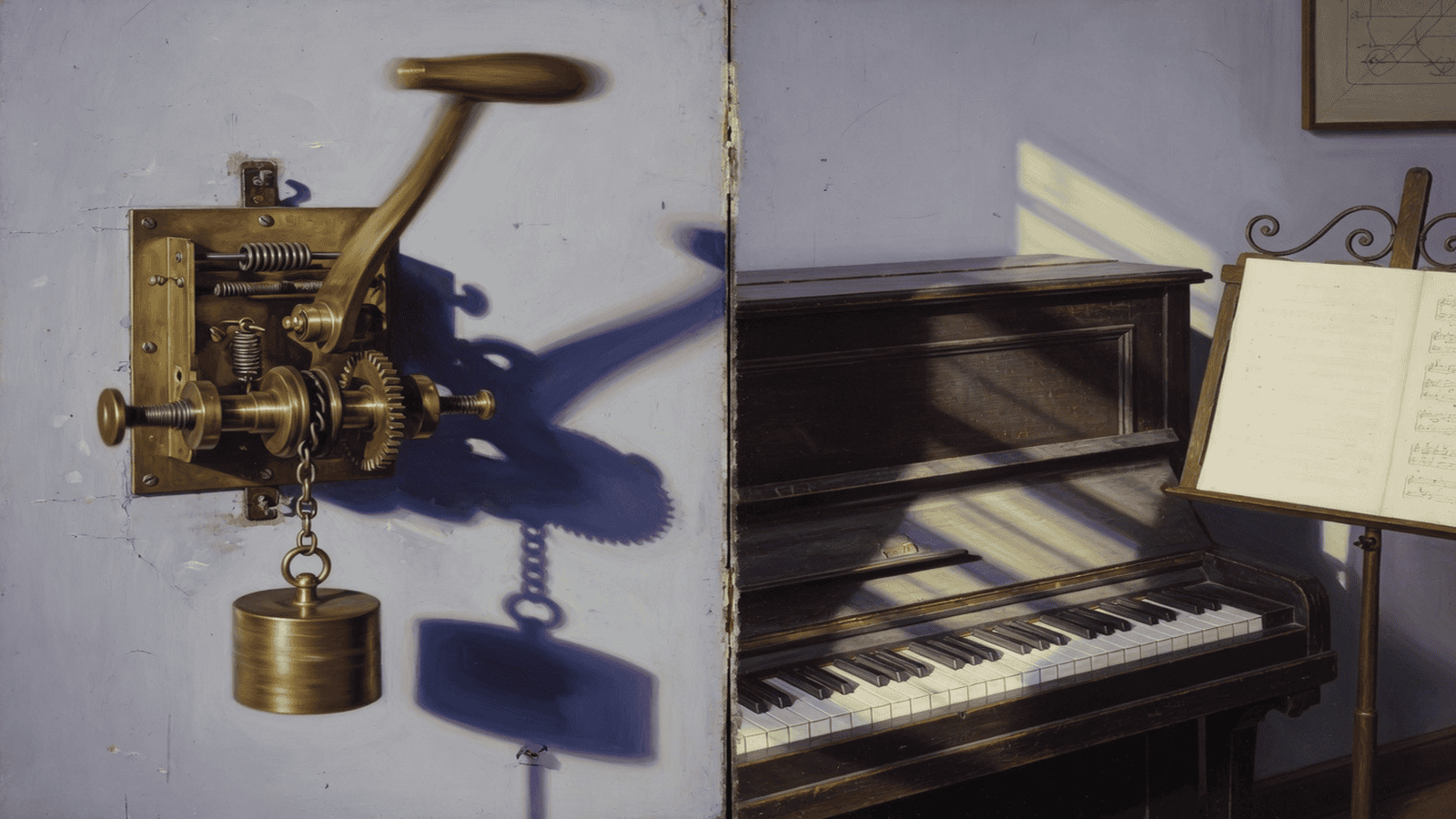
Anyone who has learned a piece from the page knows the stage where every note is right and nothing is happening. The fingers find the keys in order. The rhythm is counted, the rests observed, the dynamics marked in pencil and obeyed. A teacher listening from the next room would hear no mistake. And the player knows, with an embarrassment hard to name, that the piece has not yet arrived. The sequence is correct. Something else is missing.
Physics has a version of that embarrassment, and it is not a sign that physics has failed. We can calculate the torque on a wrench, trace a planet’s orbit centuries ahead, predict how far a beam will bend under a load. The equations work, and their success is real. Yet knowing how a system behaves is not always knowing what, underneath, makes it behave that way. A law can tell us how quantities change together and say nothing about what the world is doing while they change.
I. The Roll That Plays Correctly
At the start of the twentieth century, middle-class parlors in America and Europe filled with player pianos. A perforated paper roll passed over a tracker bar; each hole let air through a channel, and the channel struck a key. The roll was a score made literal, a set of instructions that needed no reader. It played Chopin without a wrong note, and nobody in the room believed the roll understood Chopin.
The roll is the limit case of knowing what follows what. It holds the full sequence and nothing else. Its existence makes a distinction visible that is easy to blur in people: between possessing the pattern and possessing whatever the pattern is a pattern of.
The analogy has a limit, and it should be stated before it does any work. Music is not a hidden mechanism waiting behind the notation, the way a gear train waits behind a clock face. What the score leaves open is not a concealed fact but an encounter: a performance, a listener, an hour. Bach’s Art of Fugue does not even name the instrument it is for; harpsichord, organ, string quartet, and brass ensemble all play it from the same notes. Physics is different. When we ask what gravity is, we suspect there is an answer, and that our equations are silent about it.
II. I Frame No Hypotheses
Isaac Newton knew this silence from the inside. The Principia gave a law of universal gravitation that reached from a falling apple to the tides to the orbit of the Moon, and it said nothing about how one body pulls on another across empty space. Leibniz and the Cartesians accused him of reviving occult qualities. In the General Scholium added to the second edition in 1713, Newton answered with the most famous refusal in science: he had not been able to discover the cause of gravity’s properties from the phenomena, and hypotheses non fingo, I frame no hypotheses. It was enough, he wrote, that gravity exists, acts according to the laws he had set out, and accounts for the motions of the heavens and the sea.
In private he was less serene. A letter to Richard Bentley in 1693 calls the idea that matter could act on matter at a distance, through a vacuum, without anything mediating, so great an absurdity that no one competent in philosophy could fall into it. Gravity must be caused by some agent acting according to certain laws, he wrote, “but whether this agent be material or immaterial, I have left to the consideration of my readers.”
General relativity later gave the readers an answer: mass curves spacetime, and bodies follow the curvature. It is a deeper answer, and it explains things Newton’s law cannot. It also hands over a new score, and the question of what spacetime is, beyond the equations that describe it, did not end in 1915. Richard Feynman made the point in his Cornell lectures, published as The Character of Physical Law: every attempt to supply a machinery behind gravity had failed, and what remained was the mathematical form, which keeps working.
III. Three Questions in “How Does It Work?”
It helps to slow down the question. “How does it work?” can ask for a mechanism, the parts and their interactions, the way a watchmaker answers it. It can ask for a deeper theory, a law from which the first law follows. Or it can ask for an explanation in the plain sense, an account that makes the event intelligible to us. These demands overlap, but they are not the same, and a theory can meet one while failing another.
Philosophers of science have spent most of a century learning how far apart prediction and explanation can drift. Carl Hempel’s deductive-nomological model held that to explain an event is to derive it from laws and conditions, which made explanation and prediction two uses of one argument. Sylvain Bromberger’s flagpole broke the symmetry. From the height of a flagpole, the angle of the sun, and the laws of optics, we can derive the length of its shadow, and that derivation explains the shadow. From the length of the shadow and the same laws, we can derive the height of the flagpole just as rigorously, and nobody thinks the shadow explains why the pole is tall. The two derivations predict equally well. Only one of them explains. The Stanford Encyclopedia entry on scientific explanation traces the decades of work that followed: causal accounts, unification accounts, each trying to say what the second derivation lacks.
Eugene Wigner named the other side of the puzzle in 1960, in an essay on the unreasonable effectiveness of mathematics. The formalism keeps fitting the world better than anyone had a right to expect, and nobody can say why. Success, in other words, is itself one of the things left unexplained.
IV. One Score, Many Performances
Quantum mechanics makes the tension hard to ignore. Its equations underlie lasers, transistors, and MRI machines, and its relativistic extension, quantum electrodynamics, predicts the magnetic moment of the electron in agreement with experiment to better than one part in a billion. No theory has been tested more closely. And physicists who share every line of that mathematics disagree about what it describes.
The Stanford Encyclopedia entry on quantum mechanics lays out the options. The Copenhagen tradition treats the wave function as a tool for predicting measurement outcomes and declines to say more. Hugh Everett’s many-worlds reading takes the wave function as the whole of reality and accepts that every outcome happens. David Bohm’s pilot-wave theory adds particles with definite positions, guided by the wave. Collapse theories change the equations themselves. At a 2011 conference on the foundations of the field, Maximilian Schlosshauer, Johannes Kofler, and Anton Zeilinger polled 33 participants on sixteen basic questions and found no consensus on the essential ones. The people who know the formalism best perform it differently.
The physicist David Mermin coined “shut up and calculate” to sum up one response (the line is often misattributed to Feynman), and later found it too blunt for what he meant. It is the player-piano solution: keep the roll, trust the holes, stop asking what the music is. It works, which is the uncomfortable part.
None of this means the theory is defective, or that physics only memorizes patterns. Its laws compress an enormous range of facts into a few principles. Feynman opened his Lectures on Physics by saying that if one sentence had to survive a catastrophe, it should be that all things are made of atoms, and he showed how much of the world unfolds from that one claim. Physics lets us intervene, build, and correct ourselves. The narrower point is that a theory can be extraordinarily successful and still leave open what its entities ultimately are.
V. Correct Is Not the Whole Encounter
Back at the piano, the beginner’s embarrassment does not resolve by adding more notes. No amount of extra detail on the page closes the distance; a more precise score is still a score. What changes is something the player does: phrasing, weight, a decision about where the line is going, often arrived at without being able to say what it is. In an earlier post I argued that worth does not live in the score but in the encounter, and the physics case presses on the same seam from the other side. The equations are not lacking a note. What they lack, if they lack anything, is not the kind of thing a further equation would supply.
That is the source of the unease, and it is more exact than a complaint about ignorance. We do not know nothing. We know, to nine decimal places, what follows what. The disquiet is that reliable knowledge can stop short of the understanding we thought it promised, and that we cannot always tell, from inside the calculation, which of the two we have.
Newton left the question to the consideration of his readers. More than three centuries later, the readers have produced curved spacetime, quantum fields, and a handful of rival accounts of what a wave function is, and every new answer has arrived with its own consideration attached. Meanwhile the satellites stay in their orbits, computed from the score.
And now, abracadabra: we have language models that produce the right next word with astonishing reliability, and pseudoscientists, and some scientists too, telling us the models are conscious. A player piano that has read every score ever written. As if we had learned anything.
Further reading
- Isaac Newton — Hypotheses non fingo, General Scholium to the Principia (1713); letters to Richard Bentley (1692–93), see action at a distance
- Richard Feynman — The Character of Physical Law (1965)
- Richard Feynman — The Feynman Lectures on Physics, Vol. I, Ch. 1, “Atoms in Motion”
- Stanford Encyclopedia of Philosophy — “Scientific Explanation”
- Stanford Encyclopedia of Philosophy — “Quantum Mechanics”
- Deductive-nomological model — Hempel, and Bromberger’s flagpole
- Eugene Wigner — “The Unreasonable Effectiveness of Mathematics in the Natural Sciences” (1960)
- Maximilian Schlosshauer, Johannes Kofler, Anton Zeilinger — “A Snapshot of Foundational Attitudes Toward Quantum Mechanics” (2013)
- Interpretations of quantum mechanics; Copenhagen interpretation; precision tests of QED
- Player piano; J. S. Bach — The Art of Fugue