Some questions arrive late at night and in bad shape. This one came out roughly as: if the universe began at all, why did it begin with anything left to happen? It sounds like the kind of thing one says after the second glass, and I was ready to drop it. Then I found that physicists ask a sharper version of it in print, and that the sharper version is still open.
The usual picture of entropy as disorder makes the question look silly. The universe began hot and dense, so it must have begun in a mess, and messes do not need explaining. But the early universe was not a mess in the sense that matters. It was close to perfectly smooth, and in a universe governed by gravity, smoothness is a very improbable condition. The puzzle is not why entropy started at zero. It did not. The puzzle is why the universe started so far from equilibrium, with so much room for entropy to grow.
I. The Smooth Beginning
Ludwig Boltzmann’s grave in Vienna’s Zentralfriedhof carries one formula, S = k log W. Entropy counts the number of microscopic arrangements that look the same from outside. A gas spread evenly through a box has enormous entropy, because almost every arrangement of its molecules looks like a gas spread evenly through a box. That is why gases spread out and do not gather back into a corner.
Gravity reverses the intuition. For matter that attracts itself, the even spread is the unstable state, and the probable future is clumping: stars, galaxies, finally black holes, which hold more entropy than anything else we know. The cosmic microwave background, released about 380,000 years after the Big Bang, shows matter spread to within about one part in a hundred thousand. Hot, yes. But gravitationally it had barely begun to clump, which means it sat at the bottom of the entropy it could have.
Roger Penrose has spent decades making that point impossible to ignore. In “Before the Big Bang” (2006) he estimates the entropy the observable universe would have if its matter were collapsed into a single black hole, and from that the odds of starting as smoothly as ours did by chance: one in ten to the power of ten to the 123rd. His Weyl curvature hypothesis names the condition, gravitational degrees of freedom switched off at the start, without saying why it held.
II. The Arrow Is a Boundary Condition
We remember yesterday and not tomorrow. A glass breaks; the fragments do not climb back onto the table. Arthur Eddington called this direction “time’s arrow” in The Nature of the Physical World (1928), and his point was that the arrow does not come from the laws. Newton’s equations, Maxwell’s, the Schrödinger equation: run any of them backward and they still work. Josef Loschmidt raised this against Boltzmann in 1876. If every collision can be reversed, how can the reversible laws of single molecules produce a one-way law for many of them?
The answer that survived is that they cannot, on their own. Entropy rises toward the future because it was lower in the past, and that fact is an input, not a result. Richard Feynman said it plainly in his Messenger Lectures at Cornell, published as The Character of Physical Law: it is necessary to add to the physical laws the hypothesis that in the past the universe was more ordered than it is today. The philosopher David Albert later gave the addition a name, the past hypothesis. Memory, cause and effect, the impossibility of going back that I wrote about in May: all of it hangs on a boundary condition that the laws themselves do not supply.
III. The First Frame That Isn’t There
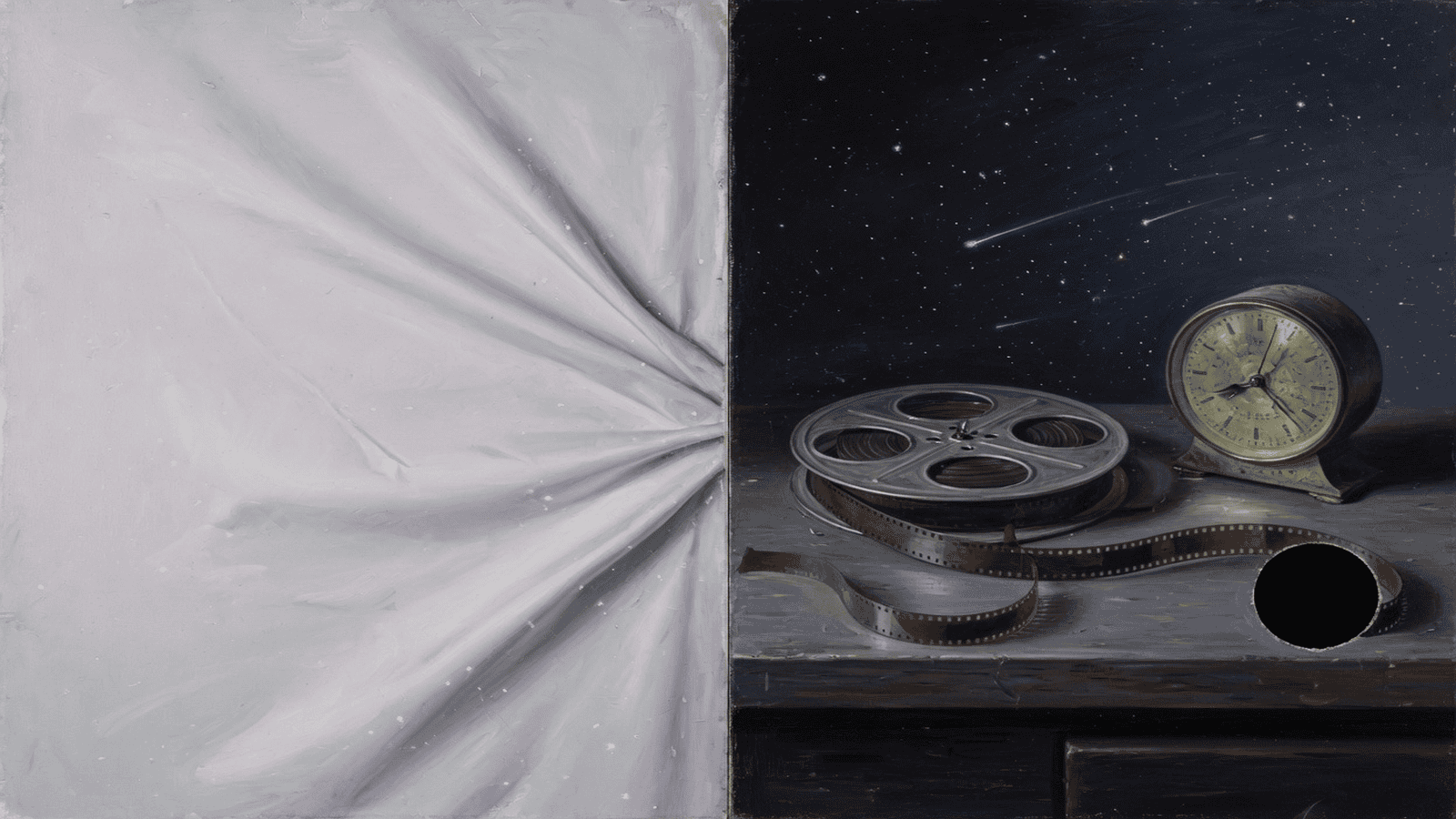
The beginning tempts us to picture a film. There is a first frame, and before it a dark leader of blank celluloid, and the question is what was on the reel before the projector started.
The Planck time, about 5.4 × 10⁻⁴⁴ seconds, feeds the picture, because it sounds like the length of that first frame. I helped spread the confusion myself. In a post from January 2025 I wrote that the Planck time “sets the lower limit for measurable time intervals.” That is the textbook shorthand, and it claims too much. The Planck time is a scale built from three constants, the point where quantum effects and gravity should both matter and where our two best theories, used together, stop giving reliable answers. It marks where the description fails, not a tick of a cosmic clock, and not a timestamp for creation.
Augustine saw the trap sixteen centuries ago. In the Confessions he reports the joke answer to “what was God doing before he made heaven and earth?” — preparing hell for people who ask such questions — and declines to use it. His own answer, in The City of God, is that the world was made not in time but with time. Stephen Hawking reached a cousin of that position by other means. In the no-boundary proposal he developed with James Hartle in 1983, asking what came before the Big Bang is, he said, like asking what lies south of the South Pole.
The analogy helps until it pretends to settle the physics. The no-boundary proposal is one model among several, and quantum gravity is unfinished. The South Pole tells us the question might be malformed. It does not tell us that it is.
IV. Three Questions, Kept Apart
It helps to separate what the word “beginning” runs together. The first question is what the hot Big Bang model describes. Here the answer is strong: from a fraction of a second onward, the model predicts the light elements forged in the first few minutes, the microwave background, and the large-scale structure that grew from its small ripples, and the predictions match observation.
The second question is what it means to say that time began. That one is tangled in unresolved physics and in what we take time to be, and the honest answer is that nobody knows.
The third question is why the early universe was in such a low-entropy state. This is the hard boundary. Cosmology can trace the consequences of the past hypothesis with great precision, the stars, the chemistry, the direction of memory, and cannot derive the hypothesis from anything deeper. Inflation was once offered as the explanation. Penrose’s objection is that inflation needs special starting conditions of its own, so it moves the specialness back a step instead of removing it.
V. Moving the Beginning
Other proposals move it further. Penrose’s conformal cyclic cosmology, set out for general readers in Cycles of Time (2010), makes the cold, thinned-out end of one aeon the smooth start of the next. Sean Carroll and Jennifer Chen proposed in 2004 that baby universes bud off from a high-entropy background, each with its own arrow; Carroll’s From Eternity to Here tells the longer story. Boltzmann himself guessed that our region might be a rare fluctuation in an eternal equilibrium, and that guess now survives mostly as a warning: a random fluctuation is far more likely to produce a single brain with false memories than a whole universe with a consistent past.
These are serious ideas, worked out in mathematics, and some make predictions. None is settled. And each owes the same debt it was invented to pay: a bounce needs an account of why the bounce resets entropy, a multiverse needs an account of the background it buds from. Moving the beginning backward does not close the account.
None of this means science knows nothing, or that the gap is a place to put whatever metaphysics one already preferred. The unease is more exact than that. We have reconstructed thirteen billion years from faint light and the ratio of helium to hydrogen, and we still cannot say why the boundary was drawn so that a history with a direction could happen at all. The universe did not start from zero. It started with a difference, between what it was and what it could become, and that difference is what we call a before and an after.
Further reading
- Roger Penrose — “Before the Big Bang: An Outrageous New Perspective and its Implications for Particle Physics”, Proceedings of EPAC 2006
- Roger Penrose — Cycles of Time (2010); conformal cyclic cosmology; Weyl curvature hypothesis
- Sean Carroll — From Eternity to Here (2010)
- Sean Carroll and Jennifer Chen — “Spontaneous Inflation and the Origin of the Arrow of Time” (2004)
- Richard Feynman — The Character of Physical Law (1965), “The Distinction of Past and Future”
- Arrow of time, past hypothesis, Loschmidt’s paradox, Boltzmann brain
- Hartle–Hawking state — the no-boundary proposal
- Planck time — a scale, not an observed first instant
- Cosmic microwave background
- NASA — “The Big Bang”