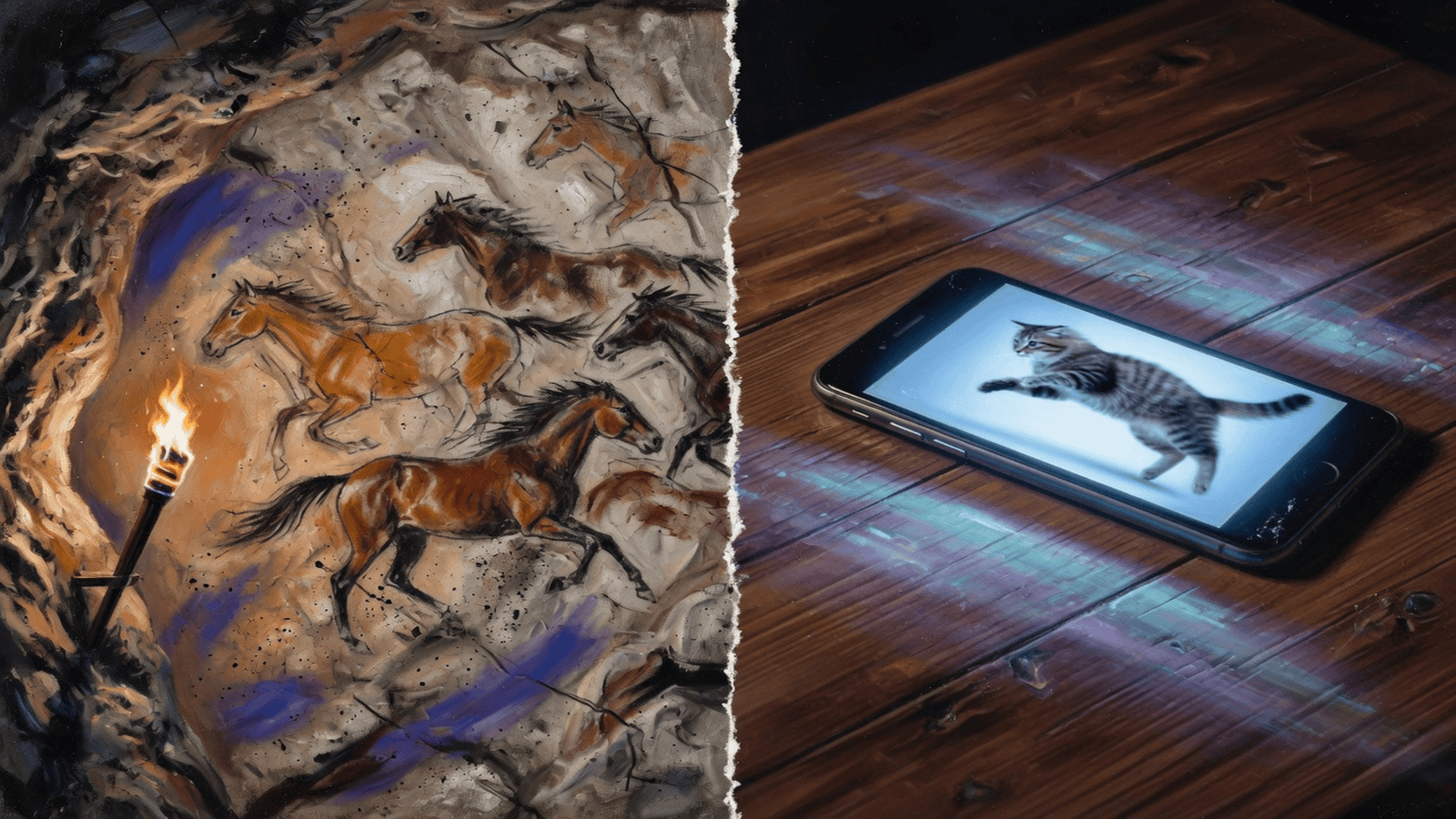
First, the torch. It burns pine, it smokes, and it never holds still, so the wall never holds still either. The chamber is deep in a limestone cliff above the Ardèche gorge, in the south of France, and the wall bulges and folds like a hide. On it, in charcoal, a pride of lions moves from left to right. Their heads overlap, one behind another, as if the same animal had been caught at several points of a turn. Nearby a horse has too many legs. A bison has eight.
The Chauvet Cave was found in December 1994 by three speleologists, and the oldest of its drawings are now dated to more than thirty-five thousand years ago. The extra legs were once read as hesitation, a hand correcting itself. The archaeologist Marc Azéma and the artist Florent Rivère argued the opposite in Antiquity in 2012: the superimposed limbs are successive positions, and under a moving flame they flicker into a gallop. Werner Herzog, filming in the cave for Cave of Forgotten Dreams (2010), called the eight-legged bison “almost a form of proto-cinema.” A wanna-be animation, drawn by someone who had no word for it.
Last week I recorded my cat in mid-leap, in 4K, on a phone. Three seconds of video, the body stretched between the floor and the back of a chair. It was not art and I did not intend it as art. But the gesture was the one on the wall: I saw a living thing move and did not want the movement to disappear. The rhyme is almost too neat. The Chauvet lions are cats too, drawn without manes, as the cave lion seems to have been. Across thirty-five thousand years the same body is being drawn.
I. Not a Primitive Version of Us
The usual story of art runs uphill. Crude beginnings, slow refinement, perspective in Florence, photography, cinema, and finally us. Chauvet breaks that story, because the drawings at the beginning are not crude. The lions have weight. The horses’ muzzles are shaded by smudging the charcoal with a finger, and the painters used the rock itself, letting a ridge become a shoulder, a hollow become a flank. Herzog lingers on them in long, silent passes, and what the camera finds is not an early draft of art. It is art.
The people who made them were anatomically modern humans. Same brain, same hands, same eyes tuned to the same motion. They lived under the same three pressures we do: to survive, to do better than survive, and to turn what they saw into something someone else could see. The first two they shared with every animal on the steppe. The third is the one on the wall.
Radiocarbon dating suggests the cave was visited in two periods, the first roughly between 37,000 and 33,500 years ago and the second between 31,000 and 28,000 years ago. According to the dating Herzog presents, some figures that overlap on the same panel were drawn about five thousand years apart. People came back across a span of time longer than all of recorded history, stood in front of marks left by strangers, and answered them. That is a conversation, not a doodle.
II. Speed and the Tool
If the impulse has not changed, something else has. The most visible difference is speed. A charcoal horse took hours, a torch, a supply of burned wood, a body that knew the cave well enough to work in it. My cat took three seconds and a thumb. That changes how much gets made, enormously. It does not change why anyone makes it.
The tool is the second difference, and it is easy to overrate. Charcoal, ochre, and the curve of a wall set the resolution of the Chauvet lions: a few lines, the essential silhouette, and motion faked by repetition. The phone’s sensor, the codec, the editing app set the resolution of my video. The tool decides how much of the movement survives and how far it travels. It does not supply the intention to keep the movement in the first place.
There is a midpoint between the wall and the phone. In 1878 Eadweard Muybridge set a row of cameras along a racetrack in California and photographed a horse called Sallie Gardner at a gallop, one frame per camera, to settle whether all four hooves ever left the ground at once. They did. The sequence is often called the beginning of cinema. Seen next to Chauvet, it looks more like a solution to an old problem: how to put the horse’s successive positions in a row so that the eye will run them together. The Chauvet painters stacked the positions in one place and let the torch do the running. Muybridge laid them out side by side and let a projector do it.
III. The Ratchet
The most serious candidate for a real difference is neither speed nor tools. It is accumulation. The psychologist Michael Tomasello, in The Cultural Origins of Human Cognition (1999), named it the ratchet effect: humans inherit what the previous generation figured out and add to it, and the gains rarely slip back. Language is built on language, technique on technique, so each generation starts higher up the wall.
The Chauvet painter had a few dozen neighbors and some ancestors to learn from. I have, in principle, everyone at once. Every way anyone has ever filmed a cat is a search away, and the phone already encodes centuries of optics, chemistry, and mathematics I could not reconstruct. A difference of scale that large sometimes becomes a difference in kind. Writing did that to memory, and printing did it to argument.
I am not sure it does it here. The ratchet raises the floor of what anyone can make; it does not obviously raise the act of seeing. The Chauvet painter had to look at a lion for a long time, from a safe distance or not, before drawing it from memory in the dark. I looked at my cat for a fraction of a second, and the phone did the looking. When everyone records everything, the question is how much of the recording is still seeing, and how much is a reflex that fires before the eye has time to land. Accumulation gives us more of the means and, perhaps, less of the attention the means were built to serve.
IV. What the Hand Is After
I once wrote about writing as the long project of moving knowledge outside the skull, from cave walls to transformers. This is not that argument. Storage is about keeping what we know. The lions are not stored knowledge; nobody needed a diagram of a lion to survive one. They are an attempt to keep presence: the specific way a body turns, the instant before it is gone.
That impulse is what has not changed, and I suspect it never was about the tools. Tools are how a given environment lets us answer. Charcoal was what a fire left behind; the phone is what our environment leaves lying on the table. The answer is the same move each time: a creature reacting to its surroundings and trying to get past them, to leave something that outlasts the moment of seeing. Whether the result lasts thirty-five thousand years in a sealed cave or three weeks in a camera roll depends on the world. The reaching does not.
V. Two Lights
A torch moves across a curved wall, and the light runs ahead of the hand that carries it. Where it passes, eight legs become four in motion, and a pride of lions turns its heads toward something just out of frame.
A phone lies face up on a dark table at night. The screen wakes, and its cold light spills across the wood. On it, a cat is suspended above the floor, blurred at the paws, three seconds from landing.
Further reading
- Chauvet Cave — discovery, the two occupation periods, the Lion Panel
- Marc Azéma, Florent Rivère — “Animation in Palaeolithic art: a pre-echo of cinema”, Antiquity 86 (2012)
- Werner Herzog — Cave of Forgotten Dreams (2010)
- Eadweard Muybridge — Sallie Gardner at a Gallop (1878)
- Michael Tomasello — The Cultural Origins of Human Cognition (1999)