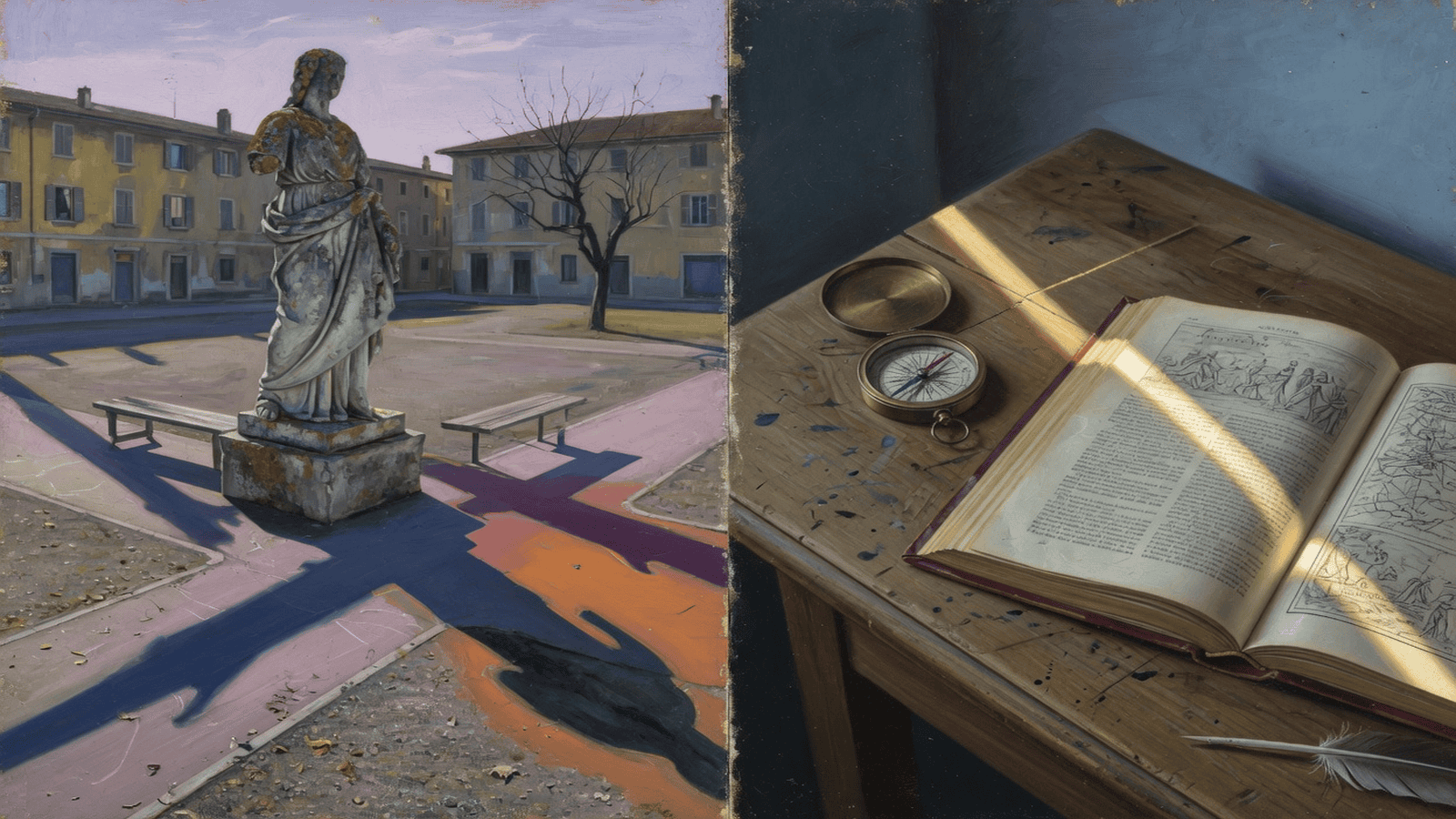
In the schoolbooks I grew up with, Simón Bolívar was not a man. He was a sequence. He swore an oath on the Monte Sacro in Rome, crossed the Andes with a ragged army in 1819, won at Boyacá, freed five nations, and died betrayed. Every town had a plaza with his name and a bronze version of him on a horse. He had no body except the statue, and no doubts except the ones history had already resolved in his favor.
Then, in 1989, Gabriel García Márquez published The General in His Labyrinth, an account of Bolívar’s last voyage down the Magdalena River toward death in Santa Marta. The general in the novel is not yet fifty and looks seventy. He is feverish, vain, insomniac, sentimental, and foul-mouthed. He bathes for hours in hot water, dances when he can barely stand, and cannot stop counting the ingratitudes of the men he made. Some readers in Venezuela and Colombia were scandalized. The book did not accuse Bolívar of anything. It gave him a body, and for a statue that is the worst accusation.
I did not read the novel as a debunking. The man in it was harder to admire and easier to believe. The older I get, the less I think of heroes as people who reached a higher moral altitude, and the more I think of them as human beings seen through one decisive context. The question is what an example is for once it stops being a statue.
I. How a Person Becomes a Statue
The polishing is old. Plutarch wrote his Parallel Lives around the turn of the second century as a machine for making character legible: a Greek beside a Roman, Alexander beside Caesar, each pair inviting comparison. “It is not histories I am writing, but lives,” he warns at the start of his Alexander, and a small thing, “a phrase or a jest,” often reveals more of a person than battles where thousands fall. Plutarch wanted the jest. His readers, for two thousand years, mostly kept the battles.
Institutions keep them too, and for a reason. Max Weber described charismatic authority as the power of an extraordinary person, and noted that it cannot survive its bearer unless it is routinized: turned into offices, rituals, doctrines, and anniversaries. A living hero is unpredictable. A dead one can be administered. Bolívar has been claimed by nearly everyone since: Colombian guerrillas stole his sword from a museum in 1974, and a Venezuelan president had his remains exhumed in 2010. The statue is not the hero’s memory. It is the institution’s use of him.
James Baldwin told a room of teachers in 1963 that American history is “longer, larger, more various, more beautiful, and more terrible than anything anyone has ever said about it.” His “A Talk to Teachers” was about what a national myth costs the children who are asked to believe it, especially the children it leaves out. The clean hero is part of that cost. Polished enough, a person becomes too pure to imitate and too sacred to criticize, and both conditions keep the rest of us safely where we are.
II. The Decision Was Not Made in a Vacuum
The story most Americans learned about Rosa Parks is that, on December 1, 1955, a tired seamstress refused to give up her seat on a Montgomery bus. The story is true and almost useless. Parks was the secretary of the local NAACP chapter. That summer she had attended a workshop on desegregation at the Highlander Folk School in Tennessee. In her autobiography she corrected the legend directly: the only tired she was, was tired of giving in.
Nine months earlier, a fifteen-year-old named Claudette Colvin had refused to give up her seat on a Montgomery bus and was dragged off and arrested. Local leaders decided she was not the right face for a campaign. She was young, outspoken, from a poor neighborhood, and soon pregnant. Parks was respected, composed, and married. The movement chose its symbol with care, as movements must, and the choice shows how heroes are made: not only by what a person does but by who is in a position to tell the story.
None of this makes Parks less brave. She was arrested, lost her job, and received death threats for years. It makes her decision legible as a decision, prepared by an organization, enabled by a moment, and still hers. A usable example needs that balance. If we reduce the hero to circumstance, history becomes a catalogue of excuses and nobody is responsible for anything. If we reduce the circumstance to the hero, the decision becomes a miracle, and miracles cannot be learned from.
III. The Danger of the Borrowed Pose
Nietzsche saw both the use and the trap. In “On the Uses and Disadvantages of History for Life” (1874) he describes monumental history, the kind that collects great deeds, as a source of courage: whoever reads it learns that greatness was once possible and so may be possible again. Then he names its danger. Monumental history works by analogy. It makes unlike things look alike, loosens the past from its causes, and invites imitation of effects whose conditions no longer exist. The result is a museum of poses, worn by people who have mistaken a costume for a choice.
The phrase “role model” carries the same risk in its name. A model is something to copy, and no life can be copied. No one inherits Bolívar’s war, Parks’s Montgomery, or the body and the timing and the friends that made either one’s decisive moment possible. The more carefully we look at an example, the less imitation makes sense. What survives the close look is smaller and more useful than the gesture.
I wrote about the same failure from the other side in the hero who hoards, and about the story under the story that keeps a character alive while the surface keeps changing. A hero is made by selection and compression. That is not a scandal. It is what a map does. The mistake is to walk the map as if it were the ground.
IV. Evidence That Another Option Existed
At the Eichmann trial in Jerusalem in 1961, a witness spoke for a few minutes about a German sergeant named Anton Schmid. In Vilnius, Schmid had helped Jewish partisans with forged papers and army trucks, without asking for money, until he was arrested and executed in 1942. Hannah Arendt, covering the trial, wrote in Eichmann in Jerusalem that the courtroom fell silent, as if the crowd had decided to observe two minutes in honor of a man. Then she drew the lesson. Under conditions of terror most people will comply, but some people will not. “Humanly speaking,” she wrote, “no more is required, and no more can reasonably be asked, for this planet to remain a place fit for human habitation.”
Schmid does not work as a role model. Almost nothing is known about his inner life, his reasons, or his flaws, and no reader faces his situation. He works as something else: proof. Eichmann’s defense rested on the claim that nothing else had been possible. Schmid is the counterexample. He shows that the default was a default and not a law.
That is what I now want from admired lives. Not a template but a pointer, a mark on the map showing that a road existed where the ground looked closed. Read that way, an example asks three questions. What seemed inevitable to everyone around this person? What made another decision possible: character, yes, but also timing, institutions, relationships, resources, a summer workshop in Tennessee? And what option does the example make visible now, in circumstances that are not the same?
V. The Narrowed Question
The third question matters most because so much of modern life is built to close it. Careers, platforms, and institutions arrive pre-optimized for safety, reputation, consensus, and efficiency, and they rarely announce the limits they impose. The best answer to a narrow question can look like the only answer. An example from outside that frame does not tell us what to do. It tells us that the question was narrowed, that a choice irrational by the dominant metric can be intelligible by another one: loyalty, dignity, truth, refusal.
This does not ask for admiration of the whole person. Bolívar can be a pointer and also an autocrat by the end. Schmid is a pointer with almost no biography. A person can be a useful example without being admirable as a whole, and the habit of requiring admirable wholes is how we end up with statues. It is also why the statue never helps at the moment that counts. Standing in a plaza, it has no doubts to share.
At the end of the novel, García Márquez’s general asks how he will ever get out of this labyrinth. It is the question of someone who has run out of default answers. I find the man who asks it more useful than the bronze rider in the plaza. Neither tells me what to do. Only one of them looks as if he once had to decide.
Further reading
- Gabriel García Márquez — The General in His Labyrinth
- Plutarch — Parallel Lives
- Max Weber — charismatic authority
- James Baldwin — “A Talk to Teachers”, in The Price of the Ticket
- Rosa Parks — Rosa Parks: My Story, and the Highlander Folk School
- Claudette Colvin
- Friedrich Nietzsche — “On the Uses and Disadvantages of History for Life”
- Hannah Arendt — Eichmann in Jerusalem
- Anton Schmid