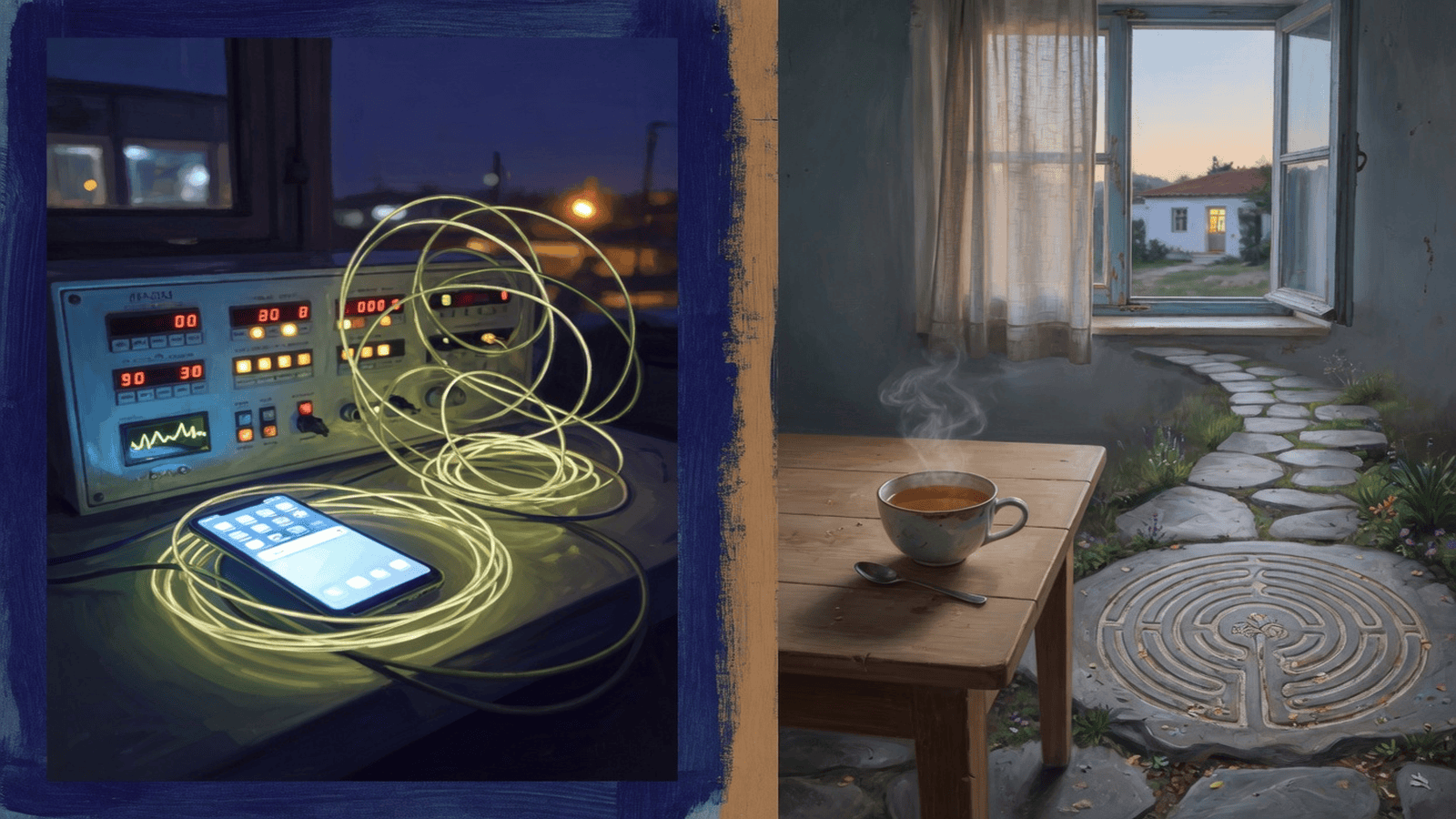
I pick up the phone to check one thing, the weather or the time of a train. When I look up, forty minutes have passed. Nothing dramatic happened in them. There was a notification, then a video someone had shared, then the next video, then a headline, then a small red number that needed to go away. No single moment felt like a loss of freedom. The hour was made of ordinary moments, and none of them was mine.
Duran Duran released “Ordinary World” in the early nineties, a song Simon Le Bon wrote partly out of grief, about trying to find a way back to a normal life after something has broken it. The title stays with me for another reason. The public conversation calls this moment “the impact of AI,” as if the change were a meteor arriving from outside. What is spreading is older and more deliberate: automation pushed into every corner of work, and products engineered to hold attention for as long as possible. The song’s question fits that second change. Is there still a world in which being human does not look like a defect waiting to be automated away?
I. The Hour Made of Ordinary Moments
The anthropologist Natasha Dow Schüll spent fifteen years among machine gamblers in Las Vegas. In Addiction by Design (2012) she describes what the players call “the zone,” a state in which time, money, and the self dissolve into the next spin. The players did not want to win. They wanted to keep going. The industry, she shows, had learned to tune the pacing, the near-misses, the chairs and the lighting to keep them there. The zone was not a flaw in the gamblers. It was a product feature.
The method travels. A feed that never ends, a notification timed to the moment attention drifts, an autoplay that removes the decision to continue: none of these requires anyone to be weak. They require only that someone be paid by the minute of attention. I wrote about the smaller version of this in the mosquito effect, the low, constant irritant that shapes behavior because it never rises to the level of a decision.
The harm is easier to feel than to measure. Jonathan Haidt’s The Anxious Generation (2024) argues that smartphones and social media rewired adolescence and drove a rise in anxiety and depression. The developmental psychologist Candice Odgers answered in Nature that the data do not support so strong a causal claim, and Amy Orben and Andrew Przybylski had already found, across more than 350,000 adolescents, that the average association between technology use and well-being was tiny. Averages hide the people at the tails, and design matters more than screen time. The honest claim is not that phones or AI caused a mental-health crisis. It is that environments built for constant stimulation make existing vulnerabilities harder to live with, and make quiet feel like a symptom.
II. Where the Saved Time Goes
In 1930, John Maynard Keynes wrote a short essay called “Economic Possibilities for our Grandchildren.” He predicted that within a century productivity would grow so much that his grandchildren’s main problem would be leisure, and a fifteen-hour week would be enough. He was right about the productivity. He was wrong about the hours.
The historian Ruth Schwartz Cowan found the same pattern at home. In More Work for Mother (1983) she showed that washing machines, vacuum cleaners, and electric stoves did not reduce the hours American women spent on housework. The standards rose to meet the machines. Clothes were washed more often, floors were expected to be cleaner, and the servant and the visiting laundress disappeared while the labor stayed. C. Northcote Parkinson put the office version as a joke in 1955, that work expands to fill the time available, and the joke has outlived most serious management theory.
Generative AI is now running the same experiment. A study of customer-support agents by Erik Brynjolfsson, Danielle Li, and Lindsey Raymond found that an AI assistant raised productivity by about fourteen percent, most of all for the least experienced workers. That is a real gain. But a gain is not yet a gift. The worker who finishes a task in half the time discovers that the half saved has become the new baseline. The tool made the work easier. Nothing in the system made room for a life beyond it. Who receives the saved hour is not a technical question, and no model will answer it.
III. The Apology and the Incentive
On January 31, 2024, at a hearing of the United States Senate Judiciary Committee, Mark Zuckerberg turned to face parents whose children had been harmed through social media and apologized. The apology may well have been sincere. It was also an apology in the grammar of unintended consequences, delivered by the head of a company whose revenue still depends on time spent and whose incentives did not change when he sat back down.
Technology does not arrive as a neutral capability whose effects depend only on how people use it. It arrives inside institutions with owners, business models, and measures of success. Shoshana Zuboff called one version of this surveillance capitalism; Yanis Varoufakis, more provocatively, calls it technofeudalism, a system in which platforms collect rent on attention the way lords collected it on land. I have written about that feudal imagination before. Both labels are arguments, not settled facts, and neither is needed for the simpler point. When the measure of success is engagement, attention becomes inventory, dependence gets renamed convenience, and an apology changes nothing that is measured.
The counterargument deserves its full strength. Automation removes drudgery. It makes expertise available to people who could never have paid for it. It gives disabled people capacities they did not have, and gives everyone hours back from tasks nobody would miss. To reject tools because powerful interests can capture them is to leave the definition of progress to those interests. The problem is not change. It is change without anyone accountable for what should remain.
IV. A Prosthetic God
In the same year Keynes promised his grandchildren leisure, Sigmund Freud published Civilization and Its Discontents, and he was less optimistic. “Man has, as it were, become a kind of prosthetic God,” he wrote. “When he puts on all his auxiliary organs he is truly magnificent; but those organs have not grown on to him and they still give him much trouble at times.”
The sentence holds up better than much of Freud’s theory. The organs have not grown on to us. We carry an evolutionary and cultural inheritance that no product team can patch: the need for sleep, for bodies near other bodies, for the attachment that John Bowlby showed infants cannot do without, for limits, for meaning that does not arrive as a metric. Freud and Carl Jung disagreed about nearly everything that lay under that inheritance. Freud saw a psyche paying for civilization with renunciation; Jung, in Modern Man in Search of a Soul (1933), saw one hungry for a meaning modern life had stopped supplying. Neither is a substitute for current evidence about mental health. But both understood that a person is not a blank slate waiting for an update, and that the cost of new organs is paid by the old body.
V. The Missing Return
Joseph Campbell’s The Hero with a Thousand Faces (1949) is remembered for the departure: the call to adventure, the threshold, the trials, the ordeal. Fewer readers remember that its last part is about coming home. In Campbell’s account the hero must bring the boon back to the community, and this is the hardest stage. He has a chapter called “The Refusal of the Return,” in which the hero, having found what he went looking for, does not want to go back. Even the Buddha, in the tradition Campbell follows, hesitated after his awakening, doubting that what he had learned could be told to anyone.
Campbell has fair critics. Folklorists, Alan Dundes among them, objected that he chose the examples that fit and dropped the ones that didn’t, and that one story told a thousand times is a reader’s construction, not a law of the psyche. I wrote about the gap between Campbell’s wisdom and the people who sell it earlier this year. Read as a diagnostic rather than a doctrine, though, the monomyth asks a useful question of a culture in love with acceleration: where is the return? Every new capability opens another trial. Each release is a new departure. There is no shared story about sufficiency, about bringing the gain home, about the moment the journey is supposed to end in a life someone can live.
The oldest return in Western literature ends at a bed. When Odysseus reaches Ithaca after twenty years, Penelope tests him by asking a servant to move their bed out of the bedroom. He is furious, because the bed cannot be moved: he built it himself around the trunk of a living olive tree, and the house around the bed. That is how she knows him. The proof of the return is a thing that does not travel.
VI. An Ordinary World
Searching for an ordinary world is not nostalgia. The past had its own drudgery and cruelty, and fewer of the tools that let me write this from anywhere. It is a demand that progress be judged by whether people can still sustain attention, keep relationships, follow the rhythms of a body, do meaningful work, and spend time that nobody measures. Those are not leftovers to be protected once efficiency has finished. They are what efficiency was supposed to serve.
Three questions keep the distinction honest. What can the tool actually do, apart from the marketing and the imagined futures? What does the system around it reward, and who receives the time and capacity it creates? And what should remain humanly ordinary, the forms of life that should not have to justify themselves through productivity, engagement, or scale? The first question belongs to engineers. The second belongs to anyone who works or votes. The third has no owner, which is why it keeps going unanswered.
The answers will not come from one act of willpower, a weekend without a phone, a heroic renunciation. They will come, if at all, from repeated practices and collective limits: hours that a workplace agrees not to colonize, products that are allowed to be finished, a measure of success that includes the evening. The aim is not to stop history, and not to hand the future to whoever owns the servers. It is to have a say in what the tools are building, and to keep somewhere a bed that cannot be moved.
Further reading
- Duran Duran — “Ordinary World”
- Natasha Dow Schüll — Addiction by Design: Machine Gambling in Las Vegas
- Jonathan Haidt — The Anxious Generation
- Candice L. Odgers — “The great rewiring: is social media really behind an epidemic of teenage mental illness?”
- Amy Orben and Andrew K. Przybylski — “The association between adolescent well-being and digital technology use”
- John Maynard Keynes — “Economic Possibilities for our Grandchildren,” in Essays in Persuasion
- Ruth Schwartz Cowan — More Work for Mother
- C. Northcote Parkinson — Parkinson’s law
- Erik Brynjolfsson, Danielle Li, and Lindsey Raymond — “Generative AI at Work”
- The Kids Online Safety Act and the 2024 Senate hearing
- Shoshana Zuboff — The Age of Surveillance Capitalism
- Yanis Varoufakis — Technofeudalism
- Sigmund Freud — Civilization and Its Discontents
- John Bowlby — attachment theory
- Carl Jung — Modern Man in Search of a Soul
- Joseph Campbell — The Hero with a Thousand Faces
- Alan Dundes — folklorist and critic of the monomyth
- Homer — The Odyssey