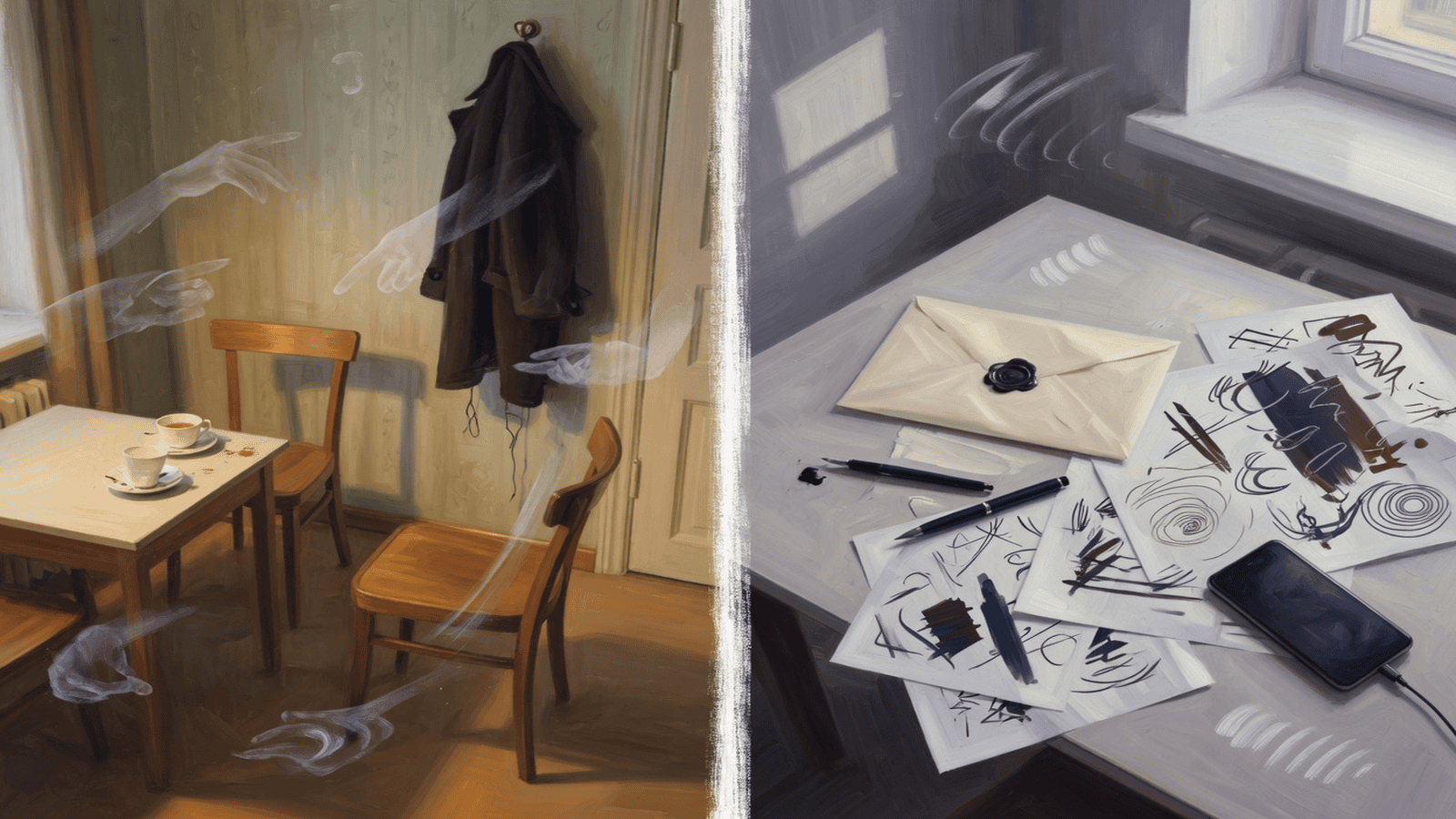
Two people meet in a doorway. “So good to see you,” one says, and means it, or believes she does. Her shoulders, meanwhile, stay angled toward the hall she came from, and her weight never quite leaves the back foot. The other answers warmly, the conversation lasts four minutes, and both walk away with a conclusion neither could quote. Nothing false was said. Something was communicated anyway.
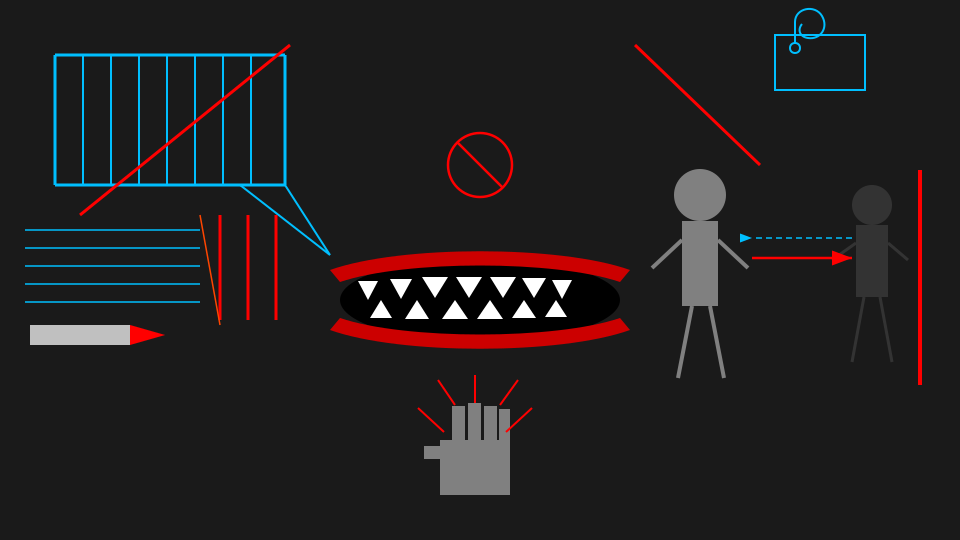
We talk about communication as if it were one activity called language. It is at least three. The body speaks in posture, rhythm, distance, and gaze. The voice speaks in sound and sequence. The hand speaks in marks that survive the speaker’s absence. The three overlap, translate badly into one another, and disagree most often when the message matters most.
I. The Sentence Nobody Said
Charles Darwin noticed the problem before it had a name. In The Expression of the Emotions in Man and Animals (1872) he catalogued the bared teeth, raised hackles, and lowered brows that animals and people share, and argued that expression had a history long before it had a vocabulary. Bodies were signaling to other bodies for hundreds of millions of years before anyone said a word.
Erving Goffman gave the social version of the same insight. In The Presentation of Self in Everyday Life he separated the expression a person gives, the words chosen on purpose, from the expression a person gives off, everything else that leaks around them. Observers, Goffman noticed, tend to trust the second more, precisely because it seems harder to fake. The guest who praises the dinner is checked against the speed at which she eats it.
This is why “I’m fine” is one of the least informative sentences in any language. The words are a formula. The information lives in the breathing, the half-second of delay, the eyes that leave the face of the person asking. We read that script continuously, and we write it whether or not we intend to.
II. Older Than Words
Michael Tomasello’s Origins of Human Communication makes the case that human language did not begin in the mouth. It began in pointing and pantomime: gestures that only work if two minds already share attention on the same object and a rough guess about each other’s purpose. An infant points at a dog before she can say “dog,” and the point carries a whole sentence: look, there, with me. Speech arrived later and built on that scaffolding instead of replacing it.
Speech brought a power the body never had. It can name what is absent, distant, past, hypothetical, or false. A gesture can point at the river; only a sentence can describe the river that flooded in your grandfather’s youth. Writing then extended that power across time and space, letting a sentence outlive the throat that made it.
But each new layer was built on top of the old ones, not instead of them. The body never stopped talking when the mouth learned how. It simply became the channel we cannot quote afterward.
III. A Language Without a Dictionary
Calling this “body language” invites a mistake, and an industry has been built on the mistake. Ray Birdwhistell, who coined the term kinesics in the 1950s, spent years filming conversations frame by frame hoping to find a grammar of movement, units like phonemes and words. He concluded that no gesture carries a fixed meaning independent of context. A crossed arm is cold, or defensive, or comfortable, or just a way of keeping warm in an air-conditioned room.
The popular claim that 93 percent of communication is nonverbal comes from Albert Mehrabian’s experiments in the late 1960s, which tested listeners’ reactions to single words spoken in a tone that contradicted them. Mehrabian has spent decades explaining that the 7–38–55 rule does not apply to conversation in general. It travels anyway, because it flatters a fantasy: that the body is a truth machine, and that a trained observer can read people like a printout.
Culture breaks the machine further. Edward T. Hall’s The Silent Language describes an American and a Latin American at a party, the first stepping back to restore a comfortable distance, the second stepping forward for the same reason, until one has backed the other across the room. Each reads the other’s body fluently and wrongly. Lisa Feldman Barrett’s work on constructed emotion adds that even faces, the supposed universal script, signal much less reliably than the textbooks claimed.
So the body is not a dictionary. It is a high-bandwidth field of hypotheses. Someone looks away out of shyness, respect, boredom, fear, convention, or because they are trying to remember a date. The reader still has to infer, and inference draws on the reader’s history as much as on the signal.
IV. Writing Grows a New Body
Writing seems to solve the problem by removing the body altogether. Walter J. Ong’s Orality and Literacy describes what that removal costs: the written word is detached from the voice, the room, and the moment that gave it sense. Plato saw it first. In the Phaedrus, Socrates complains that a written text, when questioned, “always says one and the same thing,” and cannot defend itself without its father present.
Yet the body grows back. A four-word text message arrives, and the recipient rereads it the way she would study a face. Is the period cold? Why no exclamation mark this time? Why did it take three hours? Researchers at Binghamton University found in 2016 that text replies ending in a period were rated less sincere than identical replies without one. In handwriting, a period is just the end of a sentence. On a phone it became a tone of voice.
Latency, capitalization, voice notes, stickers, and the timing of a “seen” receipt all do the work that posture and breath used to do. The supposedly disembodied medium has quietly evolved an anatomy. Deborah Tannen’s studies of conversational style showed that pauses and overlaps carry different meanings for different speakers; the same is now true of typing indicators. Every medium solves one ambiguity by creating another.
V. Emission, Translation, Revision
What happens in an exchange, then, is less a delivery than an assembly. Bodies, voices, and hands emit signals, some chosen and many not. The receiver translates them, combining what arrived with memory, cultural expectation, and the scene in front of her. And each channel revises the others: words can explain a gesture or make it more suspicious, a gesture can undercut a sentence, and writing can freeze an interpretation that a second conversation might have repaired.
The divergence is sharpest exactly where the stakes are highest. “I forgive you,” spoken by a body still braced for the next blow. A careful letter whose excessive care is itself the resentment. A silent embrace that says what neither person can yet put into a sentence. The more important the message, the more channels it travels through, and the more chances they have to disagree.
This is why we often remember the feeling of a conversation long after the words are gone. The words were the one channel we could have written down. The rest was absorbed below the level of quotation and filed as a verdict: she was happy to see me; he was holding something back; that meeting went badly. The verdict lasts. The evidence for it does not.
VI. Not a Sealed Thought
In 1979 the linguist Michael Reddy described what he called the conduit metaphor: the way English speaks of putting ideas into words, getting a point across, finding meaning in a sentence, as if thoughts were objects packed into containers and shipped to another head. George Lakoff and Mark Johnson took up the idea in Metaphors We Live By. The metaphor is so built into the language that it is hard to describe communication without it, and it is wrong in exactly the place it matters. Nothing is shipped. The receiver builds a meaning out of what arrived through several channels, each with its own history and its own way of failing.
Seeing it this way rules out two comfortable positions at once. Words are not all that matter, because they arrive inside an older stream of evidence that the listener cannot switch off. And the body does not tell the truth, because what it emits is noisy and what the reader makes of it is a story. The doorway greeting, the “no problem” with a tightened jaw, the four-word text: in each case someone is translating between three languages at once, mostly without knowing which one they are trusting.
Sometimes the most honest sentence available is the one that names the gap. I’m glad to see you, and I’m also late for something. It does not make the body agree with the words. It only gives the listener one less thing to guess.
And none of it holds still. Communication is dynamic today because all three languages influence each other: text rebuilds the body out of punctuation and delay, speech picks up the rhythms of text, and the body learns gestures it first saw on a screen. The traffic has always run in every direction. Our numbers still carry the body: a digit is a finger, we count in tens because we have ten of them, and the cubit, the foot, and the span measured the world long before the meter did. Symbols come and go, and some come back. The Egyptian hieroglyph, an owl, a reed, an eye drawn on a temple wall, has returned as the emoji in your phone.
Further reading
- Charles Darwin — The Expression of the Emotions in Man and Animals
- Erving Goffman — The Presentation of Self in Everyday Life
- Michael Tomasello — Origins of Human Communication
- Ray Birdwhistell — kinesics
- Albert Mehrabian — the 7–38–55 rule and its limits
- Edward T. Hall — The Silent Language and proxemics
- Lisa Feldman Barrett — theory of constructed emotion
- Walter J. Ong — Orality and Literacy
- The cubit and other body-based units of measure
- Plato — Phaedrus
- Gunraj et al. — “Texting insincerely: The role of the period in text messaging”
- Deborah Tannen — That’s Not What I Meant!
- Michael Reddy — the conduit metaphor
- George Lakoff and Mark Johnson — Metaphors We Live By