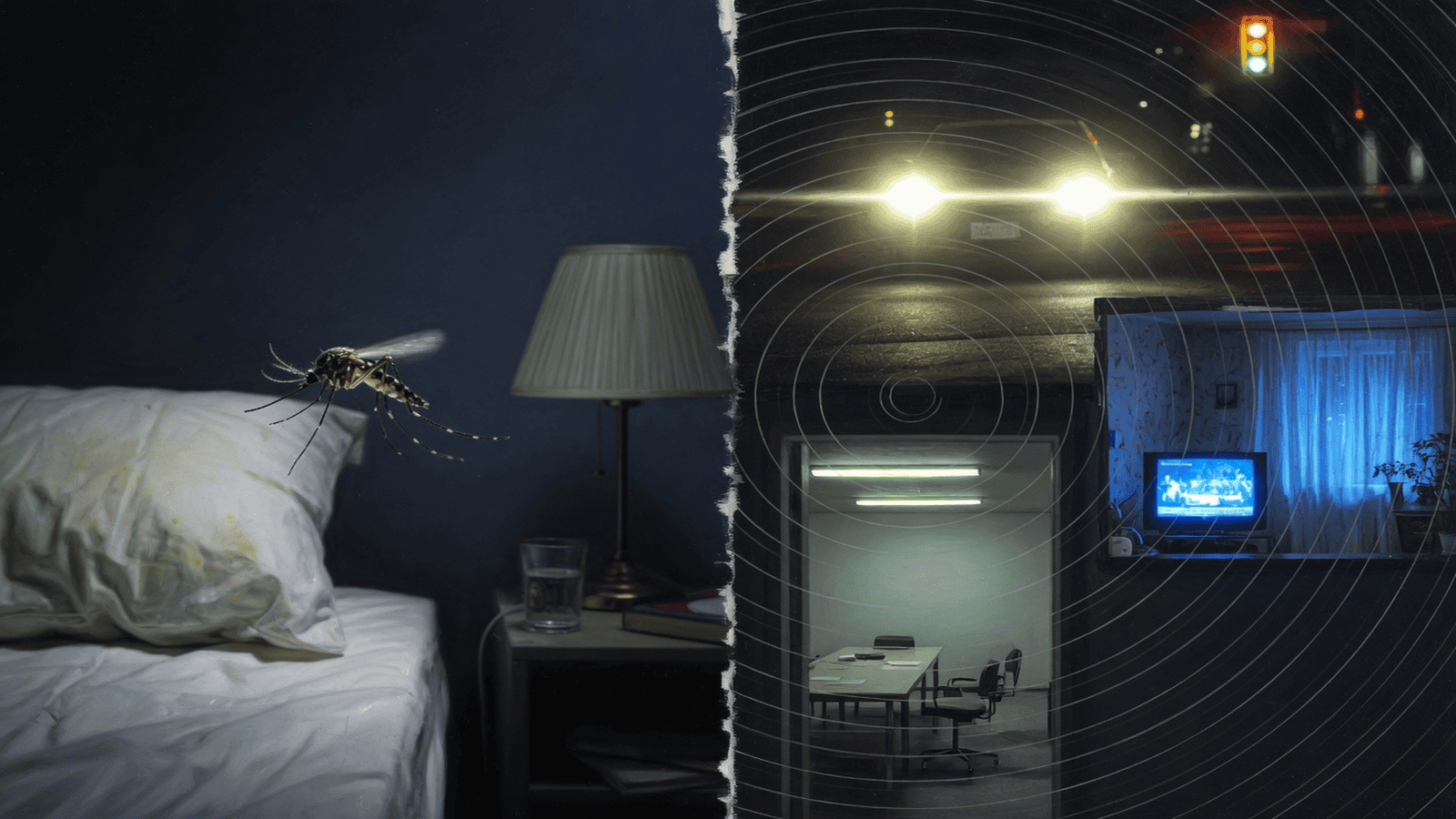
The lamp is off and the room is almost asleep when the whine arrives at the left ear: thin, rising, gone. A slap in the dark lands on your own cheek. Then stillness, and the stillness is no longer rest. It is surveillance. Ten minutes later you are standing on the mattress with the light on, scanning the ceiling for a speck the size of a comma, more alert than you were at any point during the working day. The insect weighs about two and a half milligrams. It has just reorganized the night of an animal some thirty million times its mass.
The same person may have sat calmly through a diagnosis, closed a failing company, or buried a parent with a composure others admired, and still lose a whole evening to the neighbor’s television leaking through the wall. It is never loud enough to call anyone about. It is only loud enough to rebuild the other room in your head: the laugh track, the ad break, a voice that might be the news. The disproportion is the puzzle. Why does resilience against large things buy so little immunity against small ones?
I. Too Small to Fight, Too Frequent to Ignore
A tiger produces a clean response. You run, fight, hide, and eventually recover. A mosquito produces a loop instead: notice, dismiss, notice again, search, fail to find, hear it again. The stimulus is too minor to justify mobilizing the whole self and too recurrent to be forgotten. It lives on the unfinished edge of attention.
The physiology is older than any opinion about it. In the 1950s and 60s the Soviet psychologist Evgeny Sokolov described the orienting response, the reflex turn toward anything new: the head moves, the pupils widen, the heart briefly slows, all before a thought has formed. Its counterpart is habituation. A signal repeated regularly and without consequence gradually fades into the background, which is how people sleep beside highways and refrigerators. But habituation needs two conditions, regularity and irrelevance, and the mosquito defeats both. So does the neighbor’s television, which carries speech, and speech is the one sound the brain cannot stop trying to parse. The refrigerator hums. The television talks.
B. F. Skinner’s pigeons offer a second clue, as long as they are used carefully. Behavior rewarded on an unpredictable schedule of reinforcement is the hardest to extinguish; the bird that cannot know which peck will pay keeps pecking. The mind scanning a dark bedroom is doing something structurally similar. The reward is not food. It is confirmation that the enemy is still there. Predictive-processing accounts of the brain, set out most readably in Andy Clark’s Surfing Uncertainty, describe cognition as a running attempt to predict incoming signals and suppress error. A sound that cannot be modeled leaves the error open, and an open error keeps pulling at attention, much as the Zeigarnik effect keeps interrupted tasks mentally within reach. The mosquito is a prediction error with wings.
II. The Tiger Comes with a Script
Major crises are terrible, but they tend to come organized. They supply a role, an enemy, a deadline, and a story about what must be done. Neighbors bring food. The calendar reorganizes itself around the emergency, and the self has permission to mobilize everything it has. Minor disturbances supply none of this. They sit below the threshold of justified action and above the threshold of perception, and because they do not deserve a full response, they settle into a permanent partial one.
The history of literature is full of people who handled large suffering better than small noise. Schopenhauer, who wrote with complete calm about the misery of all existence, produced an essay in Parerga and Paralipomena that is essentially a howl against the coachmen cracking their whips in the streets of Frankfurt. Franz Kafka’s two-paragraph sketch “Great Noise” (1912) describes his room as the headquarters of the noise of the entire apartment: doors, a stove, a sister’s voice, his father’s dressing gown dragging past. Marcel Proust lined his bedroom with cork. None of them were fragile in any ordinary sense. They were people whose work depended on a continuous line of thought, and each discovered that the line could be cut by something too small to name as an enemy.
This is the paradox the resilient person runs into. They know how to meet a real challenge. They can plan, sacrifice, and endure. There is simply no dignified strategy for being buzzed by an unresolved irritation every ninety seconds. Then shame adds a second hook to the first: I should not be bothered by this. The effort of proving that one is unaffected becomes its own disturbance. At that point the self-image of resilience is part of the trap, because it forbids the ordinary complaint that would end the problem. Someone who has survived real hardship can find it harder, not easier, to knock on a neighbor’s door and ask for the volume to come down.
III. When the Sound Has an Author
Not every mosquito is an insect. A driver leans on the horn a half-second after the light changes. The sound is brief, socially illegible, and bodily immediate. The nervous system receives an order before the mind has formed an opinion. It is not just decibels; it is an anonymous claim that your body should move faster. The neighbor’s television is not just sound either. It is someone else’s priorities crossing a wall without negotiation.
Then there are the disturbances that come with an author and deny that they have one. A meeting contains no explicit insult, but one person is interrupted each time they speak, one contribution draws a smile and another a slight turn of the shoulders. Erving Goffman, in Interaction Ritual, called the fabric this tears the interaction order: the small, mostly silent rituals by which people protect one another’s face. A gesture can be deniable in isolation and unmistakable as a pattern. The psychiatrist Chester Pierce coined the word microaggression in 1970 for exactly this kind of patterned deniability; Derald Wing Sue later built a research program around it, and Scott Lilienfeld’s 2017 critique argued, with some force, that the concept had been measured loosely and stretched to cover too much. Both sides of that debate agree on one thing: much of the cost lies not in the event but in the adjudication. The target leaves unable to prove anything and unable to say that nothing happened.
None of this means a horn and a slight are the same thing. The horn is a sound, and the slight is a hierarchy compressed into a form that makes protest look excessive. Their meanings differ, and so do their remedies. What they share is a structure of capture in three layers. The first is sensory: the signal reaches the body before interpretation does. The second is interpretive: the mind searches for intention, danger, or disrespect, and works hardest exactly where the signal is most ambiguous. The third concerns agency: because the disturbance is too small to warrant escalation, the person spends their own time regulating themselves around it. The mosquito takes the night by making you the one who has to stay awake.
The body keeps its own accounts, and they do not round small numbers down to zero. The World Health Organization’s research on noise and health ties chronic night-time noise to fragmented sleep, raised stress hormones, and cardiovascular risk. The same research literature has long observed that annoyance tracks poorly with measured loudness and much better with whether the listener feels any control over the source. “Minor” describes the stimulus. It does not describe the exposure.
IV. A Small Thing Can Be Small and Still Deserve to Stop
Simone Weil wrote that attention is the rarest and purest form of generosity, and in Gravity and Grace she treated it almost as a spiritual act. The mosquito effect is the dark inversion of that idea. If attention is a gift, then the small repeated intrusion is a small repeated theft, taken without consent in amounts too slight to report.
The obvious advice, be less sensitive, misreads the problem. It turns a question about the environment into a verdict on the person, and it ignores the fact that control over one’s environment is unevenly distributed. Someone who cannot afford the quiet apartment, the private office, or the seniority to finish a sentence is not failing at self-regulation. They are paying a tax the others were exempted from. The opposite mistake is also available. Naming a pattern can loosen its grip, but it can also install a new layer of monitoring, as anyone with misophonia knows: the trigger becomes something to watch for, and watching is its own capture.
The proportionate answer lies in between. It means giving small disturbances accurate names and small, real forms of control: felt pads and earplugs, a knock on the neighbor’s door, a different route home, a sentence spoken aloud in the meeting (I wasn’t finished). It means granting oneself the right to treat repeated minor harm as real without inflating it into catastrophe. Accepting an irritation is different from surrendering the right to a boundary. A person can hold both of these at once: this is small, and it still deserves to stop.
What small, repeated thing has been quietly deciding how you spend your attention, and have you ever simply asked it to stop?
Further reading
- Evgeny Sokolov and the orienting response; habituation
- B. F. Skinner and C. B. Ferster — schedules of reinforcement
- Andy Clark — Surfing Uncertainty
- Bluma Zeigarnik — the Zeigarnik effect
- Arthur Schopenhauer — “On Noise,” in Parerga and Paralipomena
- Franz Kafka — “Great Noise” (1912)
- Marcel Proust and the cork-lined room
- Erving Goffman — Interaction Ritual; face
- Chester Pierce, Derald Wing Sue, and Scott Lilienfeld on microaggressions
- World Health Organization — health effects from noise
- Simone Weil — Gravity and Grace
- Misophonia