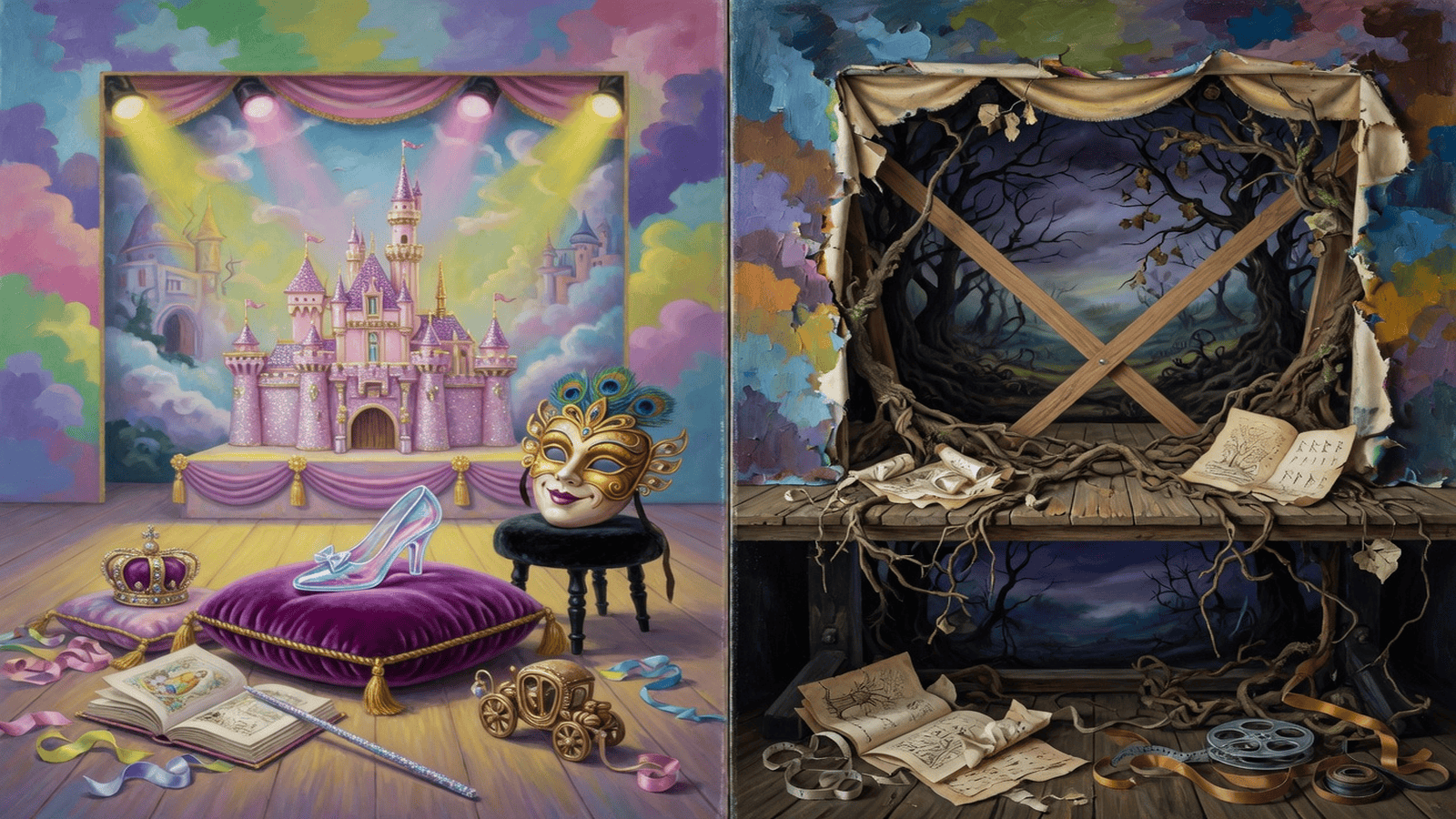
Most people who grew up on the Disney Cinderella believe they know how the story ends: midnight, the glass slipper, the wedding. That belief is not wrong so much as it is late. It arrives already several centuries and several continents downstream of where the story starts, and the version that feels most original is usually just the version we happened to receive first. Underneath a great many familiar characters sits an older, stranger engine — one the polished surface was built to manage rather than replace.
I. The Familiar Version Is the Latest Version
Cinderella is not a single story. It is a family of them, cataloged by folklorists as tale-type ATU 510A and traced back at least to Duan Chengshi’s ninth-century Chinese account of Ye Xian, a girl aided by the bones of a magic fish rather than a fairy godmother. Giambattista Basile’s Cenerentola (1634) predates Perrault by more than sixty years and gives its heroine a role in her own stepmother’s death. The Brothers Grimm, working a century after Perrault, kept the blood: the stepsisters mutilate their own feet to fit the slipper, and pigeons peck out their eyes at the wedding. None of that violence is a later corruption of an innocent original. It is closer to the reverse — the innocence is the corruption, or at least the intervention, and it is comparatively recent.
Snow White carries the same machinery under gentler lighting. A jealous mother, a mirror that adjudicates beauty as a matter of life and death, a huntsman ordered to bring back the girl’s organs as proof of murder, death, and resurrection through a poisoned object lodged in the throat — this is not children’s whimsy with menace added for texture. It is the menace, wearing whistling dwarves and a red bow as camouflage. Marina Warner’s From the Beast to the Blonde and Jack Zipes’s The Irresistible Fairy Tale both make the same point from different angles: the fairy tale did not lose its danger over time. It relocated the danger somewhere a later audience would agree not to look.
II. The Backing Story: Myth Beneath the Character
Some characters are not really characters. They are containers built to hold a cultural wish too large for a single plot to state directly. Batman looks like a man in a costume, but behind him sit the detective story, the pulp vigilante, the gothic orphan, and the fantasy that private grief can be disciplined into private justice. Different decades expose different layers of that container without ever finishing the job: the campy diplomat of the 1960s, the noir returned to power by Frank Miller’s The Dark Knight Returns (1986), the trauma-cased billionaire of the Nolan films. There is no authoritative Batman underneath the adaptations. There is only a set of pressures each era rearranges in a new order.
Wonder Woman carries a denser and more specific backing story. She was created in 1941 by the psychologist William Moulton Marston, co-inventor of an early lie-detector test, who lived in a long-term household with his wife Elizabeth Holloway Marston and their partner Olive Byrne, and who built into the earliest comics an explicit theory of “loving submission” — chains, binding, and rescue as instruments of a psychological argument about power and consent, not incidental kink. Jill Lepore’s The Secret History of Wonder Woman recovers that origin in detail. Later decades kept the golden lasso and the Amazonian island and quietly retired the theory that built them, converting an unstable, genuinely strange feminist experiment into a legible action-figure icon. The backing story is not more authentic than the surface. It is closer to a second engine: a character survives when the visible plot is being driven by something the plot itself never has to explain.
III. Sugar-Coating as a Technology of Survival
Betty Boop began her career as an animated flapper with an unmistakable erotic charge — flirtation, innuendo, a body drawn for adult attention in cartoons meant for adult theaters. The enforcement of the Motion Picture Production Code in 1934 did not erase her; it converted her, trading a woman with sexual agency for a milder, more domestic figure who kept the name and the voice and lost the voltage. Whether that trade counts as damage or as survival depends on which half of the sentence you weigh, and both halves are true.
Fairy tales run the same mechanism in the opposite direction, relocating violence rather than removing it. Bruno Bettelheim’s The Uses of Enchantment argues that children need the darkness precisely because the story gives them a form sturdy enough to hold fear, rivalry, and punishment at a survivable distance — a container, not a sedative. The cut foot in the Grimms’ slipper, absent from Disney, is not proof that Disney sanitized a purer text. It is proof that every version is already a negotiation about which truths this audience, in this decade, is judged able to bear. That judgment is rarely made by the audience itself. It is made by parents, studios, censors, and markets, on the audience’s behalf, and “for children” has always meant care and control in roughly equal measure.
IV. When the Mask Is Shown
A smaller set of works refuses to choose between the costume and the machine underneath it, and lets both run in the same frame. Robert Zemeckis’s Who Framed Roger Rabbit? (1988) sets Toontown’s primary-color slapstick directly inside a hard-boiled murder plot about the deliberate destruction of Los Angeles’s streetcars, and lets the cartoon and the noir contaminate each other rather than resolving into one register. Nothing gets uncovered and nothing gets kept innocent; the film’s trick is refusing to pick.
Ang Lee’s Life of Pi (2012) makes the same refusal into its entire argument. Pi offers investigators a beautiful account involving a tiger, and then, when they will not accept it, a second account in which the animals are people and the ocean crossing is closer to what a shipwreck survivor actually does to stay alive. The film does not ask which version is true. It asks whether a beautiful version is a lie, a mercy, or the only form in which an unbearable fact can be carried at all — and refuses to answer on the audience’s behalf.
Shrek (2001) performs the same double exposure as comedy. It is not simply a parody of the fairy tale; it depends on the audience already knowing the beauty standard, the rescue plot, and the social sorting by ugliness that it is dismantling, joke by joke. Take away the story underneath and the jokes stop working. The revision needs the thing it mocks to still be standing.
Alan Moore and Dave Gibbons’s Watchmen (1986–87), later filmed by Zack Snyder (2009), goes further than any of these three: it removes the seam between costume and machine entirely. Its heroes are not hiding damage underneath a mask; the mask is the damage, worn by aging, compromised, frequently cruel people, kept on screen rather than behind it. Ozymandias is the genius-savior archetype run to its actual conclusion — mass murder, justified by an argument the story refuses to let anyone win cleanly. Rorschach is the hardboiled detective with the empathy surgically removed and the certainty left standing. Doctor Manhattan is what a remote, all-seeing power looks like from the inside, once it can no longer feel anything for the people it still protects. None of it is parody or imitation of the genre’s usual poses. It is the genre’s own vocabulary, run without the forgiveness that vocabulary is normally granted.
What these four share is not a technique for finding the “real” story hidden beneath the costume. It is a refusal to let the costume finish its job of hiding anything. Most adaptations succeed by making the audience forget there was ever a choice to make. These succeed by making the choice visible, and asking what it costs either way — the beautiful account and the brutal one, held open at once, with no vote taken on which one gets to be called the truth.
Which version of the story did you inherit first, and which one had to disappear so you could believe it?
Further reading
- Charles Perrault, the Brothers Grimm, and the tale-type ATU 510A tradition — Cinderella
- Snow White and its Grimm-era variants
- Jack Zipes — The Irresistible Fairy Tale
- Marina Warner — From the Beast to the Blonde
- Bruno Bettelheim — The Uses of Enchantment
- Jill Lepore — The Secret History of Wonder Woman
- Batman across eras, from camp to Frank Miller’s The Dark Knight Returns
- Who Framed Roger Rabbit? (1988), dir. Robert Zemeckis
- Life of Pi (2012), dir. Ang Lee
- Shrek (2001), dir. Andrew Adamson and Vicky Jenson
- Alan Moore and Dave Gibbons — Watchmen (1986–87); film adaptation dir. Zack Snyder (2009)