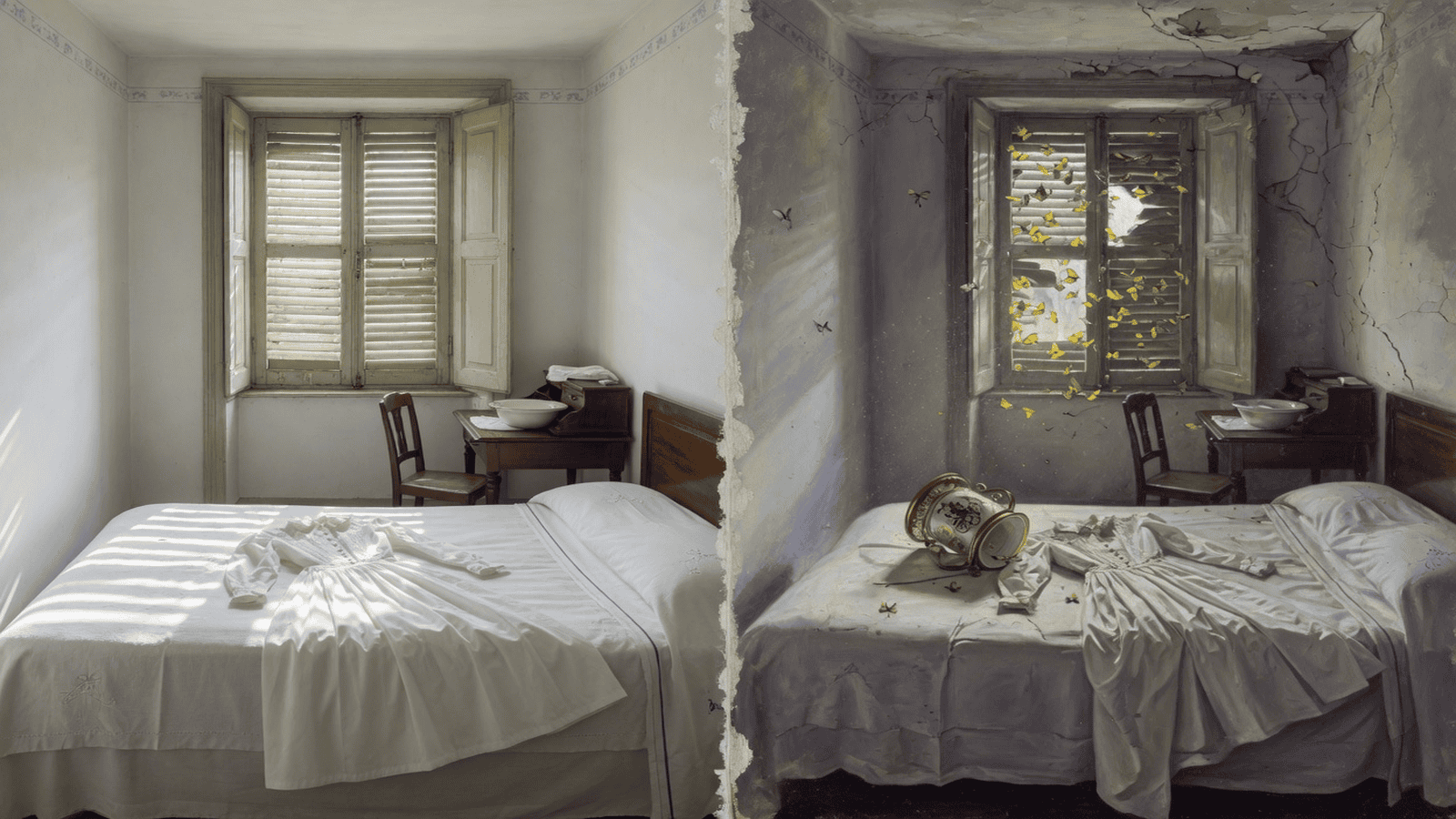
Readers of One Hundred Years of Solitude tend to file Fernanda del Carpio under the unbearable one and move on. It is an understandable reflex and a small act of cowardice, because she is the character in the book whose conduct is most easily defended on paper. She keeps the house clean. She protects the family name. She enforces mourning, decency, schedules, prayer. Almost everything she does can be justified by a principle, and almost everything she does causes damage. Gabriel García Márquez built her as a machine for demonstrating that those two facts are compatible.
I. The Girl Raised to Be a Queen
Fernanda comes down to Macondo from a gloomy highland city of stone and belltowers, from a house where the family fortune had long since been converted into the appearance of a family fortune. She was raised on funeral wreaths and Latin prayers, educated for a throne that no longer existed anywhere on the continent, and sent out into the world with a golden chamber pot bearing the family crest. That object is the whole character in miniature: the most private function of the body, gilded, engraved, and made heraldic.
She was not raised to live. She was raised to represent. When Macondo’s carnival crowns her queen — an accident, a costume, a joke the town is barely paying attention to — she receives it as the confirmation of a destiny. Everything that follows proceeds from a woman who believes her standards are not preferences but offices she has been appointed to.
II. Úrsula’s Order and Fernanda’s
The novel is careful not to let this be an argument against order, because Úrsula Iguarán is the most orderly person in it. She whitewashes walls, keeps accounts, enlarges the house, runs a candy-animal business that funds the family for decades, and in extreme old age navigates the rooms blind by the memory of where everything has always belonged. Two women of discipline, and the disciplines are opposites.
The difference shows up in what each one does with an inconvenient fact. Úrsula absorbs it: bastards, madmen, deserters, lovers, the illegitimate children of men who never came home — the house expands and feeds them. Fernanda removes it from view. She closes the shutters, imposes calendars of abstinence and mourning, forbids the town, and sleeps in a nightgown with a single buttonhole at the waist so that conjugal duty can be performed without either party being visible to the other. Úrsula’s order is maintenance, the kind that keeps a household alive. Fernanda’s is presentation, the kind that keeps a household presentable. On a list of chores the two are indistinguishable. In function they run in opposite directions, and a house that cannot be seen into eventually becomes a house that cannot be lived in.
III. The Vocabulary She Refused to Learn
Fernanda falls ill with something in her womb and begins a correspondence with a circle of invisible doctors who propose to operate on her by telepathy. The comedy is famous. The diagnosis underneath it is not funny at all: she cannot name the organs involved, because the words are indecent, so she invents her own terms and describes her symptoms in a private vocabulary that no physician, visible or otherwise, could act on. She will die rather than say the word.
This is the real cost structure of purity, and it has nothing to do with sex. Every forbidden word marks off a region of reality that has to be handled blind. A code that cannot name a body cannot treat one; a family that cannot name a debt cannot pay it; an institution that cannot name a failure will reorganize around the silence instead of the failure. Fernanda’s father completes the logic from the other end. The crates of Christmas gifts keep arriving on schedule from the highlands long after there is anyone left up there to send them, and the last crate contains his corpse — the appearances maintained right through the death they were supposed to be decorating.
IV. The Butterflies and the Guard
Then there is Meme. Fernanda’s daughter falls in love with Mauricio Babilonia, a mechanic at the banana company who is followed everywhere by yellow butterflies, and Fernanda responds with a sequence of entirely procedural decisions. She confines the girl. She has a guard posted on the roof of the house, on the pretext of a chicken thief. The guard shoots. Mauricio spends the rest of his life paralyzed in a bed, remembered by the town as a thief. Meme is taken to a convent, where she never speaks again. The child born of that love arrives in a basket and is hidden in the old workshop, unnamed and denied, to be raised as a secret in a house that officially contains no such person.
Not one rule is broken in any of this. A mother protects her daughter; a household protects itself against scandal; a guard is posted against theft; a girl is placed in the care of nuns; a child is fed and sheltered. Every step is defensible in the terms of the code, and three lives are destroyed with no sin committed. Judith Shklar’s argument in Ordinary Vices for putting cruelty first among the vices becomes concrete here: a moral system that ranks impropriety above cruelty will generate cruelty efficiently, with a clean conscience, and will experience it from the inside as duty.
V. Dirt Is Matter Out of Place
Mary Douglas, in Purity and Danger, makes the point that dirt is not a substance but a judgment — matter out of place. Shoes are not dirty; shoes on the dining table are. Purity systems are therefore classification systems, and what they defend is the classification rather than anything like hygiene. This explains Fernanda’s disgust better than any account of her piety. Macondo does not offend her by being immoral. It offends her by being unclassifiable: bastards carrying the same names as legitimate sons, four generations of Aurelianos and José Arcadios who refuse to stay in their boxes, a husband whose mistress is a public fact and whose livestock breed better at her house than at his. Fernanda’s project was never virtue. It was taxonomy, enforced on living people.
Erving Goffman’s The Presentation of Self in Everyday Life supplies the other half. Everyone maintains a front region and a back region; the performance is not the pathology. The pathology is believing the front region is the true one and the back region is a contaminant to be eliminated. A household in which nothing is permitted to go backstage has only one way to handle what cannot be staged, and Fernanda uses it: the guard, the convent, the basket in the workshop.
VI. The Type, Not the Monster
What makes her useful is that she is a social type rather than a villain, and the type is everywhere. It is the colleague whose objection to the process is genuinely correct and deployed as a weapon. It is the institution whose rules were written for defensible reasons and are now applied mainly to protect the institution from embarrassment. It is the public argument in which nobody is lying and nobody is being kind. Nietzsche’s suspicion in On the Genealogy of Morals was that the interesting question about a value is not whether it is good but what it is doing and for whom. Fernanda answers that question for the entire history of respectability in a hundred pages, without ever raising her voice.
She outlives nearly everyone she disapproved of. The house she spent her life perfecting is the house from which each of her children departs — one to a seminary he abandons, one to a convent she never leaves, one to Europe — and she dies alone inside the order she built, the shutters closed, the linen immaculate, the crest on the chamber pot still legible. García Márquez never states the argument. He simply keeps the windows shut and lets the reader start wanting air.
Have you seen Fernanda in your organization?
Further reading
- Gabriel García Márquez — One Hundred Years of Solitude
- Judith Shklar — Ordinary Vices
- Mary Douglas — Purity and Danger
- Erving Goffman — The Presentation of Self in Everyday Life
- Friedrich Nietzsche — On the Genealogy of Morals