The modern job is not only a contract for labor. Increasingly, it is a story that has to be kept alive from one day to the next.
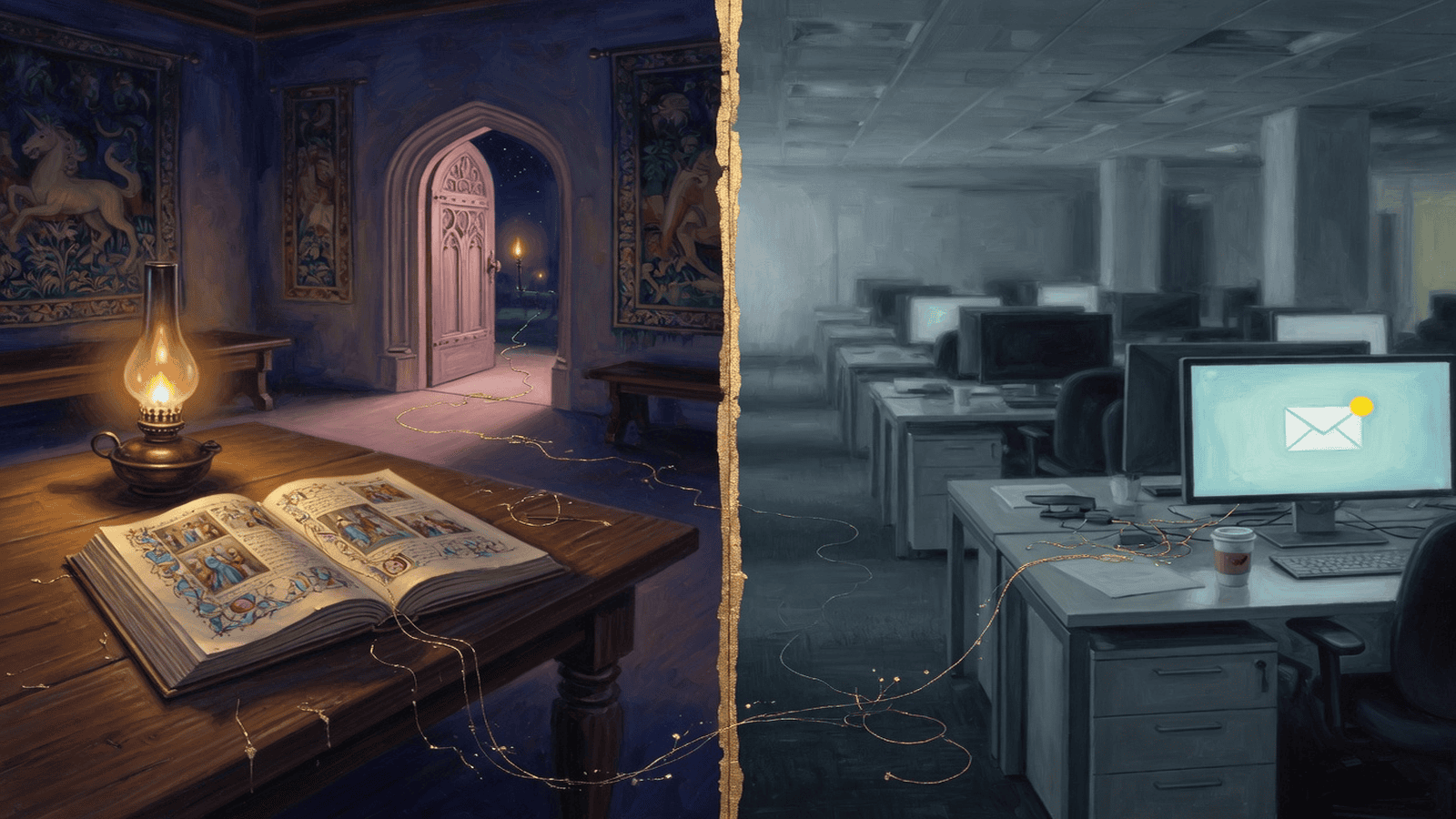
The image is Scheherazade in The Thousand and One Nights. She survives by telling the king a story so compelling that he postpones her execution to hear the ending. The story is never allowed to close. Each night buys another morning. No employee is literally Scheherazade, and a layoff is not an execution — the analogy would collapse if pushed that far. But the structure of uncertainty transfers cleanly: survival depends on keeping an authority interested in a future that has not yet arrived. The new project, the strategic initiative, the quantified productivity gain, the skills acquired in a spare evening, the enthusiastic email to a manager — all of it functions as an installment in the same ongoing narrative. The worker is not merely doing the job. The worker is continuously proving there will still be a reason for the job tomorrow.
I. The Pink Slip as a Suspense Device
The pink slip has stopped belonging to an older industrial imagination — the factory whistle, the foreman with a clipboard. It now arrives as an email that could land at any hour of any day, which means the ordinary workday is contaminated by a second, parallel time: the present task, and the imagined message that could cancel the future built around it. Nobody wants to know what a layoff feels like in the abstract. What they want is to avoid becoming its next case study.
This produces a strange, doubled kind of labor. People maintain the appearance of continuity precisely because interruption is always available as an option to someone else. They preserve optionality, document their own achievements as though building a legal case, cultivate visibility in meetings whose content matters less than their attendance, and try to read a shift in a manager’s tone days before it becomes an announcement. The job becomes partly a performance about the job — not fraudulent, exactly, just aimed at an audience rather than only at the task. None of this describes ordinary ambition, which has never needed defending. Wanting to do good work is not the anxiety in question. The anxiety is that no accumulation of good work can manufacture a stable expectation, because the actual decision may be made elsewhere entirely — in a reorganization, a market correction, an acquisition, a line item on a spreadsheet nobody at the desk in question will ever see.
II. The Postwar Interlude
Underneath the anxiety sits a historical question: did the decades after the Second World War produce a genuine, if uneven, experience of job security that has since eroded? The period should not be romanticized. Its security excluded women, racial minorities, migrants, and informal workers on a scale large enough to make “postwar security” a claim about a subset of the workforce rather than the workforce itself. But for the workers it did include, in much of the industrialized world, the horizon lengthened: a job could support a household, a career could accumulate rather than merely persist, and the future did not require renegotiation every quarter.
Karl Polanyi’s The Great Transformation names the deeper mechanism this interlude briefly restrained: labor treated as a commodity like any other, bought and sold at a price the market sets without regard for the person attached to it — what Polanyi calls a fictitious commodity, since a human being was never actually produced for sale. The postwar settlement wrapped that fiction in enough protection — unions, pensions, the expectation of tenure — that its fictional character stopped being felt day to day. Richard Sennett’s The Corrosion of Character tracks what happened once that wrapping came off: flexible capitalism did not simply reduce job security, it shortened the time horizon over which a person could reasonably plan a life, and in doing so corroded the kind of character — loyalty, patience, a coherent narrative about oneself — that a longer horizon used to make possible. Guy Standing’s The Precariat gives the resulting condition a name and insists it is structural rather than a string of individual misfortunes: a class defined not by low income alone but by the absence of any of the seven forms of labor-related security a stable job once bundled together.
The institution still asks for loyalty. It has simply stopped promising to return it, and increasingly asks the worker to behave as though the relationship were long-term while reserving, quietly, the right to end it without notice. The resulting damage runs deeper than a bank balance. Stable work used to give a person a place in time — the ability to plan five years out without the plan being a fantasy. When that stability disappears, identity, family life, and the basic capacity to imagine a future all become conditional on renewal. A society tolerates difficult work far more easily than it tolerates a population required to audition, indefinitely, for the right to keep going.
III. What “Exacerbating” Means
Say that AI has been exacerbating this condition, and notice the tense: the present perfect continuous. Not a completed event, as if artificial intelligence once made things worse and the episode has closed. Not a simple present fact floating free of time. An action that began earlier, continues now, and produces effects that are already visible. AI may eventually eliminate specific tasks or occupations outright — that debate continues elsewhere — but its nearer effect is narrative and psychological before it is technical. It hands employers a new vocabulary for questioning whether a role is necessary, for comparing a person’s output against an automated alternative, for asking more from fewer people under the cover of a plausible efficiency story. Even before any system replaces anyone in particular, the credible possibility of replacement changes the atmosphere of the room. Every worker is quietly asked to keep demonstrating that their version of the story still contains something a model cannot cheaply produce.
Daron Acemoglu and Simon Johnson’s Power and Progress makes the more precise argument that follows from this: technological change is not automatically shared, and history is full of episodes where a new capability made workers worse off for decades before — if ever — redistributing its gains. The claim worth resisting here is not “AI will destroy all jobs,” which is both too easy and too narrow to be useful. The sharper claim is that AI is entering a labor market that was already organized around chronic uncertainty and intensifying its oldest instrument of management: doubt about whether you are still needed. Technology does not have to cause every dismissal to make employment feel permanently conditional. It only has to make the threat more credible than it already was.
Scheherazade’s own stories eventually change the relation between the teller and the king: the postponement accumulates into a duration long enough that the person who was supposed to be disposable reshapes the future simply by continuing to speak. The modern job market offers no equivalent resolution. A worker can tell an excellent story — deliver, adapt, upskill, exceed every target set for them — and still be let go, because the decision was never really about the story’s quality. The question this raises is political rather than motivational: why should individuals be required to perform endless narrative continuity in order to receive what institutions, within living memory, once treated as an ordinary social expectation?
The honest answer refuses the advice to simply become more adaptable. Adaptability is a genuine skill, worth having. But a society organized around permanent adaptability as a condition of survival has converted insecurity into a virtue and called the conversion freedom. John Maynard Keynes, writing in 1930, imagined that a century of compounding productivity would leave his grandchildren’s generation with the problem of too much leisure and not enough purpose to fill it — a prediction that reads, a century later, as a diagnosis of a road not taken rather than a forecast fulfilled. Hannah Arendt’s The Human Condition distinguishes labor, the endless metabolic activity that keeps a body alive and never finishes, from work and action, which build something durable enough to outlast the maker. The deeper threat AI poses to a fragile arrangement is not that machines might become more capable than people. It is that people will be trained to live as though their own lives were temporary contracts, renewed every night, for an audience that may already have decided to stop listening.
Further reading
- One Thousand and One Nights
- Karl Polanyi — The Great Transformation
- Richard Sennett — The Corrosion of Character
- Guy Standing — The Precariat
- Daron Acemoglu and Simon Johnson — Power and Progress
- Hannah Arendt — The Human Condition
- John Maynard Keynes — “Economic Possibilities for our Grandchildren” (1930)