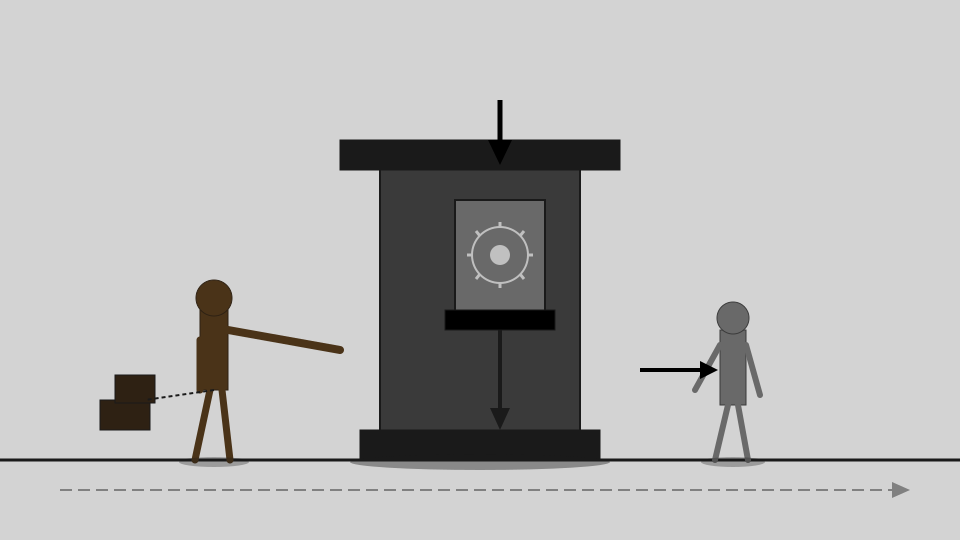
The public imagination tends to place the danger of artificial intelligence at the far end of the scale: autonomous weapons, a machine that surpasses human intelligence, something with a chassis walking down a street. Those scenarios deserve the attention they get. But the first large social shock is more likely to arrive through a route with no cinematic value at all — the ordinary work already performed inside email, spreadsheets, ticket queues, and the small in-house tools that run a modern office.
These tasks are unusually exposed precisely because they are already mediated by software. An agent does not need to solve general intelligence before it can sort a mailbox, reconcile a spreadsheet, fill out a form, move a record between two systems, draft a reply, or execute a workflow it has seen a hundred times. A language model wrapped in a harness turns a sequence of small, legible actions into a service that runs continuously, never asks for a raise, and costs a fraction of an hour of someone’s time. The question that matters is not whether every job disappears. It’s who loses bargaining power first, who ends up supervising an expanding perimeter of automated work instead of doing it, and who keeps the resulting surplus. Optimization can arrive dressed as a feature update while it functions, for the person on the other end of it, exactly like redundancy.
I. The Cinematic Threat and the Administrative One
Terminator stories make AI legible as a danger because they give the transformation a body — something you can point at, something with intent. The administrative version has no body. It shows up as a new integration in the office suite, a browser agent that can now fill out the forms an intern used to fill out, a manager’s quiet observation that the team handles more volume than it used to with two fewer people on it. No single deployment has to look historic. Nobody announces the reorganization of the labor market; it just accumulates, one workflow at a time, under the name of efficiency.
The office is especially exposed because its work is unusually legible. Messages, tickets, spreadsheets, calendars, and records leave traces by default — that’s what office software is for. Once a process can be described clearly enough for a new hire to learn it from a document, it is usually clear enough for a model to attempt, verify against an outcome, and repeat. This isn’t a claim that office work is simple. Much of it depends on judgment, institutional memory, and a kind of responsibility that doesn’t decompose into steps. But automation was never required to reproduce an occupation whole. It only has to strip out enough of the routine layer that fewer people are needed to run what’s left, or that each remaining person is now responsible for the workload that used to belong to three.
II. The Low-Hanging Fruit Is Also the Workforce
“Low-hanging fruit” is a comfortable phrase when it’s describing an efficiency program in a slide deck. It gets more charged once you notice the fruit is somebody’s daily work. A task can be boring and still be the thing that pays someone’s rent, or the credential that gets them taken seriously in a meeting, or the relationship-building excuse that got them a mentor. Boredom has never been a reliable proxy for whether a task is disposable to the person doing it.
Job-seekers carry a second, sharper version of the problem. Entry-level work is usually where someone learns an industry from the inside — not through a course, but through the accumulated small repetitions of doing the routine part badly, then less badly, then well. If the routine layer is automated first, the ladder can disappear before anyone climbs it. An organization can retain its senior decision-makers, whose judgment doesn’t decompose into steps a model can imitate, while quietly closing off the apprenticeship tasks that used to produce more people like them. The résumé that used to say “two years doing the unglamorous part” stops being a résumé anyone writes, because the unglamorous part no longer needs a person.
The plausible outcome isn’t a labor market with less capability in it. It’s one with more capability and a narrower set of entry points into meaningful work — a system that gets more productive while getting harder to get inside. Those gains don’t distribute themselves by default. They follow ownership, bargaining power, regulation, and the story a society tells itself about who is owed a share of a surplus that automation, and not any individual worker, produced.
III. The Politics We Avoid Naming
A society that automates broad categories of administrative labor eventually has to answer questions that get treated, in ordinary conversation, as ideological contamination rather than as questions: who owns the systems doing the producing; how the resulting gains should be shared; what a firm owes the people its own efficiencies made redundant; what a decent life looks like once paid employment is no longer the default mechanism for getting one.
The word “socialist” tends to function as a warning label rather than an argument in these conversations, a way to end the sentence before its logic has to be examined. But some degree of socialization of the gains from automation may turn out to be close to unavoidable, in the same practical sense that some degree of unemployment insurance became unavoidable a century ago once industrial cycles started throwing people out of work faster than markets reabsorbed them. That observation doesn’t settle the institutional answer — a universal basic income, a sovereign wealth-style dividend on automation profits, mandated retraining obligations, a shorter standard workweek, and outright market-driven adaptation are not the same proposal wearing different names, and they have very different implications for who ends up with power. It does mean the debate about AI is going to become a debate about distribution whether or not anyone intends it to, running in parallel to the more publicized debate about capability and safety.
The near-term challenge, then, is less about pinning down the date of some future general intelligence than about noticing what is already automatable this year, in this office, on this team. The future in question doesn’t announce itself with a press release. It shows up as an inbox team of three instead of six, a spreadsheet nobody staffs an analyst against anymore, an internal tool that has quietly absorbed what used to be someone’s first job out of school. The spectacular scenarios matter and deserve the research attention they get. So does the work disappearing while everyone is still watching the horizon for the spectacle.
Further reading
- David Graeber — Bullshit Jobs
- Daron Acemoglu and Simon Johnson — Power and Progress
- Harry Braverman — Labor and Monopoly Capital
- Erik Brynjolfsson, Danielle Li, and Lindsey Raymond — “Generative AI at Work”, NBER Working Paper