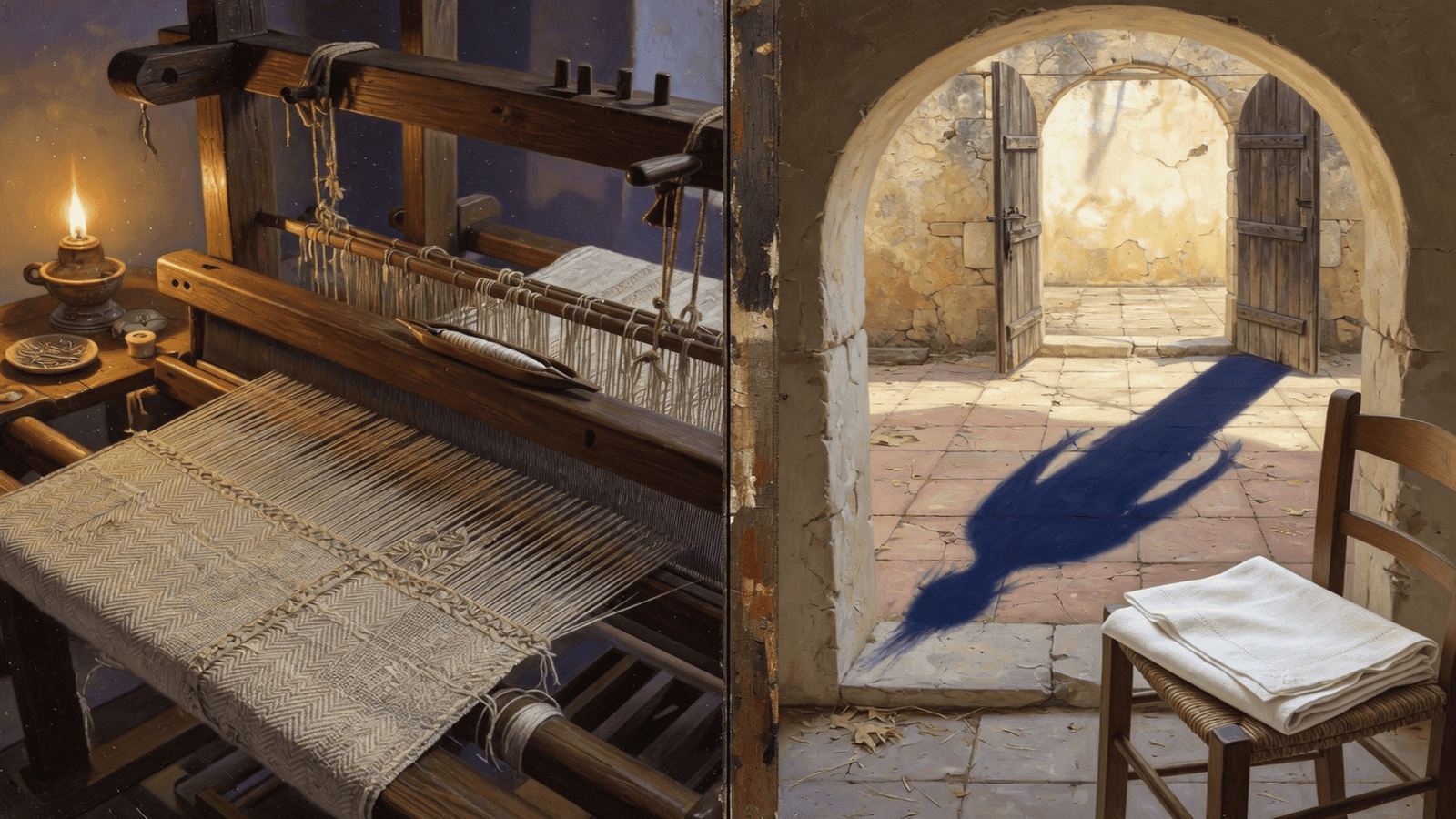
In One Hundred Years of Solitude, Gabriel García Márquez stages one of literature’s strangest domestic visits. Death arrives at Amaranta Buendía’s door not as a specter or a car crash but as a courteous woman with a specific piece of information: Amaranta will die the day she finishes weaving her own shroud. Amaranta does not panic. She weaves by day and unravels her work by night, buying herself time not out of fear but to settle her affairs, and when the cloth is finally allowed to be finished, she bathes, dresses in it, lies down, and dies without drama. The scene is often read as magic for its own sake. It is closer to a thought experiment: what happens to the fear of death when the one variable we assume drives that fear — not knowing when — is removed.
I. Interruption, Not Non-Being
Martin Heidegger’s account of Sein-zum-Tode, Being-towards-death, in Being and Time, treats mortality as our most individual and non-transferable possibility, the one fact about a life that no one else can live through on our behalf. But Heidegger also names the more common posture: death as something that happens to “one,” an abstraction that stays comfortably third-person until it isn’t. What makes that abstraction collapse is rarely the fact of ending. It’s the manner — the sense that the story could stop anywhere, mid-sentence, with the wrong things left unsaid.
Epicurus argued in the Letter to Menoeceus that death is nothing to us, since we do not coexist with it — where we are, it is not, and where it is, we are not. The argument is airtight and almost no one finds it consoling, because it answers a question nobody was actually asking. The dread was never really about the state of non-existence, which by definition can’t be experienced as anything. It was about the interruption: the meeting not attended, the amends not made, the sentence broken off. Amaranta’s shroud doesn’t touch the metaphysics of non-being at all. It solves the interruption instead, by converting an ambush into an appointment. A life with a named ending date is not a shorter life. It’s a life with a period at the end of it instead of a car horn.
II. The Loom as an Instrument of Agency
What makes the scene more than a folk fable about accepting fate is what Amaranta does with the interval. She doesn’t wait. She weaves, and then, at night, alone, she unpicks the day’s work and starts again — not endlessly stalling, but pacing herself against a deadline she has effectively made negotiable within limits she alone controls. The shroud is simultaneously a countdown clock and a craft object, and by holding the needle herself she converts a sentence handed down from outside into a project she is authoring. When she finally lets the cloth be finished, the choice of when remains hers, even though the that was never in question.
Set this against the modern hospital death, where uncertainty is not eliminated but relocated and multiplied — a prognosis revised weekly, a monitor’s alarm standing in for an actual conversation, a family calibrating hope against a number nobody will commit to. Ariès and the literature on the medicalization of dying describe this well: length of life increased, but legibility of one’s own ending often didn’t, and the two are not the same achievement. Amaranta’s arrangement, fictional as it is, names a kind of dignity that has nothing to do with when death comes and everything to do with whether the dying person is the one holding the needle.
III. The Postman for the Dead
Before she dies, Amaranta tells Macondo she’s leaving, and offers to carry letters to whoever the town has already lost. The neighbors line up with notes for parents, spouses, and children on the other side. It’s a small, strange civic service, and it does something no wake or eulogy quite manages: it moves death out of the register of private catastrophe and into the register of a transit everyone eventually takes, with mail service both ways. The fear of death metastasizes in silence — in the collective agreement to talk around it, to schedule the will “eventually,” to let the subject arrive only as emergency. Amaranta’s shroud is public before it’s finished. The town watches her weave.
Ernest Becker’s The Denial of Death describes culture itself as a heroic defense against exactly this silence — the immortality projects, the monuments, the careers built as a bulwark against being forgotten. What Macondo does instead, for one woman, for one season, is smaller and cheaper than a monument: it just lets her say it out loud, and lets the town answer with errands. Terror management theory would predict that naming death should spike anxiety. In the scene, naming it does the opposite, because naming converts a taboo into a task, and tasks are the one thing dread has never known what to do with.
IV. What Certainty Would Actually Cost
None of this proves that a real, universal foreknowledge of one’s death date would be a mercy rather than a life sentence read out at birth. It’s easy to imagine the other version of Amaranta: someone who spends the whole interval unraveling the shroud not to finish her business but to avoid ever finishing it, turning the deadline into the permanent occupation, which is its own kind of paralysis — Michel de Montaigne’s counsel in the Essays, that to philosophize is to learn to die, assumes a practiced relationship with the fact of ending, not a single terrifying appointment dropped on a stranger to the idea. García Márquez doesn’t resolve this either way. He gives Amaranta decades of ordinary life before the visit, and grants her the composure only at the very end, once the letters have been collected and the cloth is finally allowed to close. The relief in the scene was never that death announced itself. It’s that by the time it did, there was nothing left that needed to happen first.
V. The Letters I’d Actually Collect
I’ll admit, without any of Amaranta’s grace, that death doesn’t frighten me much. What I would actually enjoy is the specific administrative satisfaction of her arrangement: knowing the date in advance, and spending the interval the way she spends hers in Macondo — collecting letters, emails, voice notes, whatever anyone wanted carried across to somebody they’d already lost. I’d keep the ledger. I’d take the requests seriously. And then, right before the part where she lies down and dies without drama, I’d break the illusion on purpose: there was never anybody on the other end to deliver any of this to — not because the dead don’t matter, but because they never actually left. Information doesn’t disappear. It just stops being addressed to anyone in particular.
Further reading
- Gabriel García Márquez — One Hundred Years of Solitude
- Martin Heidegger — Being and Time
- Epicurus — Letter to Menoeceus
- Ernest Becker — The Denial of Death
- Michel de Montaigne — Essays