Life becomes thick easily. Not necessarily tragic in the grand, literary sense, and not only through the unmistakable presence of grief, illness, or catastrophe. A week can acquire weight through ordinary accumulation: a body that needs sleep, work that makes a further demand just as another is met, a relationship that contains both refuge and obligation, a decision whose consequences cannot be known until they arrive. The surprise is not that this happens. It is that we keep treating it as evidence that something has gone wrong.
The universe offers no particular reason to expect ease. It is made of appetite and consumption, of time that only moves one way, of space that keeps things apart, and of contingency at every scale. Even the clean strangeness of quantum entanglement is not a consolation: the world is not organized around the human wish for a stable, legible plot. This is not a case for despair, or for announcing, in the voice Milan Kundera lent to the phrase, that existence is unbearable. It is a case for taking seriously the density of being alive.
I. The Cost Hidden in Every Gift
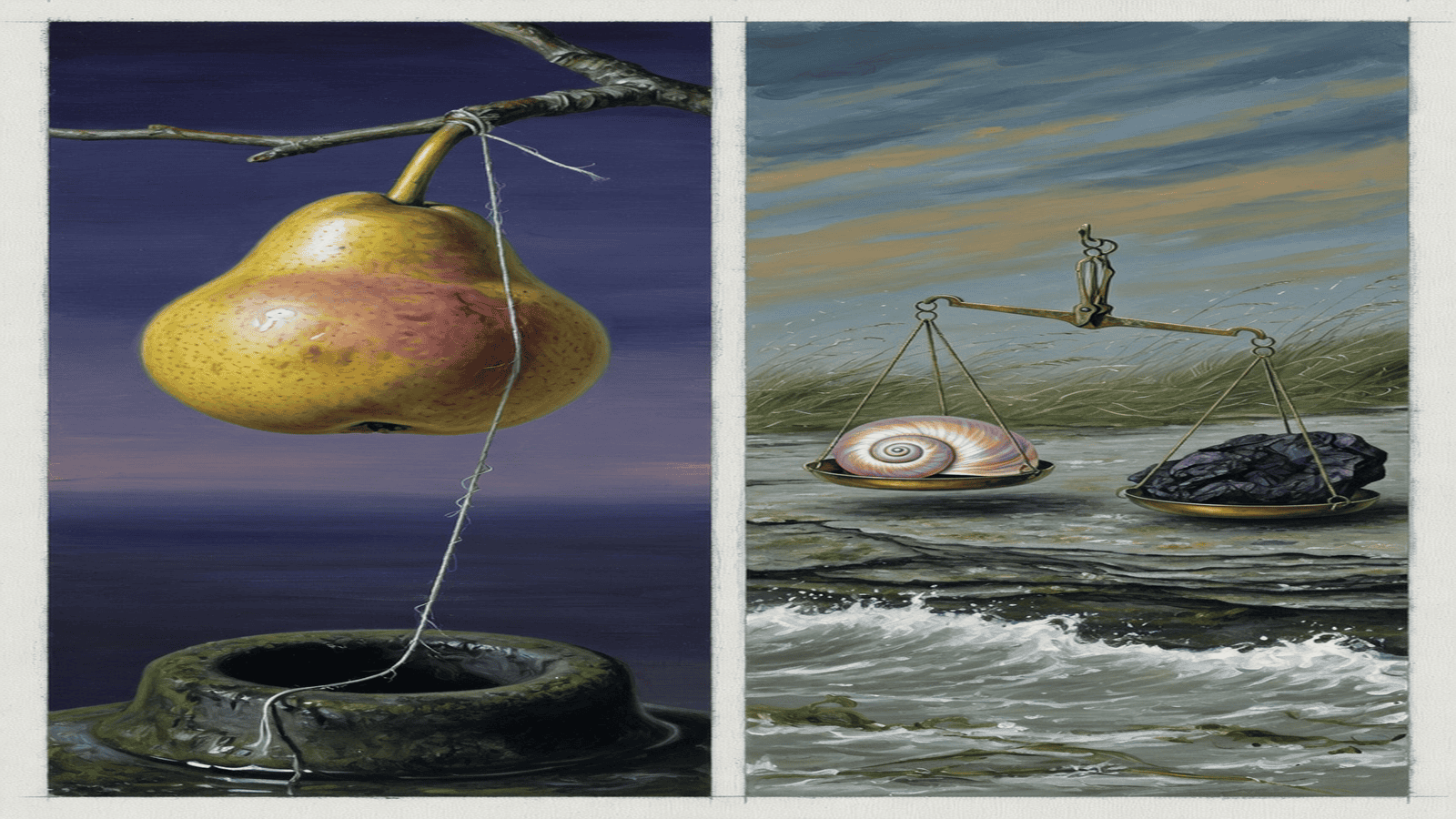
Arthur Schopenhauer’s line, from On the Suffering of the World, that life is “a business whose returns are far from sufficient to cover its expenses,” is useful precisely because it is too severe to be adopted whole. It notices a real ledger: every good thing has demands attached to it. Love makes a person vulnerable to loss. Ambition provides direction and invents new disappointments. Attention deepens pleasure and also increases the capacity to be wounded. To call these relationships contradictions is not quite right. They are closer to inseparable terms. The blessing and the burden are often the same fact viewed at different times.
Ralph Waldo Emerson’s account of compensation, in his essay of that name in Essays: First Series, offers a less terminal frame. He wrote, elsewhere, in The Conduct of Life, that “great men, great nations, have not been boasters and buffoons, but perceivers of the terror of life, and have manned themselves to face it.” His work does not promise that every loss is secretly repaid. It insists instead that power and limitation, gain and obligation, action and consequence belong to the same field. Read against his companion essays “Fate” and “Illusions,” compensation is not a motivational law of equal exchange — a coin returned for every coin spent. It is closer to an account of antagonism: every force in nature meets an opposing force, and a life is the record of that meeting, not a settlement of it. The point is not to turn suffering into a moral lesson, but to abandon the fantasy that a life without costs was ever on offer.
II. The Cruel Education of Desire
Patrick Süskind’s Perfume can serve as the grotesque extreme. Jean-Baptiste Grenouille’s extraordinary sense of smell grants him a world of overwhelming richness, while isolating him from the ordinary human world it might have made more beautiful. The novel refuses the comforting idea that intensified perception is uncomplicatedly a gift. Grenouille does not suffer from a deficit; he suffers from an excess that no one around him shares, and the isolation is the direct cost of the capacity, not an unrelated misfortune that happens to accompany it. The book also cautions against a false solution to heaviness: controlling every variable, acquiring the perfect object, engineering a life that will no longer resist us. Desire does not become harmless when it succeeds.
The contemporary version of this false solution is emotional accounting. We want to know whether an event is positive or negative before it has had time to become anything. A promotion, a move, an illness, a new obligation: each is immediately sorted, announced, and defended. But many of the important events in a life cannot honestly be scored at the moment they occur. Their meaning changes as they meet other events. The demand for an instant verdict adds a second and avoidable burden to the first.
III. Affliction Is Not the Same as Difficulty
Simone Weil drew a distinction worth preserving here, in essays like “The Love of God and Affliction”: ordinary suffering and malheur — affliction — are not the same register. Affliction, for Weil, seizes the soul itself and makes a person feel abandoned even by the possibility of meaning. Most of the heaviness discussed above is not that. It is the friction of finite creatures meeting a world that does not defer to them. Naming the difference matters, because collapsing every difficulty into catastrophe cheapens the word for the cases that deserve it, and inflating every friction into affliction is its own kind of dishonesty.
William James proposed a different resource in “The Gospel of Relaxation” and in his writing on habit and will: the “strenuous mood,” a mode of engagement that meets difficulty by rising to meet it rather than by first calculating whether the difficulty is fair. The Stoics kept a related distinction alive between acceptance and resignation. To accept a cost is to see it clearly and still act; to resign oneself is to stop expecting anything from action at all. The first keeps a person in the field. The second removes them from it while leaving the body behind.
IV. Taming the Expectation of Lightness
To tame expectations is not to become numb, pessimistic, or grateful for what hurts. It is to stop treating difficulty as a breach of contract. A life can be accepted as dual — cost and gift as the same fact — without making a cult of suffering. The practical posture is neither optimism nor negativity but readiness: make room for impact, because impact is the price of contact with a world that is real.
None of this forecloses the harder question of when a cost stops being the ordinary price of being alive and starts being a condition that should be resisted or repaired. Weil’s distinction helps here too: the friction of finite existence is not the same thing as an arrangement — a wage, a law, a relationship — built to extract more than it returns. Accepting the first is wisdom. Accepting the second by mistake is what the demand for lightness, ironically, makes easier to do, because a person exhausted by pretending everything should be effortless has less energy left to ask which costs were never fair to begin with.
The question, then, is not how to become invulnerable, nor how to spin every blow into a benefit. It is how to keep one’s judgment supple enough to carry both terms at once: fortune and its bill, terror and attachment, pleasure and the risk that gives it depth.
Further reading
- Arthur Schopenhauer — On the Suffering of the World
- Ralph Waldo Emerson — Essays: First and Second Series (including “Compensation,” “Fate,” and “Illusions”)
- Ralph Waldo Emerson — The Conduct of Life
- Patrick Süskind — Perfume: The Story of a Murderer
- Simone Weil — Gravity and Grace
- William James — Essays on Faith and Morals (including “The Gospel of Relaxation”)
- Milan Kundera — The Unbearable Lightness of Being