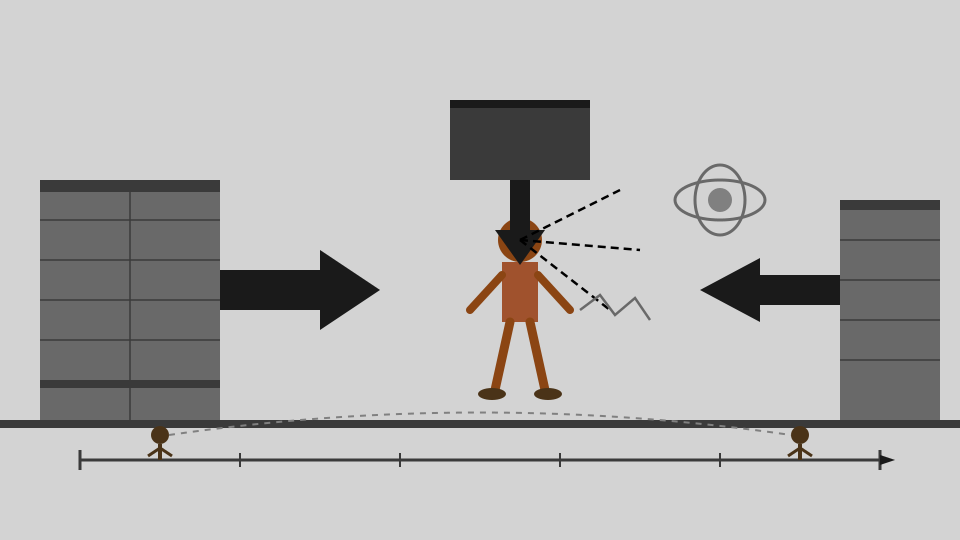
We speak about cortisol as if it were a contaminant: the chemical residue of a bad life, the hormone responsible for belly fat, insomnia, anxiety, and the general collapse of modern existence. The language is too simple. Cortisol is not an invader. It is one of the oldest emergency systems in the body, an evolutionary gift that helped an animal survive the moment when survival became uncertain. Somewhere in that inheritance is the plain fact that someone, somewhere, was not eaten by a tiger.
The problem is not that the system exists. The problem is that we have built an environment that keeps pressing the alarm button without providing the event that would end the alarm.
I. The Hormone That Buys a Chance
A predator appears and the body has no time for a committee meeting. The stress response increases vigilance, mobilizes energy, changes cardiovascular tone, and temporarily rearranges which functions deserve resources. Cortisol is part of that response. It helps maintain blood glucose by encouraging the liver to make glucose and by reducing glucose uptake in some peripheral tissues; it also makes the effects of adrenaline and glucagon more effective. It is not the whole emergency response, but it helps make the body ready for exertion, attention, injury, and uncertainty.
That is not a defect. A body that could not interrupt digestion, free energy, sharpen attention, and dampen excessive inflammation when a predator arrived would not have left many descendants. Calling cortisol “bad” because chronic excess damages the body is like calling a fire extinguisher bad because a building with a permanent leak is full of water. The duration and context change the meaning of the tool.
II. The Tiger Became a Notification
The ancestral emergency had an ending. Either the tiger was escaped, fought, or it ate someone else. The body could return toward baseline. Modern threats are different because they are abstract, recurrent, and designed to remain unresolved. A notification implies an unanswered demand. A performance review can affect rent months from now. A layoff rumor threatens food without presenting a visible opponent. FOMO turns other people’s lives into a permanent stream of possible losses. The fear of losing a job, a house, a reputation, or one’s place in the group is not imaginary, but neither is it a tiger that can be outrun in ten seconds.
We have made survival into a continuous game. The rules are revised while we play, the scoreboard is public, and the game has no final whistle. The body keeps receiving signals that something important may be taken away. Cortisol is then blamed for obeying those signals — the central reversal being that the hormone is not malfunctioning merely because the environment keeps asking it to prepare for danger. The modern economy has turned old survival machinery into a subscription service.
III. Useful in a Crisis, Expensive as a Climate
Cortisol is adaptive in pulses and costly as a climate. Acute elevation can support attention and energy availability; sustained excess can interfere with sleep, immunity, glucose regulation, muscle and bone maintenance, mood, and cognition — the distinction Bruce McEwen called allostatic load, the price paid when a system built for short bursts of adaptation is left running. The same mechanisms that are useful for getting through a crisis become destructive when recovery never arrives.
The belly fat blamed on cortisol has a specific, traceable mechanism, and it is worth naming precisely rather than gesturing at. Visceral fat — the fat wrapped around the abdominal organs rather than sitting under the skin — carries a denser concentration of glucocorticoid receptors than subcutaneous fat does, so it responds more strongly to circulating cortisol. Chronic elevation increases lipoprotein lipase activity in that depot, favoring fat storage there, while the insulin resistance that sustained cortisol also promotes makes the same fat harder to mobilize once stored. The result is a body that, under prolonged stress, preferentially banks fat centrally and holds onto it. None of that makes cortisol the villain; a single stress pulse does not build a waistline. It is the same argument as before, applied to one tissue: the mechanism is adaptive when it activates and resolves, and pathological only when the alarm that triggers it never turns off.
This is why “reduce cortisol” is an incomplete instruction. The body does not need a life without stress. It needs stress with a return path. Exercise can raise cortisol and still be beneficial because the stressor is bounded and followed by recovery. A difficult conversation can mobilize the body and then end. A workday, by contrast, may contain dozens of small alarms, each one too minor to justify escape but too persistent to permit full quiet. The question is not whether cortisol rose. The question is whether the organism was allowed to finish the sentence.
IV. The Spoons of Sugar That Are Not There
A popular explanation says that an average person’s cortisol production can be translated into several teaspoons of sugar. This should not be repeated as a physiological fact. Cortisol is a steroid hormone, measured in mass or concentration; sugar is a metabolic fuel, measured in grams. There is no standard conversion between the two, because cortisol does not become sugar in a fixed, spoon-countable quantity.
What can be said precisely is more interesting. Healthy adults produce approximately 8–30 mg of cortisol per day. Cortisol helps raise blood glucose by stimulating hepatic gluconeogenesis and reducing glucose uptake in some tissues — one of the permissive and preparative actions Robert Sapolsky and colleagues catalogued in their review of glucocorticoid function. That is glucose mobilization, not a quantity of sugar contained inside the cortisol. The amount mobilized depends on the person, the stressor, exercise, fasting, insulin, glycogen stores, timing, and many other variables. A teaspoon-of-sugar comparison may work as a visual metaphor for available energy, but it has no universal numerical answer.
The correction matters because the bad metaphor smuggles in the bad moral: cortisol is a toxic pile of sugar accumulating in the body. The better image is a logistics officer opening fuel reserves during an emergency. The officer becomes dangerous when the emergency channel never closes, not because logistics was a mistake.
V. Who Keeps the Alarm On?
There is an individual question here: how much of the alarm is generated by interpretation, anticipation, and compulsive comparison? There is also an institutional question: who benefits from a population that remains slightly afraid? Platforms monetize vigilance. Employers can turn insecurity into availability. Markets convert the fear of losing goods into recurring consumption. Social systems make belonging contingent on performance and then describe exhaustion as a personal failure of regulation.
“Your cortisol is high” can become the wellness industry’s version of “your character is weak”: a biological diagnosis that quietly returns the entire burden to the individual. Meditation may help. Sleep may help. Exercise may help. But none of those facts should make the surrounding architecture disappear. Sometimes the tiger is not in the nervous system. Sometimes it is in the terms of employment, the rent, the feed, or the threat that never resolves because someone else profits from keeping it alive.
Cortisol deserves neither worship nor blame. It deserves a better environment: real dangers that end, effort that has a visible object, rest that is not another performance, and a social world in which losing one possession does not feel equivalent to losing survival itself.
Further reading
- Physiology, Cortisol — clinical overview of cortisol production, circadian rhythm, glucose metabolism, and immune effects
- Robert M. Sapolsky, Lewis M. Romero & Allan U. Munck — How do glucocorticoids influence stress responses? — Endocrine Reviews, 2000
- Bruce S. McEwen — Allostasis and allostatic load: implications for neuropsychopharmacology — Neuropsychopharmacology, 2000