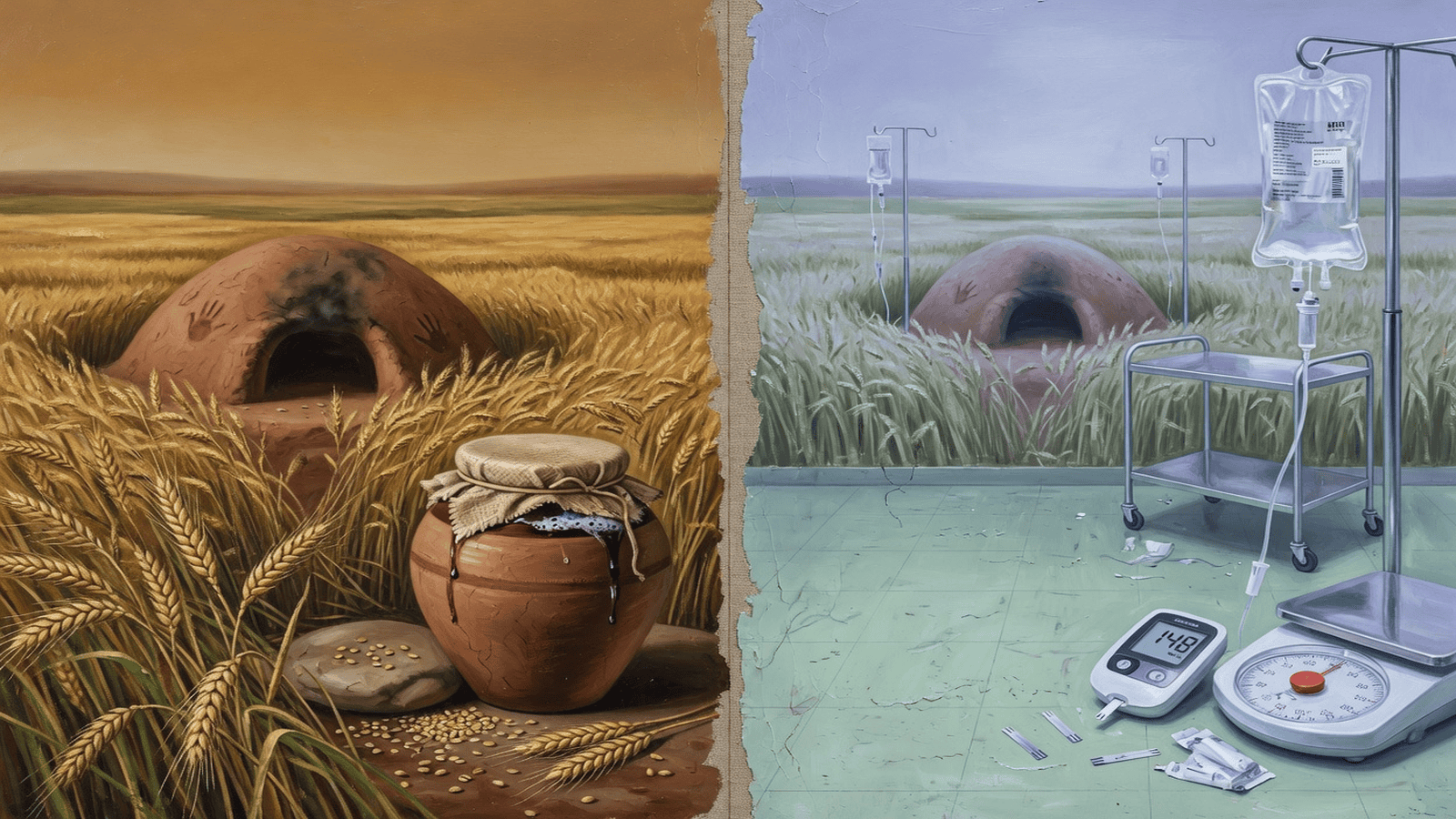
Agriculture is the oldest technology we never stopped using. Ten thousand years after the first cultivated grain, we still eat bread, still ferment wine, still brew beer — the same three inventions that let hunter-gatherers become villagers, villagers become cities, and cities become empires. It is tempting to call this progress and move on. But a civilization built on a handful of domesticated grasses has also produced, at a scale our ancestors never approached, obesity, chronic inflammation, insulin resistance, metabolic syndrome, and a mental health crisis that abundance was supposed to prevent. Ten millennia is long enough to ask a blunt question: did we learn anything, or did we just get better at building the trap?
I. The First Bargain
The Neolithic Revolution was not a single insight but a slow trade. Grain calories bought population density, storage, and hierarchy, at the cost of height, tooth quality, and disease exposure that skeletal records still show — a decline in stature and health so consistent across early farming populations that some archaeologists have called the transition to agriculture humanity’s worst mistake, even as it made everything that followed possible. Dental caries is the clearest single marker of the trade: pre-agricultural skeletons show cavity rates in the low single digits, and populations that adopted starch-heavy grain diets show rates several times higher, sometimes affecting most adult teeth. The mechanism is fermentation happening twice — once in the vat, once in the mouth. Streptococcus mutans and its neighbors in dental plaque ferment the same fermentable carbohydrates that make bread rise and beer intoxicating, excreting acid that dissolves enamel on contact; a diet of tough roots, fibrous plants, and lean game gave those bacteria little to work with, while milled grain, sugared with time as agriculture layered honey, fruit, and eventually cane and beet sugar onto the base carbohydrate, gave them a permanent, self-renewing supply. Bread was the first processed food: wild grass seed, milled and cooked into something denser, faster to eat, and easier to overconsume than anything a forager could gather in the same hour. Beer may be older than bread, or the same invention seen twice — fermentation turning surplus grain into a caloric, mood-altering liquid that could be stored, traded, and taxed. Wine did the same for the vine. All three outlived the empires that depended on them, because the underlying trade never stopped being profitable: energy density and shelf life, purchased with metabolic load.
That bargain was worth making. It is still worth making. The question is not whether agriculture should be undone — it cannot be, and no one who has known famine would ask it to be — but whether ten thousand years have taught us how to renegotiate the terms.
II. The Diseases of Surplus
For most of that history, the constraint on bread, wine, and beer was scarcity. Grain took labor to grow, mill, and ferment; calories from it were valuable precisely because they were hard to get. The industrial and then digital economy removed that constraint almost completely. What remains is a body still tuned to treat dense, fermentable, quickly digested calories as rare and worth pursuing, now facing a supply that is neither rare nor limited by effort — the same mismatch evolutionary medicine describes across dozens of modern conditions.
The resulting diseases are not exotic. Obesity and insulin resistance are what happens when a metabolism built for intermittent surplus meets permanent surplus. Chronic low-grade inflammation is what happens when that same system runs in a state of constant, mild overload for decades instead of days. Mental health decline tracks a parallel mismatch: sleep compressed by artificial light and screens, stress that no longer resolves through physical exertion or resolution, and social bonds thinned by density without proximity. None of this required a new invention. It required ten thousand years of refining the same one until scarcity, its only natural brake, disappeared.
III. Did We Learn Anything?
Ten thousand years produced enormous knowledge about growing food and almost none, until recently, about what continuous abundance does to a human body. Agriculture solved the problem it was built to solve — reliable calories — so thoroughly that the problem it created, chronic overconsumption without corresponding effort, stress, or sleep, is barely a century old as a mass phenomenon. We are not being killed by bread, wine, or beer themselves. We are being killed, slowly and statistically, by an environment where those inventions face no counterweight: no scarcity, no required labor, no enforced rest, no dense kin network to notice when something is wrong.
The honest answer is that we did learn something, just not fast enough, and not evenly. We know, now, with more precision than any prior generation, which levers matter: sleep, stress regulation, nutrition quality, and social connection. What we have not learned is how to want those things as urgently as we want the bread.
IV. The Unglamorous Fix
The proposed solution to a ten-thousand-year-old problem is almost insultingly plain: sleep enough, carry less chronic stress, eat food that resembles food, and maintain real social bonds. None of this is a new discovery. It is closer to a rediscovery of the conditions under which the original bargain was tolerable — effort, rest, and community were built into daily life before they had to be reintroduced as advice, the same argument Michael Pollan made about food that resembles food rather than food-like industrial products. The difficulty is not identifying the fix. It is that bread, wine, and beer are cheap, fast, and pleasurable, while sleep, stress reduction, real food, and social practice are slow, effortful, and unmonetizable at the same scale.
Civilization’s oldest invention bought us density and permanence. Its long-delayed side effects are now the leading causes of death in the societies that succeeded most completely at using it. Whether that counts as learning something depends on whether the next few decades close the gap between what we know and what we do — or whether we spend another ten thousand years discovering the same lesson one epidemiological study at a time.
Further reading
- Randolph Nesse & George Williams — Why We Get Sick (1994)
- Michael Pollan — In Defense of Food (2008)
- Jared Diamond — The Worst Mistake in the History of the Human Race — Discover, 1987