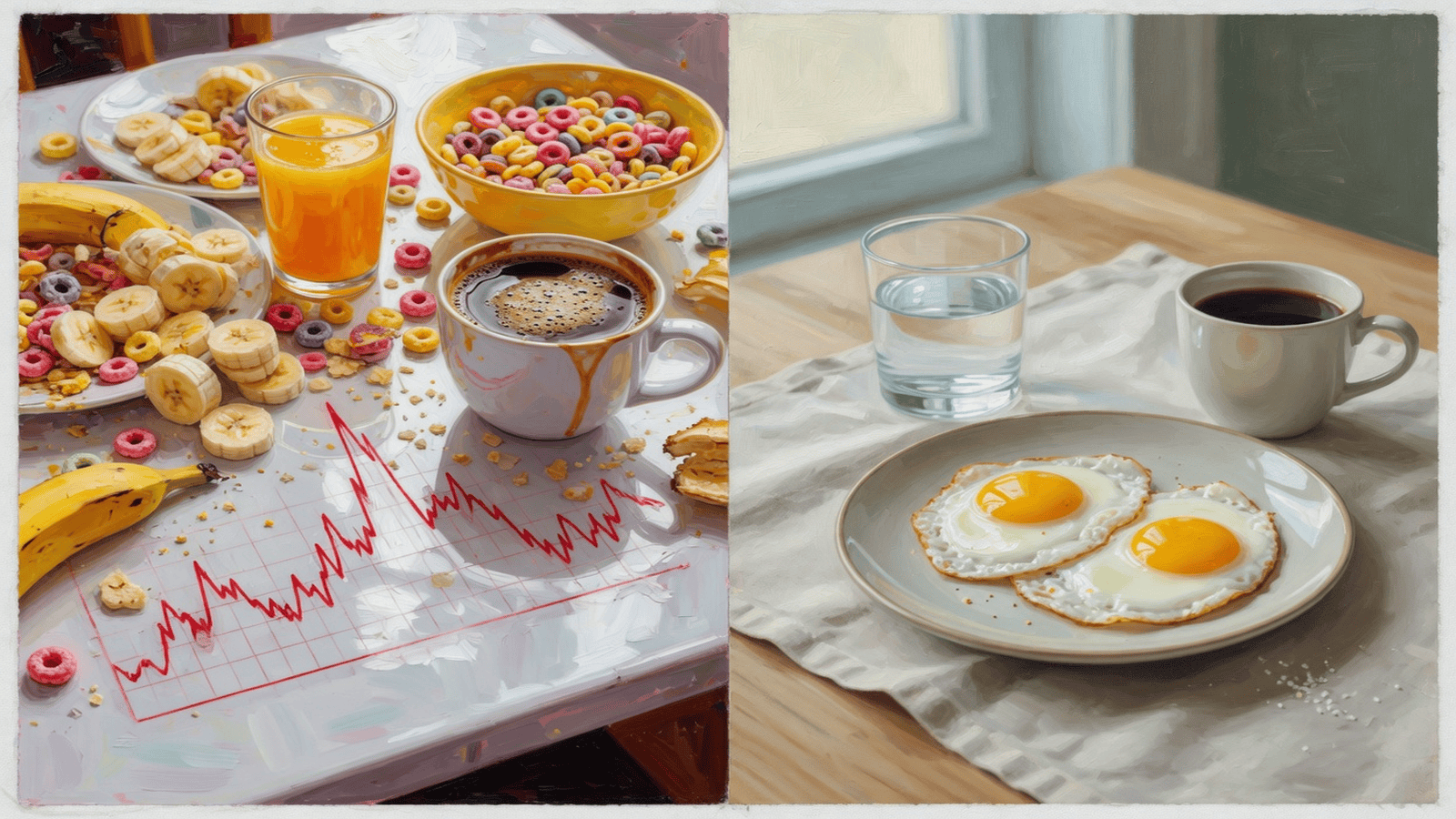
I keep calling it “healthy” out of habit. A banana, a bowl of cereal with a reassuring claim printed on the box, coffee sweetened once with sugar and once more with an artificial sweetener for good measure, a glass of orange juice because it looks like the vitamin section of the meal. Nothing on that table would fail a food pyramid inspection from 1995. And it destroys me in real time — not morally, metabolically. An hour after eating it I am foggier than before I ate, hungrier than I was on an empty stomach, reaching for something else before ten o’clock. The problem was never that I lacked discipline at that table. The problem is that the table was never mine to control. It was built to move fast, and speed is exactly what it delivers.
I. Borrowed Energy
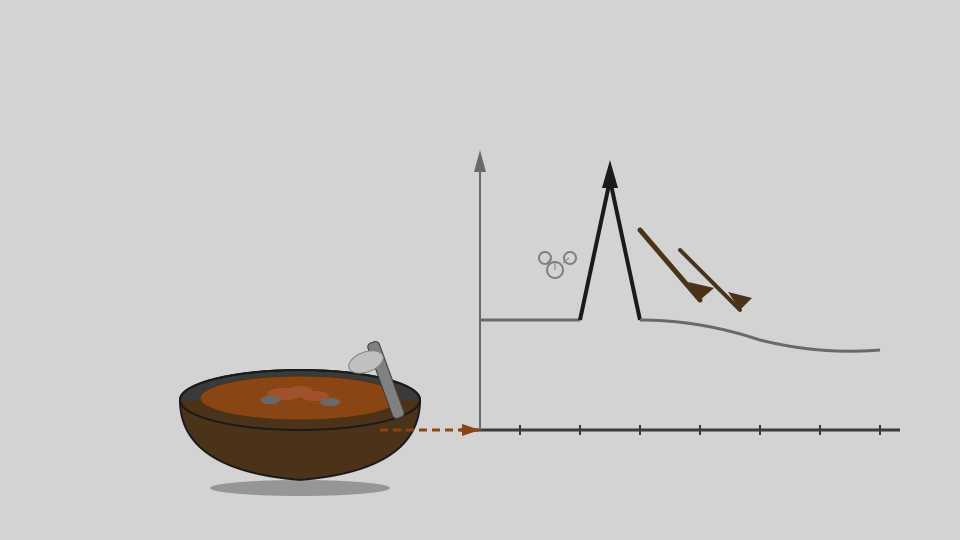
Every item on that plate shares one property: a short path from mouth to bloodstream. Fructose, sucrose, refined starch, and liquid fruit sugar all clear digestion quickly, and the body answers a fast glucose rise with a fast insulin response — the hormone whose job is to clear that sugar from the blood as efficiently as possible, mostly by pushing it into storage. David Ludwig, the Boston endocrinologist who has spent decades studying the glycemic response to breakfast specifically, found that meals built around fast carbohydrates produce a sharper insulin surge and a deeper glucose trough ninety minutes later than meals of equal calories built around protein and fat — and that trough is what the body reads as hunger, showing up as increased food intake for the rest of the day, not as satisfaction earned. What gets called “energy” in a banana-and-cereal breakfast is a withdrawal against an account that comes due before lunch. This is the same insulin story this blog has told at the level of chronic disease — the inflammatory cascade, the fatty liver, the decades-long drift into insulin resistance — playing out here in miniature, one morning at a time, small enough to miss and frequent enough to matter.
II. A Health Food, Hijacked
The strange part is that breakfast cereal was invented as the opposite of what it became. John Harvey Kellogg developed corn flakes at the Battle Creek Sanitarium in the 1890s as a deliberately bland food, part of a broader program of dietary austerity meant to calm the body rather than excite it. Sugar was not the point. Sugar was the thing competitors added once they realized bland did not sell, and the history of the modern breakfast cereal is largely the history of that reversal — a food invented to restrain appetite remade, box by box, into a device engineered to spike it, while keeping every visual signal of virtue: the bran illustration, the vitamin panel, the whole grain claim in the corner. The reversal had institutional help. A 2016 analysis in JAMA Internal Medicine by Cristin Kearns and colleagues documents how the sugar industry funded a literature review in the 1960s that steered decades of nutrition science toward blaming fat for coronary heart disease, buying sugar the very cover under which it now sits, unbothered, at the center of the standard American breakfast. The box still speaks the language of care. It has for over a century. What it is delivering has changed twice.
III. Sequence, Not Purity
None of this makes eggs a virtue or fructose a vice. Randolph Nesse and George Williams framed the body’s trade-offs as products of selection, not comfort, and the honest version of this argument is a trade-off, not a morality play: fruit sugar inside fruit, wrapped in fiber and water, behaves differently than the same sugar isolated into juice, and starch inside a whole grain behaves differently than starch stripped and puffed into a cereal flake, and none of that requires demonizing sugar as a category. What changes the outcome is what arrives first. Protein and fat slow gastric emptying and blunt the glucose curve of whatever follows, which is most of what makes a protein-forward breakfast metabolically boring in the good sense — no crash scheduled two hours out. David Raubenheimer and Stephen Simpson’s research on the “protein leverage” effect adds the appetite side of the same mechanism: across species, animals eat until a protein target is met, not until a calorie target is met, so a low-protein, fast-carbohydrate breakfast tends to under-satisfy on the one macronutrient that actually turns hunger off, guaranteeing the search for more food continues. Eggs are not medicine. They are simply first in line, and being first in line changes what the next four hours feel like.
IV. The First Vote
I do not think this is a case for demonizing fruit or worshiping one food, and I am suspicious of anyone who turns a breakfast plate into a purity test. It is a case for sequence and proportion: less sugar arriving first, more protein arriving before it, fewer liquids standing in for meals, and less trust extended automatically to the word “healthy” printed on a box that has already changed its meaning twice this century. The breakfast that wrecks me is not wrecking me because I lack willpower at nine in the morning. It is wrecking me because the sequence was decided before I sat down — by a sanitarium reformer, by a sugar lobby, by a marketing department, by habit inherited from all three. If breakfast really is the first vote of the day, the only thing worth changing is who gets to cast it.
Further reading
- David Ludwig — Always Hungry?: Conquer Cravings, Retrain Your Fat Cells, and Lose Weight Permanently (2016)
- Randolph M. Nesse & George C. Williams — Why We Get Sick (1994)
- David Raubenheimer & Stephen Simpson — Eat Like the Animals (2020)
- Cristin E. Kearns, Laura A. Schmidt, Stanton A. Glantz — Sugar Industry and Coronary Heart Disease Research: A Historical Analysis of Internal Industry Documents, JAMA Internal Medicine (2016)
- John Harvey Kellogg — Wikipedia
- Breakfast cereal — Wikipedia, history section