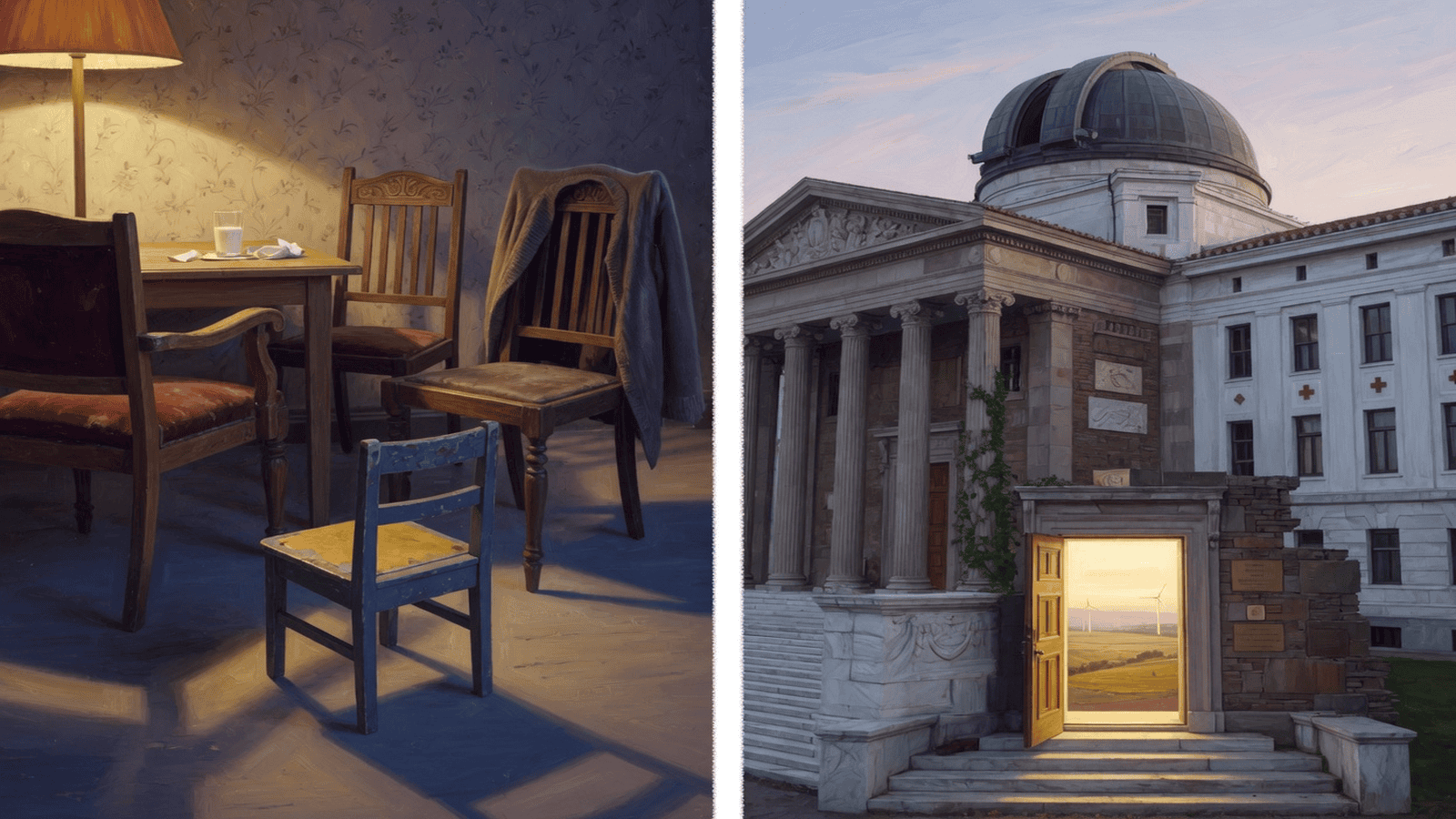
Do we ever stop asking our parents to save us, or do we only learn to rename them? God, government, medicine, science, the market, the institution, the expert: each can become a larger parent when invoked not as a tool for understanding or coordination but as an imagined adult who will absorb the consequences of our fear. The vocabulary changes — providence, policy, diagnosis, evidence, growth — but the plea underneath can stay remarkably intimate: someone bigger should come and make the danger go away.
I. The Child Hidden in the Invocation
There is a difference between asking an institution to do the work it was built to do and asking it to remove the condition of being human. A government can coordinate a response to a flood; it cannot abolish vulnerability. Science can tell us what is happening and which interventions are likely to work; it cannot decide what a life is for. Sigmund Freud diagnosed the underlying mechanism in The Future of an Illusion: religion, he argued, survives because it repeats in adulthood the child’s oldest bargain, trading submission to an all-powerful father for protection against a nature that owes us nothing. Freud aimed the argument at religion specifically, but the bargain is not proprietary to it. It reappears wherever a request for coordination quietly becomes a request for rescue — wherever we ask for evidence, then demand certainty; ask for public administration, then demand exemption from consequence.
II. Mother and Father as Two Kinds of Authority
The parental metaphor has at least two poles. The mother is imagined as the one who contains fear, feeds us, forgives us, and makes the world emotionally survivable. The father is imagined as the one who imposes order, draws the boundary, punishes the threat, and tells us what counts as real. Actual parents rarely sort this cleanly, but cultures keep reproducing the pair because it gives anxiety a grammar. Religion often carries both figures at once: shelter and judgment, mercy and law. The state can become either the benevolent provider or the punitive patriarch. Science is usually cast as the father — cold, objective, final — but in moments of panic it gets recruited as the mother too, asked to reassure us that the diagnosis or the forecast will make uncertainty disappear.
III. The Rescue That Makes Us Smaller
Erich Fromm named the trade at the center of this in Escape from Freedom: modern freedom is isolating, and isolation is frightening enough that people will surrender it to an authority that promises belonging and certainty in return. If the government is responsible for every danger, citizenship becomes complaint. If science is responsible for every decision, judgment becomes citation. If God is responsible for every outcome, faith becomes a demand for exemption from contingency. This is not an argument for rugged individualism — no adult is self-sufficient, and much of civilization runs on functional dependence: hospitals, schools, laws, mutual aid. The question is whether a given dependence enlarges capacity or replaces it. Good care returns a person to the world with more agency. Bad care makes the person grateful for the cage because the cage has been decorated as protection.
IV. What Pink Floyd Gets Right
Pink Floyd’s “Mother”, from The Wall, names this return with unusual bluntness. The song is not a caricature of an overprotective parent; it is about the point where protection and imprisonment become indistinguishable, because the mother’s voice can sincerely believe that surveillance is care and that the world outside is too dangerous to meet directly. Alice Miller documented the same confusion at scale in For Your Own Good, tracing what she called “poisonous pedagogy” — a child-rearing tradition in which obedience is taught as love and control is taught as concern, so thoroughly that the adult who emerges from it cannot easily tell the two apart in any institution that speaks the same way. That is why the pattern scales so cleanly from family to nation: power becomes most durable when it can describe its restrictions as an expression of concern, and most people are not merely weak for accepting the description — they are preserving a relationship with the authority that first taught them what safety meant.
V. Growing Up Without Becoming Alone
Maturity cannot mean eliminating every parent-shaped structure. It means seeing what each structure can and cannot do. Science can discipline belief without becoming a priesthood. Government can organize common action without becoming a household head. Religion can offer meaning without pretending to control events. The adult task is not to stop needing others; it is to stop confusing need with surrender — to ask to be held without asking to be infantilized, to ask for rules without asking to be absolved, to ask for knowledge without asking it to become fate.
Perhaps we keep returning to mother and father because they are the first names we gave to an unbearable fact: the world is larger than our power, and somebody else seems to know how to stand inside it. The work of adulthood is to keep the knowledge that we are dependent while giving up the fantasy that dependence can make us innocent.
Further reading
- Sigmund Freud — The Future of an Illusion (1927)
- Erich Fromm — Escape from Freedom (1941)
- Alice Miller — For Your Own Good (1980)
- Pink Floyd — Mother, from The Wall (1979)