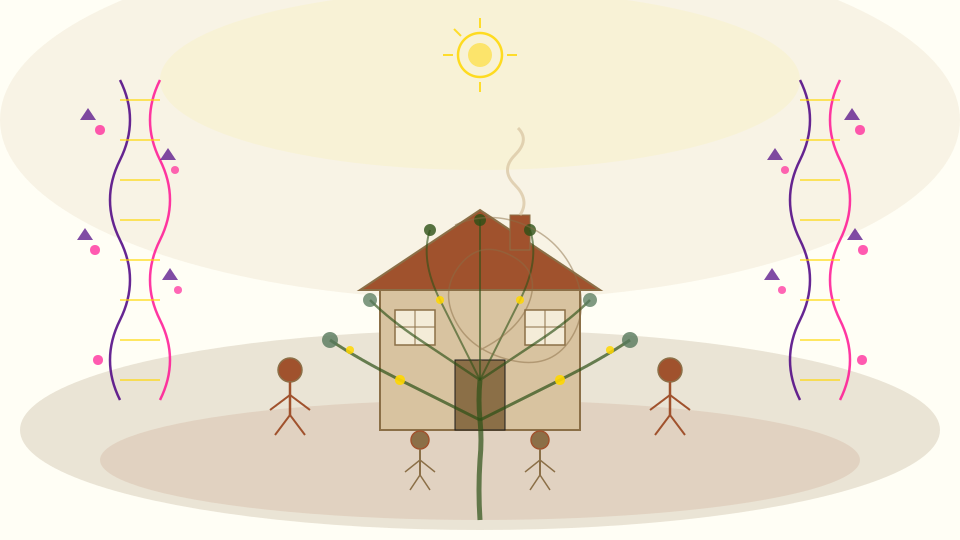
“It’s in my DNA” has become the all-purpose explanation for anything that repeats across a family or a civilization: a talent, a temperament, a taste for bread and wine, a tendency to slip on the same wet bar of soap three generations running. The phrase borrows the authority of genetics to describe something that is usually just a stable environment, a copied habit, or an unexamined tradition, and the borrowing is not innocent. Calling a pattern genetic quietly removes it from the category of things anyone chose, or could still change.
I. The Soap Bar Test
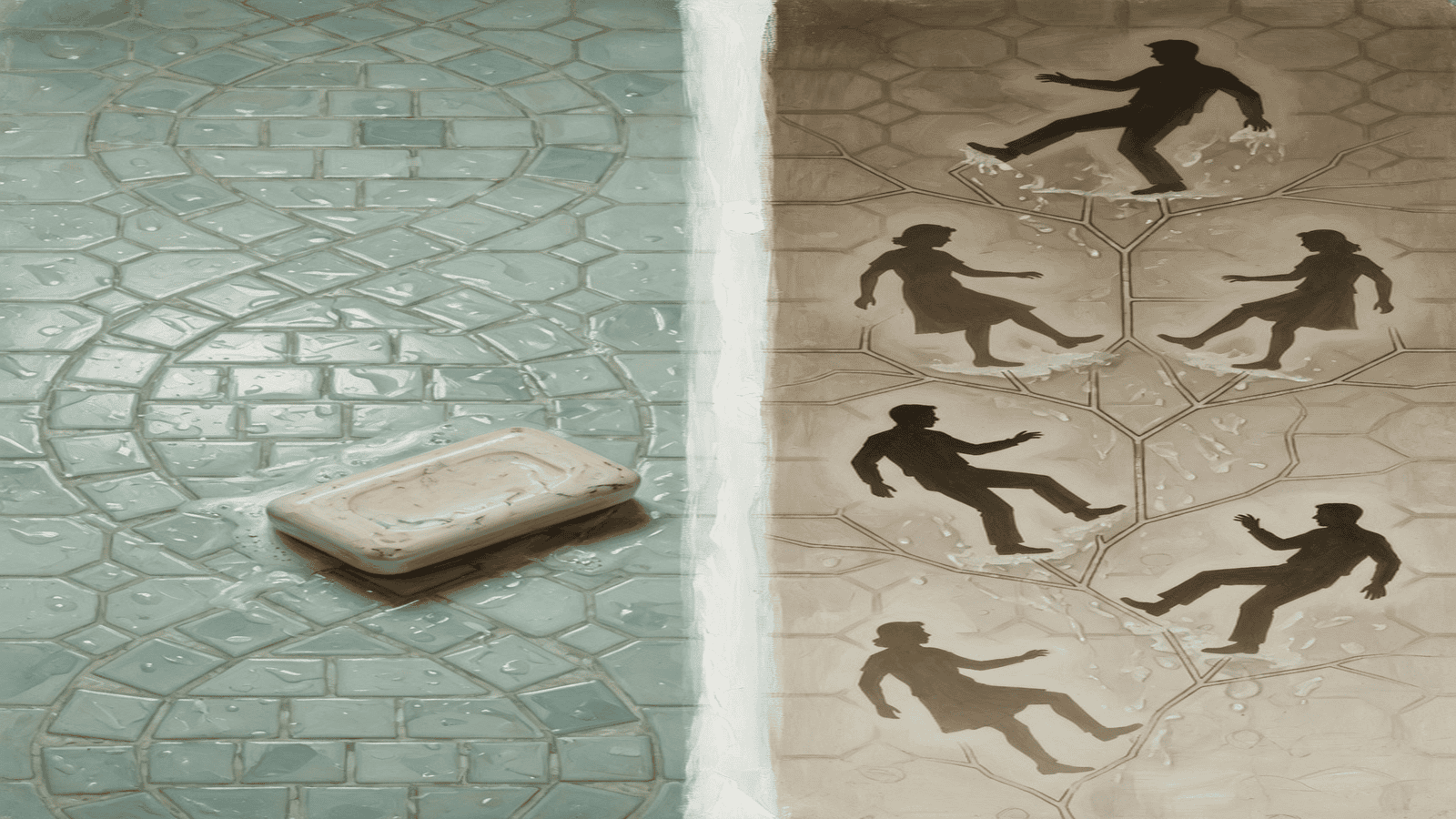
Imagine slipping on a bar of soap left on a wet shower floor, and learning your mother did too, and her mother before her. The tempting explanation reaches for a shared trait — clumsiness, poor balance, something written into the family line. The mundane explanation is almost always correct instead: nobody moved the soap dish, nobody toweled the floor, and the habit of leaving a slick bar within stepping distance of the drain passed from house to house the way recipes and grudges do, by demonstration rather than by sequence. Three generations of the same mistake is evidence of a stable floor, not a stable genotype. The test generalizes cleanly: whenever a repeated pattern can be explained either by inheritance or by a copied environment, the copied environment is the explanation that requires no unproven mechanism, and it should win by default until something forces the more expensive hypothesis.
II. A Habit Ten Thousand Years Deep
The same conflation operates at civilizational scale, and agriculture is the clearest case. Obesity, insulin resistance, and chronic inflammation are sometimes discussed as if ten millennia of grain-based surplus had time to write themselves into the human genome — as though a body now finds sugar and starch irresistible because natural selection favored ancestors who did. Ten thousand years is a long time by the clock of a single life and a short one by the clock of selection, especially under agricultural conditions where reproduction was rarely gated by metabolic efficiency the way famine once gated it. What actually got transmitted, generation after generation, was not a genotype but an environment: a grain surplus, a fermentation tradition, a food supply with no natural brake, and a table set the same way regardless of who sat at it. A civilization that keeps making the same metabolic mistake for ten thousand years is not necessarily a civilization with bad genes. It may simply be one that keeps building the same wet floor and handing down the same bar of soap, and mistaking the resulting bruises for fate.
III. Why the Metaphor Is Convenient
Genetic language survives in ordinary speech because it does rhetorical work that “I inherited a habit” does not. Dorothy Nelkin and Susan Lindee documented this directly in The DNA Mystique: since the 1980s, “gene” has functioned less as a biological unit than as a cultural icon — a secular soul, invoked to explain identity, fate, and moral character with the borrowed prestige of a laboratory. Genetic explanation implies permanence, inevitability, and, crucially, an absence of blame. Nobody is responsible for a genome. Everybody is at least partly responsible for a habit, a diet, a household rule, or a cultural script, and for whether they pass it on unexamined or interrupt it deliberately. The slide from “recurring” to “genetic” is, underneath its science-flavored vocabulary, often a quiet refusal to look at the floor. Richard Lewontin named the larger pattern in Biology as Ideology: reducing social and behavioral outcomes to DNA is not a finding forced by the evidence so much as an ideology that finds the evidence convenient, because a genetic story forecloses the harder political and personal question of who built the environment and who could unbuild it.
IV. What Actually Gets Inherited
None of this requires denying that genes matter; it requires being precise about which parts of a repeated pattern they actually explain. Judith Rich Harris built an entire argument, controversial but rigorously evidenced, around a version of the same question: family resemblance in personality and behavior is routinely attributed to parenting and heredity in roughly equal measure, when a great deal of it — particularly the part that isn’t genetic — turns out to trace to peer environment rather than the home at all. Matt Ridley’s Nature via Nurture makes the more technical version of the same correction: genes are not fixed blueprints executed regardless of circumstance but switches, expressed or silenced by exactly the environment surrounding them, which is why the nature-versus-nurture framing was wrong from the outset — the honest version is nature working only through nurture. Epigenetics gets invoked to rescue the genetic story here, and something real is happening at that layer — Nessa Carey’s The Epigenetics Revolution documents mechanisms by which environmental exposure changes gene expression across at least a couple of generations — but the popular version of that finding tends to smuggle heredity back in through a side door, treating “epigenetic” as a more scientific-sounding synonym for “inherited” rather than what it more often is: one more channel through which environment, not sequence, does the transmitting.
V. Interrupting the Floor
None of this is a case for shrugging off the mystery of what makes a family a family, or a culture a culture. It is a case for sorting two categories that get conflated constantly: this is who we are, and this is what we keep doing. The first category is mostly closed to argument. The second is, in principle, the most tractable problem a family or a civilization can face, because a copied habit does not require new selection pressure or a generation’s worth of drift to change — it requires someone noticing the wet floor and moving the soap dish. That noticing is rarer than it should be, not because the mechanism is obscure but because the genetic story is more comfortable. It hands the mirror back before anyone has to look in it.
I think about this whenever a relative explains a temper, or a body, or a way of arguing at the dinner table, as simply “how we are” — delivered with the weary satisfaction of a closed case. The sentence forecloses the only question worth asking next, which is who set the table this way, and whether it still has to be set that way tonight.
Further reading
- Richard Lewontin — Biology as Ideology: The Doctrine of DNA (1991)
- Dorothy Nelkin & M. Susan Lindee — The DNA Mystique: The Gene as a Cultural Icon (1995)
- Judith Rich Harris — The Nurture Assumption: Why Children Turn Out the Way They Do (1998)
- Matt Ridley — Nature via Nurture: Genes, Experience, and What Makes Us Human (2003)
- Nessa Carey — The Epigenetics Revolution (2011)