We do not only eat food. We eat stories about food. Fat is the enemy, or sugar is poison, or breakfast is sacred, or meat is ancestral, or grains were civilization’s original mistake, or the answer is buried in whatever a grandparent ate before anyone thought to write it down. The stories rotate. The anxiety they produce does not. Every meal becomes a small referendum on whether the body is being cared for or betrayed, and the referendum never quite closes.
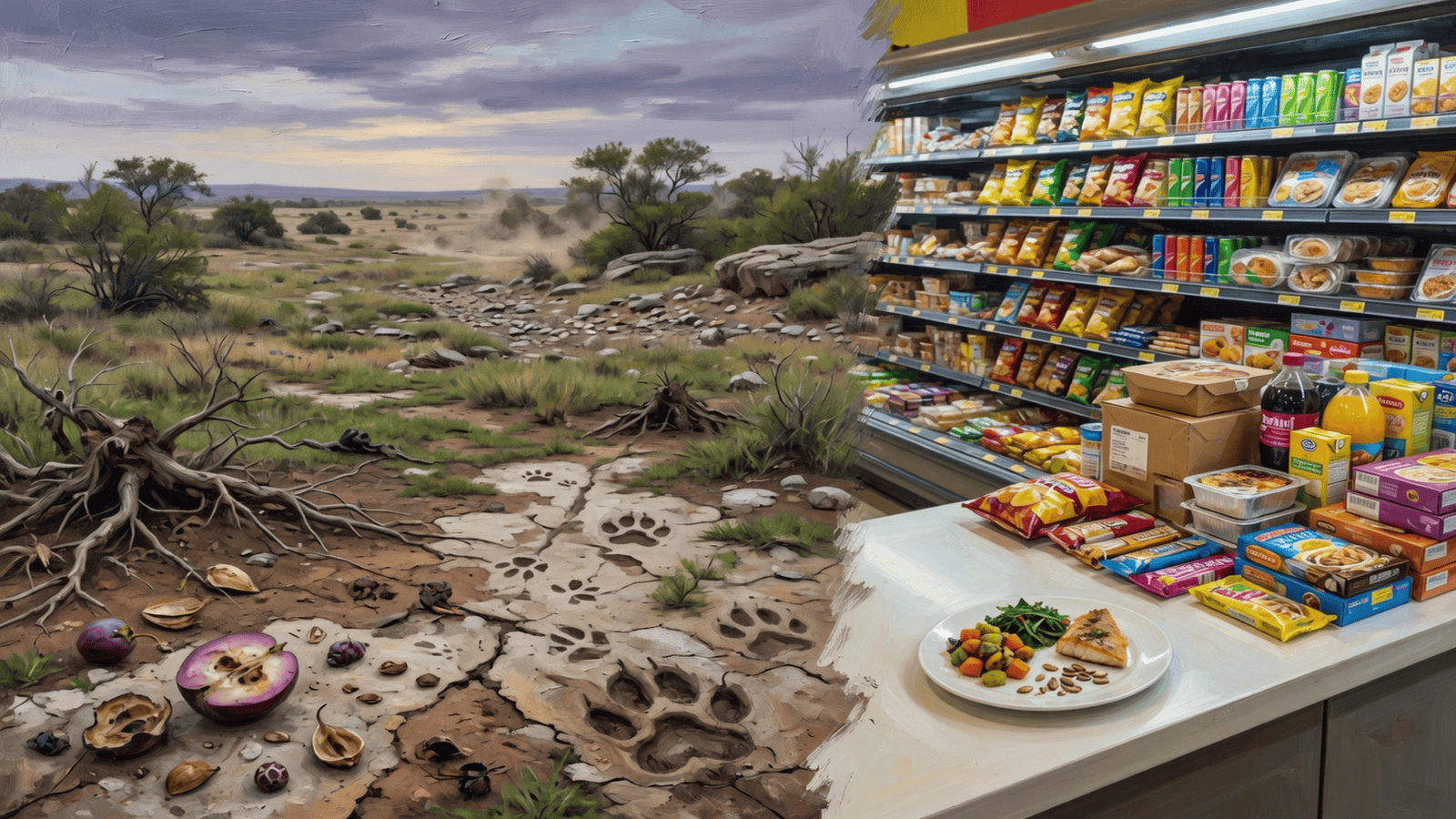
The body running that referendum is much older than the supermarket, the delivery app, the nutrition label, and the influencer explaining why oats are either salvation or slow poison depending on the week. It was shaped in environments where food was irregular, effort was unavoidable, and the calories worth having were the ones that could be found, carried, stored, or shared. It now operates inside continuous availability, engineered palatability, and relentless advice. The mismatch between those two conditions is real. What is not real, or at least not proven, is the conclusion so many nutritional movements draw from it: that evolution left behind a lost menu, and that health means reconstructing it.
I. The Body That Expected Uncertainty
Appetite was never a precision instrument built to optimize a spreadsheet of micronutrients. Daniel Lieberman describes it in The Story of the Human Body as an inherited negotiation between energy, reward, memory, season, effort, and danger — a system built to function under uncertainty, not abundance. A preference for energy-dense food was protective when scarcity was ordinary rather than an occasional inconvenience. The capacity to store fat efficiently was not a design flaw; it was the reason some ancestors survived a bad season and others did not. The thrifty gene hypothesis, first proposed by geneticist James Neel in 1962, formalizes exactly this: traits selected for feast-and-famine cycles become liabilities only once famine stops arriving on schedule. The body is not malfunctioning when it responds to cheap, dense, constant food with cheap, dense, constant craving. It is responding exactly as bodies do, inside an arrangement of signals nothing in its evolutionary history prepared it to discount.
II. The Meal as a Narrative Machine
Food is never only chemistry. It is belonging, status, memory, hospitality, discipline, and fear, and industrial food systems exploit some of those meanings while nutritional culture exploits the rest. A cereal box arrives wrapped in the language of care. A restrictive protocol arrives wrapped in the language of control. Both can turn a plate of food into a moral performance long before anyone tastes it. Marion Nestle’s Food Politics traces one half of this — how the industry that profits from constant consumption also funds the guidelines meant to restrain it — but the other half is cultural rather than corporate: a person defending a macronutrient ratio is rarely defending only the ratio. They may be defending a family ritual, a class identity, a body image, a medical scare, or the private hope that one more rule will finally make the uncertainty stop. Anxiety thrives here because food offers infinite opportunities for imagined error — too much, too little, too late, too processed, not clean enough — and the fear can become more psychologically expensive than the food itself.
III. The Myth of the Lost Menu
The phrase “ancestral diet” sounds decisive. It hides a problem: there was no single one. Hominids lived across savanna, coast, tundra, and forest, eating whatever climate, season, technology, and luck made available, and flexibility — not any particular macronutrient ratio — was the actual adaptation. Michael Pollan’s In Defense of Food distills this into a rule that survives contact with the anthropological record better than most: eat food, not too much, mostly plants — a rule that says almost nothing about paleo, keto, or any other reconstructed menu, because none of those reconstructions is what evolution actually optimized for. Evolution suggests that a body adapted to intermittent scarcity may strain under constant abundance. It does not prove that one modern diet, one supplement stack, or one romantic image of the hunter-gatherer table is universally correct. The past also carried infection, famine, tooth loss, and early death in quantities the present mostly avoids; criticizing the present by comparison to the past is only useful when the comparison is honest about what it is comparing.
IV. Nutrition Against Fear
The more humane question is not “what is the purest food” but what pattern lets a body be nourished without turning every meal into a threat. That question leaves room for evidence and for individual difference. Chris van Tulleken’s Ultra-Processed People makes a real case against a real category — engineered food built to override satiety — without needing to promise purity or demonize an ingredient list. It is possible to notice the effects of liquid calories, low fiber, and constant grazing while still treating desire itself as something other than the enemy. Psychologist Paul Rozin named part of what makes this hard: humans face an omnivore’s dilemma that no other narrowly specialized eater faces — the freedom to eat almost anything comes paired with the permanent burden of having to decide, meal by meal, whether a given thing is safe, which is fertile ground for both careful judgment and unmanageable dread. The task was never to eliminate desire. It is to build an environment in which desire is not continuously engineered against a person’s longer interests.
V. The Story We Actually Need
Perhaps the real conflict is not between ancient food and modern food. It is between a body that evolved to navigate variability and an economy that profits from predictability — predictable cravings, predictable purchases, predictable guilt, predictable return visits. Recovering an imaginary ancestral menu was never the assignment. Becoming less alienated from the conditions under which the body actually works — more time to eat, more friction around constant grazing, more movement folded into an ordinary day, more meals that look like meals — comes closer to it, and it asks for less faith than any reconstructed diet does.
I have watched myself, on ordinary weeks, calculate a snack the way one might calculate a confession — not from hunger but from a residue of rules absorbed from a decade of headlines, each one certain, each one eventually revised. The revision is the tell. A body that has survived ice ages, migrations, and famine is not waiting on this month’s study to tell it how to eat. It is waiting for the noise to quiet down long enough to be heard.
Further reading
- Daniel Lieberman — The Story of the Human Body: Evolution, Health, and Disease (2013)
- Marion Nestle — Food Politics: How the Food Industry Influences Nutrition and Health (2002)
- Michael Pollan — In Defense of Food: An Eater’s Manifesto (2008)
- Chris van Tulleken — Ultra-Processed People: Why We Can’t Stop Eating Food That Isn’t Food (2023)
- James Neel — Thrifty gene hypothesis (1962)
- Paul Rozin — Omnivore’s dilemma (psychology)