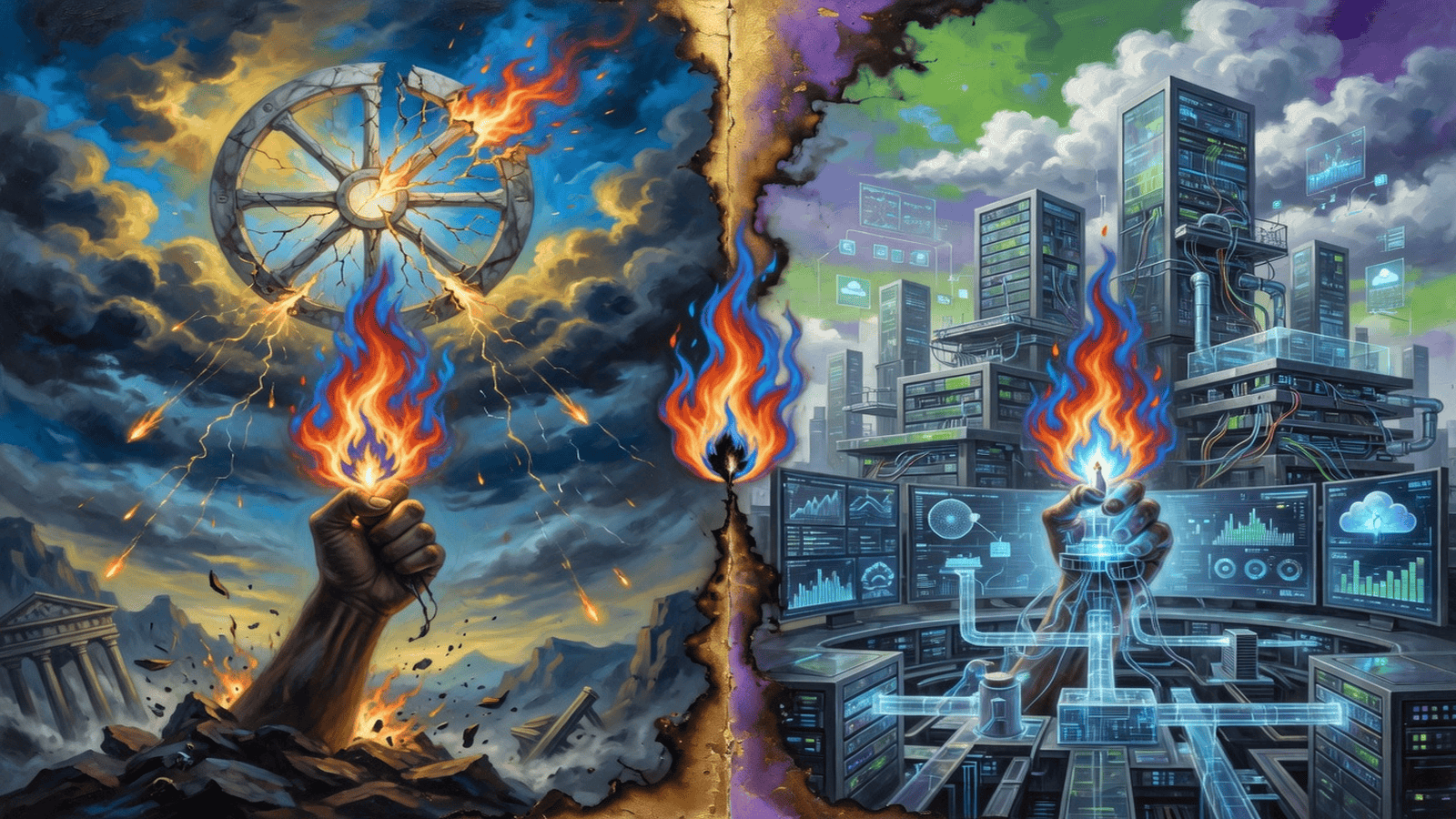
It is tempting to treat techno-accelerationism and technofeudalism as opposites. One says the machine should run faster, further, past every institutional brake; the other says the machine has already been captured, reorganized around rent, extraction, and centralized control. One sounds like the dream of total release. The other sounds like a diagnosis of total domination. But the more interesting possibility is that they are not opposites at all — that they are two projections of the same underlying myth, told from either side of the same platform.
I. The Question Underneath the Contradiction
What if techno-accelerationism is simply the utopian dialect of a feudal imagination that has learned new vocabulary? The old feudal order imagined hierarchy as natural, sanctioned by blood and God. The new one imagines platforms, cloud stacks, and algorithmic infrastructure as the apparatus through which power distributes itself without ever quite appearing as power. Yanis Varoufakis argues in Technofeudalism that this is not metaphor but mechanism: profit, the engine of capitalism, has been quietly displaced by rent, the engine of feudalism, as the dominant form of value extraction — cloud capital charging tribute for access to markets it owns outright rather than competing within them. If he is right, the question stops being whether technology liberates or enslaves and becomes whether the story of liberation was ever anything but a way of not looking at the structure that produces the limits it claims to transcend.
II. Two Mirror Projections
A projection is not simple illusion; it is a way of narrating the present through a myth already rehearsed elsewhere. Technofeudalism describes digital platforms as a new extraction regime — rents on infrastructure, monopoly over coordination, the fief reborn as the app. That diagnosis is convincing on its own terms. But accelerationism is the inverted version of the same claim: it treats the identical system as a vehicle for permanent upgrade, a way past scarcity and institutional sclerosis, the only honest response to a world too slow for the tools already built to outrun it. The two positions are not merely different. They are mirror images built from the same material. One insists the system is fundamentally parasitic. The other insists it is fundamentally emancipatory. Both explain an apparently unprecedented condition by fitting it inside a familiar story, and in both cases the machine functions as a vehicle for a political fantasy rather than a neutral fact about the world.
III. A Pattern With a History
This has happened before, more than once. Modernity is full of regimes that describe themselves as liberation and then reorganize dependence in a more abstract, more apparently inevitable form. The Industrial Revolution promised a universal rise in productive power and new freedoms from toil; it also produced factory discipline, enclosure of the commons, and forms of exploitation that had no feudal precedent because they did not need one. The digital revolution told a structurally identical story a century and a half later: networks would flatten hierarchy, information would flow freely, and the productive subject would be released from every old bottleneck. Shoshana Zuboff’s The Age of Surveillance Capitalism is, among other things, a chronicle of how quickly that promise curdled into something closer to its opposite — behavioral data as raw material, prediction as product, users as the resource being extracted rather than the beneficiaries being served. What matters is not that the liberation story was false in every particular. It was often partly true. But it was always incomplete, and the missing part was reliably the part where a new administrative regime installed itself under the cover of the old story’s momentum. Cory Doctorow’s diagnosis of “enshittification” names the terminal stage with unusual precision: platforms are generous to users until they are locked in, generous to business customers until users are locked in too, and then extractive to everyone, because extraction was the destination the whole time and generosity was only ever the fare for the ride there.
IV. The Reverse of Prometheus
Prometheus is useful here precisely because he is not primarily a figure of technical innovation. In Hesiod’s and Aeschylus’s tellings he is a figure of rebellion against a divine limit, and the fire he steals becomes a source of both power and permanent punishment — the myth is the original version of the technological sublime, in which a mortal seizes the means of control from heaven and gives them away, at personal and irreversible cost, to the species that had none. The gift is liberation from scarcity and dependency. The cost is a new relation of domination, chained to a rock, and a world reorganized around a capacity nobody can now put back.
Is techno-accelerationism the reverse of that myth? Nick Land’s founding accelerationist writings, collected in Fanged Noumena, treat capital itself as the agent that wants to go faster than any human institution can survive — not a rebel stealing fire from an order above, but a process that has already dispensed with the idea of an order to rebel against, moving under its own momentum toward an outcome no one, including its beneficiaries, is steering. That is the inversion. Prometheus is a figure of agency, paying a personal price for a deliberate act. Accelerationism, in its purest form, is a narrative of inevitability with no one left to punish, because no one is claimed to be responsible — the system’s self-image as pure velocity has already absorbed the question of whether anyone chose this. What survives from the myth is not the theft but the chain: a form of bondage to the consequences of a power nobody quite decided to release, now marketed as the only viable direction of travel.
V. What the Two Stories Share
Accelerationism and technofeudalism, read this way, do not cancel each other. They are complementary halves of the same arrangement, describing it from opposite ends of the same transaction. One emphasizes the speed, scale, and myth of perpetual motion. The other emphasizes the rents, the fiefs, and the extraction structures that make that motion profitable for a narrow ownership class while everyone else pays passage. A form of power presents itself as the inevitable expression of technical necessity, recruits the vocabulary of futurity and freedom to narrate its own advance, and the result is not the abolition of hierarchy that either story separately promises but its reappearance in a form harder to name and therefore harder to resist — recent television has reached for the same image on its own terms, from the sealed silo of Silo to the fenced park of Westworld, each one a walled fief run by an owner class that has simply stopped bothering to call itself one.
The honest position is neither the romantic wish for the old order back nor the techno-utopian faith that this time the acceleration ends somewhere better. It is holding both diagnoses at once without letting either one supply the alibi the system is always angling for — the platform as witness, the market as natural law, the machine as an actor with no author. Somebody owns the cloud. Somebody set the terms of the tribute. The myth only works as long as that somebody stays offstage.
Sometimes I think the people fluent in this vocabulary — rent extraction, compute utilization, growth curves — are not cynical so much as boxed in by their own instruments: the tool and the process are all the dashboard shows them, and the dashboard has no column for a person. The rest is an old, ugly arithmetic, sharper than anything in this essay: one death is a tragedy; past that, it’s only statistics. Nobody drafted that as doctrine. It is just what a spreadsheet does to a human being once there are enough of them to average.
Further reading
- Yanis Varoufakis — Technofeudalism: What Killed Capitalism (2023)
- Shoshana Zuboff — The Age of Surveillance Capitalism (2019)
- Cory Doctorow — “Enshittification”
- Nick Land — Fanged Noumena: Collected Writings 1987–2007 (2011)
- Hesiod — Theogony (the Prometheus myth)
- Aeschylus — Prometheus Bound
- Silo — TV series (2023– )
- Westworld — TV series (2016–2022)