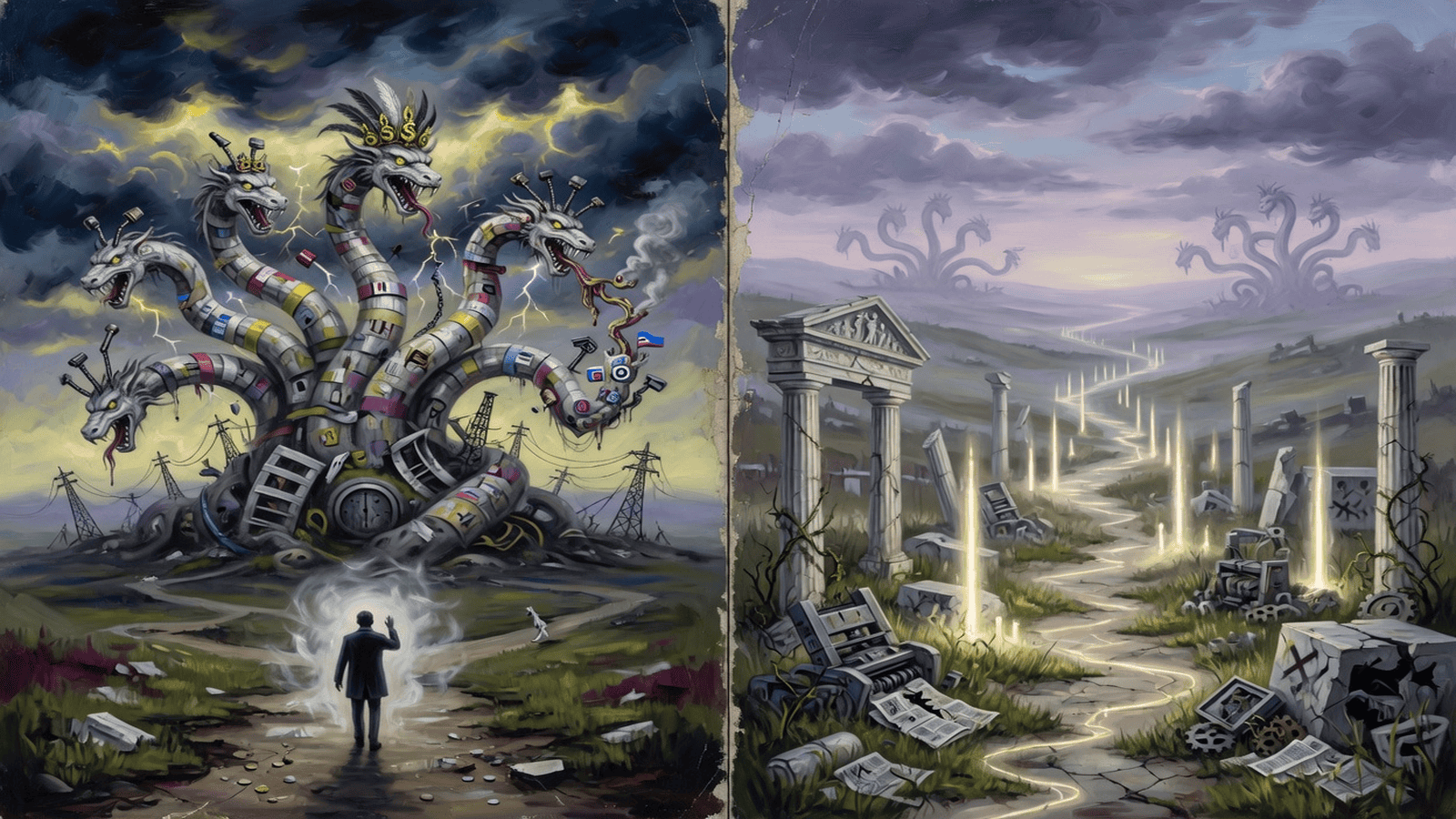
Historians of the Weimar Republic have a habit of dating its death more than once — 1929, when the crash hit; 1930, when parliamentary government effectively stopped functioning; 1932, when unemployment cracked thirty percent; 1933, when a chancellorship that was supposed to be containable turned out to be irreversible. The dates keep multiplying because no single one explains the whole collapse; each was a head, and severing it did not kill the thing underneath. A century later it has become common to feel that we are living through some recombination of those same years — not as literal repetition, since nothing repeats literally, but as a shape recurring under new names. It is the Lernaean Hydra of Apollodorus’s telling, which grows two heads for every one cut off, until Heracles’ companion Iolaus learns to sear each stump with fire before a new head can form. The comparison is not decoration. It states an actual problem: what does resistance mean against a structure that regenerates from opposition itself?
I. What the Hydra Actually Teaches
The myth is not primarily about a monster that is hard to kill. It is about a monster that specifically punishes the wrong method. Heracles’ first instinct — the straightforward application of force, club and sword against each head in turn — makes the problem worse; every stroke multiplies what it was meant to reduce. The labor is only completed once the theory of the problem changes: you cannot defeat a self-replicating structure using the same gesture that triggers replication. It takes a second actor, a different tool, and the recognition that cutting is not the operative move — cauterizing is. This is easy to admire as myth and hard to apply as politics, because the fire is never obviously available, and because most of what passes for resistance is closer to Heracles’ first afternoon than to his last: direct opposition that borrows the enemy’s own methods of centralization, censorship, and total enemy-making, and in doing so feeds the pattern it means to starve.
II. 1929, 1933, 1937
Hannah Arendt’s The Origins of Totalitarianism is not, in the end, a book about a single ideology arriving on a single date. It is an account of a social precondition: masses of people cut loose from class, guild, church, and party — atomized, lonely, no longer held by any structure that once gave their lives shape or their grievances an address — and therefore available to a movement that offers total explanation and total belonging in place of both. That precondition does not require the same costume to reappear. Economic precarity, social atomization, and a crisis of institutional legitimacy reliably produce someone willing to supply total meaning to people who have run out of smaller ones; the mechanism is closer to a basin the ball keeps rolling into than a script that keeps getting reread. This is why the feeling of “walking through 1929 again” can be entirely real without a single event actually repeating. We are not reliving a year. We are re-entering a shape.
III. Récupération
What makes the hydra a genuinely difficult opponent, rather than merely a tough one, is that some structures learn to feed on the very act of being opposed. The Situationists had a word for it — récupération — the process by which a system absorbs the images and vocabulary of its own critique and resells them as content. Guy Debord’s The Society of the Spectacle argued that this was not a failure of the spectacle but its central operation: dissent does not need to be silenced if it can instead be incorporated, packaged, and returned to circulation as another commodity among commodities. Herbert Marcuse made the same point from a different angle in his essay on “repressive tolerance,” arguing that a system’s willingness to tolerate dissent can itself be a mechanism of neutralization — opposition permitted precisely because permitting it drains its force. Thomas Frank’s The Conquest of Cool documented the mechanics in miniature: how quickly the imagery of 1960s counterculture, built explicitly against consumer conformity, became the raw material of the advertising it opposed. This is the seed’s mutation, made concrete — cut the head off, and the body has already learned to metabolize the wound as growth.
IV. The Mirror
There is a second failure mode, and it is worse than losing, because it can look identical to winning. Nietzsche’s warning in Beyond Good and Evil — that whoever fights monsters should take care not to become one in the process, and that whoever stares long enough into an abyss will find the abyss staring back — describes exactly the risk of meeting a self-replicating structure with its own tactics. Albert Camus traced the same pivot at the scale of history in The Rebel: the difference between rebellion, which says no while affirming a limit it will not itself cross, and revolution, which in pursuing total transformation ends up justifying total means to get there. The French Revolution did not fail to defeat the old order; it defeated it and then, with the Terror, began devouring its own architects, because the logic that had authorized total force against the enemy did not know how to switch itself off once the enemy was gone. The seed’s phrase — resisting “without becoming their mirror” — names this directly. The danger is not only defeat. It is a victory that arrives isomorphic with what it replaced.
V. The Corridor
If direct force triggers regrowth, and mimicry corrupts the one resisting, what is actually left to do? Václav Havel’s essay “The Power of the Powerless” offers one answer at the smallest possible scale: the greengrocer who quietly stops putting the regime’s slogan in his shop window is not trying to overthrow the state. He is refusing to keep lying to himself inside it. Havel called this “living in truth” — a refusal that does not scale to power and is not meant to, but that keeps a form of human life honest while the larger structure runs its cycle regardless. It is a smaller cousin of what Gandhi called the constructive programme: building the spinning wheel and the village school alongside, not instead of, opposing an empire — resistance as construction as much as negation, so that something remains standing whether or not the empire falls on schedule. This is closer to what the storm can actually be met with: not a promise to stop it, which the hydra’s whole design makes doubtful, but a corridor kept lit through it. It is worth remembering how the myth itself ends. Heracles kills the hydra, but he dips his arrows in its poisoned blood, and years later that same poison, carried on a centaur’s gift, kills him. Even the victory carries the defeated thing forward in a new shape. The honest description of this work was never eradication. It was custody — across a year, across a century, across however many names history assigns to the same recurring wound.
So, for now, I’m the bearer of bad news — don’t kill the messenger. If we have failed to apply the correction peacefully, in what the Buddhists would call the right way, then patience is the discipline left to practice, not as a virtue in itself but as the only instrument still available. It might take another hundred years of solitude before the wound closes on its own terms rather than ours.
Further reading
- Apollodorus — Bibliotheca (the Hydra myth)
- Hannah Arendt — The Origins of Totalitarianism (1951)
- Guy Debord — The Society of the Spectacle (1967)
- Herbert Marcuse — “Repressive Tolerance” (1965)
- Thomas Frank — The Conquest of Cool (1997)
- Friedrich Nietzsche — Beyond Good and Evil (1886)
- Albert Camus — The Rebel (1951)
- Václav Havel — “The Power of the Powerless” (1978)
- Gabriel García Márquez — One Hundred Years of Solitude (1967)