In the Phaedrus, Socrates tells a story about the Egyptian god Theuth, inventor of writing, who brings his gift to King Thamus and asks him to distribute it to the people. Thamus refuses to be impressed. Writing, he says, will not improve memory but replace it: people will stop exercising the internal discipline of recollection and instead rely on external marks made by someone else’s hand. They will seem wise without being wise, “filled with the conceit of wisdom instead of real wisdom.” It is, as far as the historical record goes, the oldest surviving complaint against a technology for knowing things — and it is aimed, with uncanny precision, at exactly the anxiety now circulating about large language models.
I. The Long Arc of Access
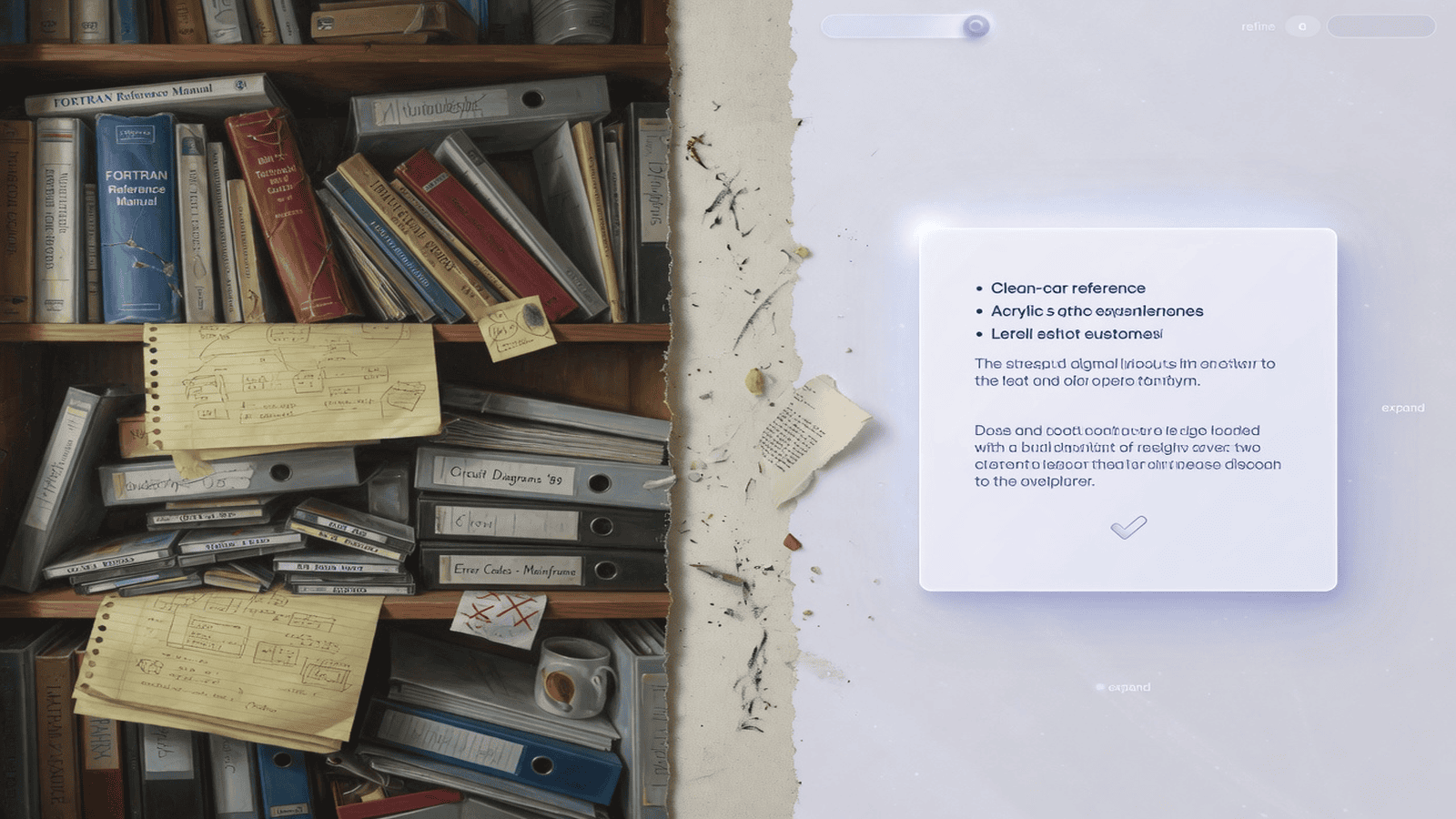
There was a time when getting the right information felt like an ordeal. You needed manuals, vendor documentation, library cards, support contracts, CD-ROMs, or the patience to wait for someone who already knew the thing. The work of computing was never purely technical; it was administrative, procedural, a matter of getting past gates built to protect knowledge by keeping it scarce. Then came search, which felt like a miracle: type a question, receive a chain of fragments and half-finished solutions. Stack Overflow made it more intimate still — the answer had usually already been written by a stranger, and the skill was mostly in phrasing the question. Large language models are not one more step along that curve. The machine no longer points to an answer; it produces one, drafted, explained, and scaffolded in a form that feels almost ready to use. That is a difference in kind, not degree.
II. Productivity as a New Religion
The obvious response is to celebrate this as progress, and in one sense it is: less friction, faster unblocking, more built per hour of consultation. But there is a quieter, more dangerous temptation — confusing access with understanding. When a system hands us the answer, we mistake the act of receiving it for the act of knowing it. Speed of retrieval becomes a surrogate for mastery. A thing can be built without being understood, a property implemented without being grasped, a system assembled while the logic underneath it stays only vaguely felt. The tool helps us act, but it can hollow out the habit of inquiry that used to be the price of acting at all.
III. The Vibe Coder and the Anxious 10x Engineer
Two figures now haunt every engineering Slack channel: the self-declared 10x engineer who treats software as a series of tricks to be memorized rather than a discipline to be practiced, and the “vibe coder” who ships a working feature with no model of why it works. Neither is new, exactly — every era of computing has had people who could produce output without holding a coherent picture of the system underneath. What is new is how far that gap can now travel before it shows. Matthew Crawford’s Shop Class as Soulcraft makes the case that skilled manual and technical trades carry a kind of knowledge that cannot be handed over verbally — it has to be earned through direct, resistant contact with a material that pushes back when you get it wrong. Code used to push back like that: it failed to compile, it threw a stack trace, it crashed at 3 a.m. and made you learn the thing you’d skipped. An LLM can absorb that resistance on your behalf, which is exactly the convenience and exactly the loss. Software engineering, at its best, was never about typing fast. It was about carrying an accurate model of the system in your head. That model is precisely what convenience routes around.
IV. Cognitive Offloading, Measured
This is not just an aesthetic complaint; it has been measured. A 2011 study by Betsy Sparrow, Jenny Liu, and Daniel Wegner, published in Science, found that when people expect information to remain accessible later — through a search engine, a shared drive, anywhere external — they remember where to find it far better than they remember the information itself. Psychologists call this the “Google effect,” a modern instance of what William James and, later, Daniel Wegner named transactive memory: the outsourcing of recall to other people, or now, to machines. Nicholas Carr’s The Shallows extended the same argument to the internet generally, describing a shift from deep, sustained attention to a mode of skimming that rewires how we read and, over time, how we think. LLMs push the offload one step further than either predicted. It is no longer only that we forget where the information lives; we may stop needing to remember what the information even implies, because the machine will re-derive the implication on request, indefinitely, without complaint.
V. Judgment as the Scarce Resource
The bottleneck has moved. It used to be access: how do I find the answer. Now it is judgment: how do I know whether the answer in front of me is any good. That is a different and, in some ways, a harder skill, because it cannot be outsourced to the same machine that produced the thing being judged without circularity. Evaluating a plausible-sounding explanation for its hidden assumptions, its incompleteness, its subtly wrong abstraction, requires the very structural knowledge that convenience makes it easy to skip acquiring in the first place. Thamus was not wrong that writing changed what memory was for. He was wrong, or at least incomplete, in treating that change as pure loss — writing also made possible forms of thought that unaided memory never could have held. LLMs will very likely do the same: dissolve one kind of competence and open room for another. The bitterness is not that this trade is happening. It is that nobody has agreed yet on what the new competence should be, and in the meantime it is far too easy to mistake fluency with the tool for command of the thing.
Further reading
- Plato — Phaedrus (the myth of Theuth and Thamus)
- Matthew Crawford — Shop Class as Soulcraft
- Betsy Sparrow, Jenny Liu, Daniel M. Wegner — “Google Effects on Memory,” Science (2011)
- Nicholas Carr — The Shallows: What the Internet Is Doing to Our Brains