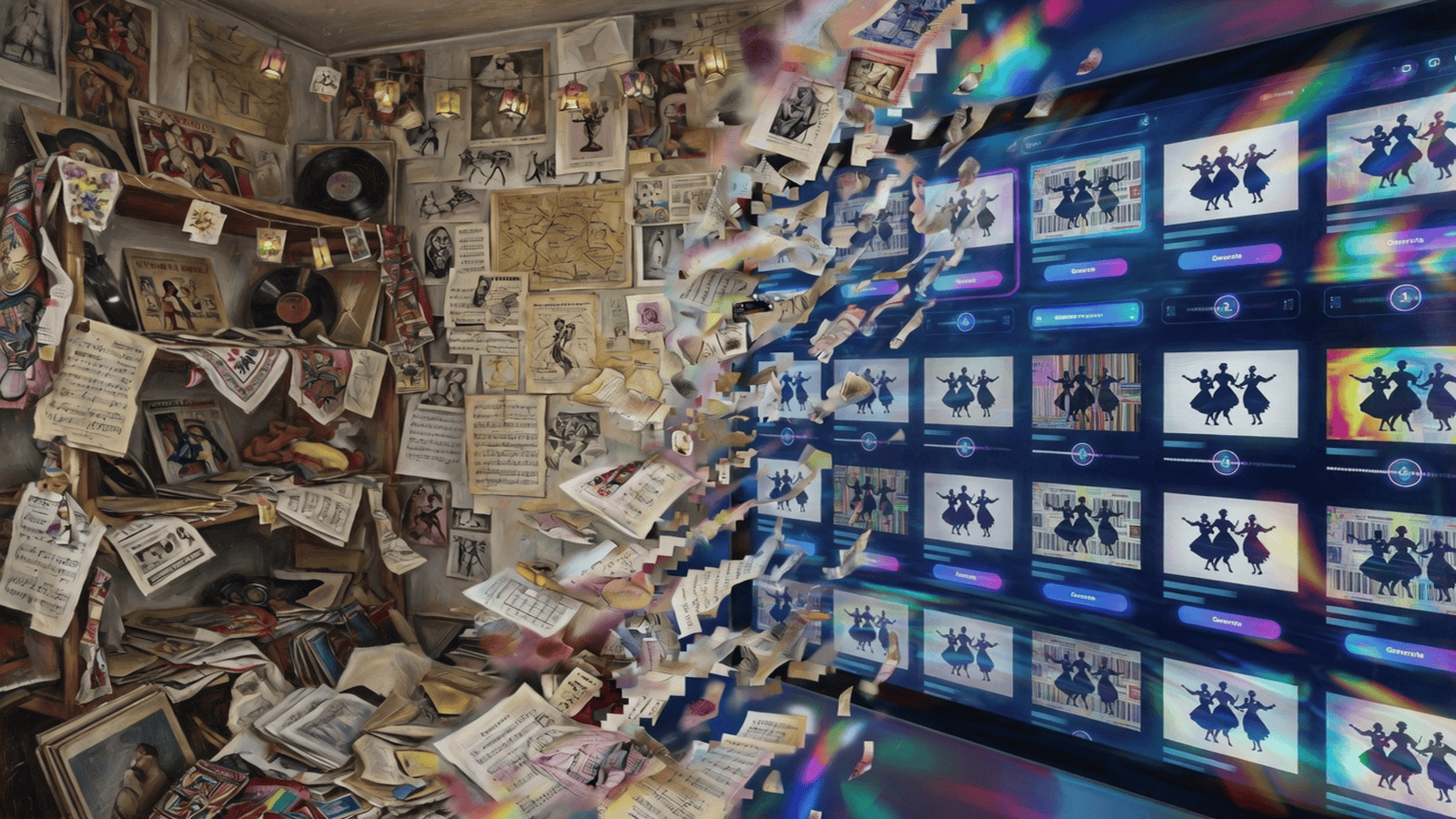
Gabriel García Márquez read Jorge Luis Borges the way a student reads a master: closely, gratefully, for years. Borges, by most accounts, did not return the favor. He found García Márquez’s prose baggy where his own was compressed, sentimental where his own was cold. The debt ran one direction only. That asymmetry is not a footnote in Latin American letters. It is a small, uncomfortable model of how culture actually works, and it is the model we need if we are going to talk honestly about AI slop.
I. The Question Nobody Is Really Asking
The easy critique of generative AI is that it can only recombine what already exists — that a model trained on the internet’s text and images is, structurally, incapable of originality, because everything it produces is some remix of the archive it was fed. This is true, and it is also almost entirely beside the point, because it describes human culture with equal accuracy. Nobody invents a story form from nothing. Every genre is a set of inherited constraints — the sonnet, the three-act structure, the vallenato — that writers and musicians have been varying for centuries. The real question was never whether a work draws on the archive. It always does. The real question is whether a given variation makes anyone stop, feel something, or care. AI does not introduce a new condition into culture. It intensifies an old one, at a speed and volume no prior technology could match.
II. Slop as a Condition, Not a Crime
It is tempting to treat slop as a moral failure — laziness dressed up as productivity, a shortcut taken by people who should have worked harder. But slop is not an exception to how culture is made. It is one of its default settings. Most songs, most novels, most images produced in any era are variations on forms somebody else already worked out, executed competently and forgotten quickly. That was true long before diffusion models existed. What generative AI changes is not the existence of derivative work. It changes the cost of producing it, collapsing it toward zero, so that the ratio of competent-but-inert output to output that actually earns attention shifts hard toward the former. The problem with slop, then, is not derivation. It is derivation offered without any attempt to become more than efficient — content optimized purely for the appearance of value, at a volume that buries the work that tried for something else.
III. The Old, Embarrassing Precedent
The Borges–García Márquez asymmetry matters here because it shows that even inside human culture, at its most celebrated, influence was never a level playing field, and derivation was never disqualifying on its own. Harold Bloom built an entire theory of literary history — The Anxiety of Influence — on the premise that every strong poet is a misreading of a poet who came before, and that greatness consists precisely in how productively a writer distorts an inherited form rather than escaping it. T. S. Eliot made a milder version of the same claim in “Tradition and the Individual Talent,” arguing that no poet has complete meaning alone, only in relation to the dead poets before them. None of this was ever about purity of origin. It was about what a given repetition manages to do with the material it inherits — which variations get treated as revelation, and which get treated as noise, and how thin that line has always been.
IV. The Human Spice
What follows from this is that humans were never actually opposed to repetition. We live inside ritual, genre, formula, and inherited plot without complaint, as long as something in the execution feels inhabited rather than merely assembled. Walter Benjamin, writing about mechanical reproduction almost a century ago in The Work of Art in the Age of Its Technological Reproducibility, worried that reproduction would strip a work of its “aura” — its situatedness in a particular time, place, and hand. Generative AI is mechanical reproduction with the constraint of an original removed entirely; there is no single hand it copies from, only a distribution. What survives that removal, when anything does, is a residue that is hard to specify and easy to recognize: a turn of phrase, a wrong note left in on purpose, a detail nobody optimized for that nonetheless makes the whole thing feel occupied by someone. Call it the human spice. It is small. It is often the only thing separating a variation worth returning to from one that dissolves the moment attention moves elsewhere.
V. Telling the Difference at Scale
Ted Chiang’s description of large language models as a blurry JPEG of the web captures the mechanism precisely: lossy compression of an enormous archive, reconstructing plausible output by averaging across what it has seen. A blurry JPEG is not fraudulent. It is simply what compression looks like when fidelity is sacrificed for coverage. The danger is not that this technique exists. It is that it can now generate plausible-looking variations faster than any human faculty for taste can sort them, which means the scarce resource shifts from production to discrimination. The future does not belong to whichever system produces the most original output — nothing, human or machine, has ever cleared that bar cleanly. It belongs to whoever, or whatever, can still tell a variation that merely exploits the archive from the rarer one that does something to a person standing in front of it. That was always the job of taste. AI just made the job urgent.
None of which exempts this essay. If it turns out to be one more competent variation — plausible, well-cited, ultimately inert — I will apologize for it, and keep writing anyway, no matter how many times that apology has to be repeated. Refusing to risk slop is not the same as producing spice.
Further reading
- Harold Bloom — The Anxiety of Influence
- T. S. Eliot — “Tradition and the Individual Talent”
- Walter Benjamin — The Work of Art in the Age of Its Technological Reproducibility
- Ted Chiang — “ChatGPT Is a Blurry JPEG of the Web,” The New Yorker (2023)