Jorge Luis Borges wrote a short story about a young man named Ireneo Funes who, after a fall from a horse, could forget nothing. Every leaf on every tree, every cloud he had ever seen, every sentence spoken in his presence, remained available to him in total, permanent, unbearable detail. Borges’s point in “Funes the Memorious” was not that perfect memory is a gift. It is that a mind which cannot forget cannot think, because thinking requires generalization, and generalization requires the discipline of throwing most of the world away. Human memory works precisely because it is lossy, associative, and biased toward what mattered emotionally rather than what happened exactly.
That story is the wrong model for what a wiki should be if a machine is going to read it. And realizing that changes what you write, and how.
I. Two Kinds of Memory, Not One
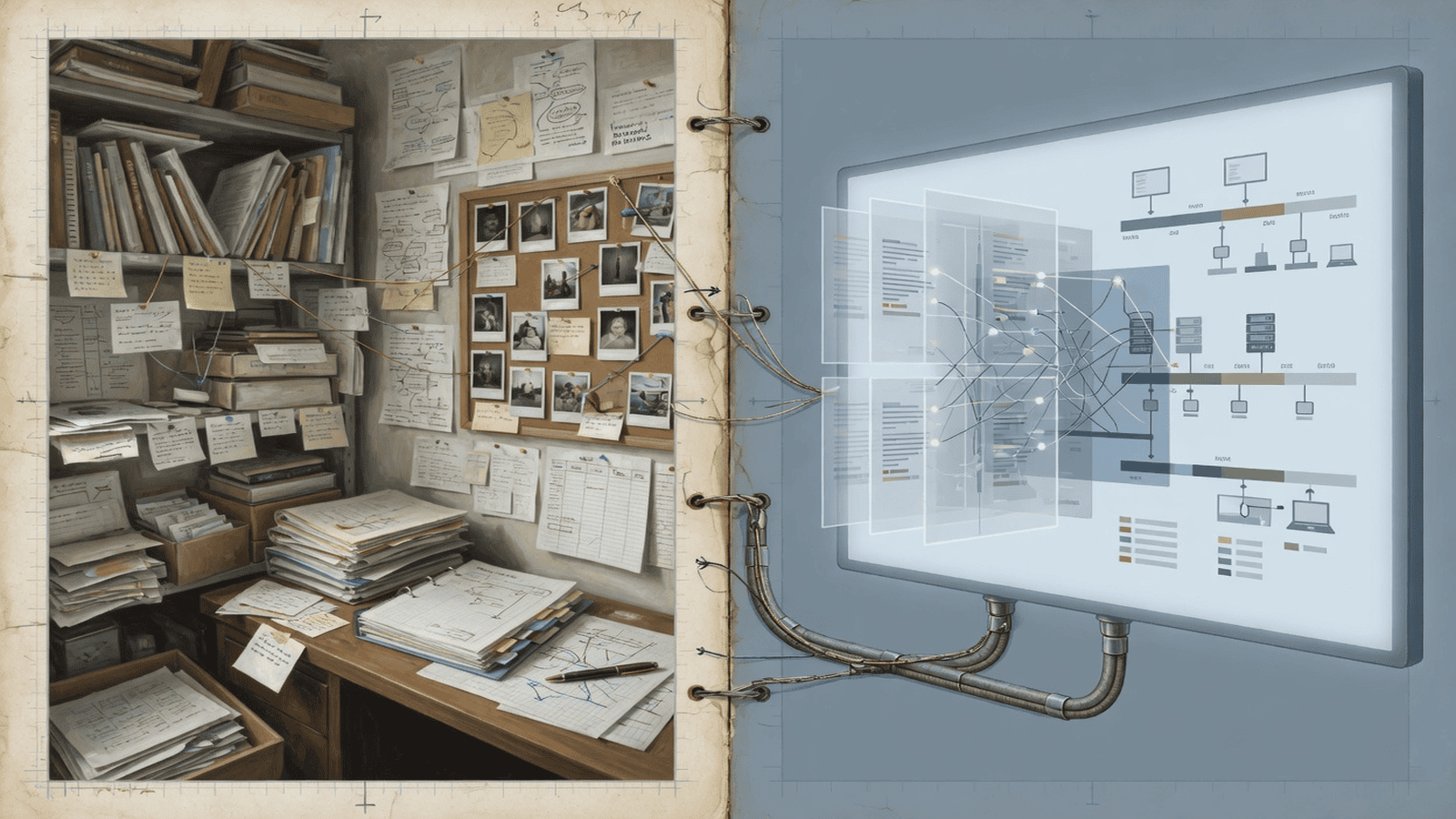
A person keeping notes is building something closer to Funes’s curse in reverse: a deliberate, partial record, curated by feel, organized around what felt significant at 11pm on a Tuesday. It works because the person who wrote it and the person retrieving it are the same continuous self, carrying context the notes never had to spell out. You can write “see the thing about the metro” in your own notebook and know exactly what you meant, because the rest of the sentence lives in you, not on the page.
A large language model has no such continuity. It does not remember writing the note. It does not carry the mood of the Tuesday it was written on. It has only the artifact — the file, the link, the structure — and whatever fits in the context window at the moment it is asked. This is the actual gap Andrej Karpathy pointed at in his note on LLM-legible wikis: not that models need more data, but that they need a different shape of data than the one humans have been producing for each other for decades of notebooks, wikis, and journals.
The mistake is treating these as the same design problem with a different reader. They are not. A human-facing wiki optimizes for the feeling of understanding when you open it. A model-facing wiki optimizes for correct retrieval under uncertainty, by something that has never lived inside your head for even a second.
II. Vannevar Bush Had the Right Instinct, Wrong Machine
The dream of externalized, associative memory predates computers by a comfortable margin. In 1945, Vannevar Bush wrote “As We May Think”, imagining a desk-sized machine called the memex that would let a person build trails of association between documents — not a filing cabinet organized by category, but a web organized by the connections a mind actually makes. Bush was building for a human user, decades before anyone else had a machine that could read a trail of links and reconstruct meaning from it. The memex was a prosthetic for a single human memory, meant to be walked by the person who built it.
What changes now is who walks the trail. An LLM reading a wiki is not trying to jog a memory it already half has. It is trying to reconstruct, cold, a body of thought it has never encountered, using only what the structure hands it. That is a much harder retrieval problem than Bush ever had to solve, because his user was never a stranger to the archive.
III. Writing for a Reader Who Wasn’t There
Once you take that seriously, the writing itself has to change. A note that says “revisit the concept from before, ties into the other thing” is perfectly legible to the person who wrote it and completely opaque to anything without the missing context — a person six months later included, but especially a model with no months at all. The useful entry names the concept, states the claim, and links explicitly to what it connects to, rather than gesturing at a shared history that does not exist on the other end.
This is not the same discipline as clean prose. An essay can gesture, imply, and trust the reader to carry an idea across a paragraph break, and that trust is often exactly what makes it worth reading. A memory substrate cannot afford that generosity, because the reader retrieving one fragment may never see the paragraph that would have supplied the missing half. The wiki entry that is dull to read as literature — flat, explicit, over-linked — is often the one that survives being read out of order, out of context, by something that showed up an hour ago and has to leave in a minute.
IV. The Session Was Never the Project
The practical failure mode of working with a model is not that it lacks intelligence. It is that it lacks continuity. Each conversation starts over, and whatever was worked out last month has to be rebuilt from scratch unless it was written down somewhere the model can find again. Ask a model today what you decided about a project in March, and unless March was externalized into something durable, the honest answer is that it never happened as far as the model is concerned.
A structured knowledge base solves exactly this failure, and only this failure. It does not make the model smarter. It gives a model that resets every conversation something to reset into — a map of the terrain that was there before this session and will still be there after it, instead of a conversation history that thins with every passing week and eventually gets thrown away entirely.
V. A Structure Built to Survive Forgetting
The strongest case for building this kind of archive was never really about the model. It is about what survives you — the change of laptop, the change of job, the six months you didn’t touch a project and came back to it having forgotten why you cared. A well-built memory substrate outlives the specific conversation that produced it, the specific machine it was written on, and arguably the specific mood of the person who wrote it. It is available to a future version of you in exactly the condition it would need to be available to a stranger, or a model, or both.
Funes could not forget, and it destroyed his capacity to think. The wiki that works is the opposite bet: build something that can forget nothing on your behalf, precisely so that you, and whatever reads it after you, are free to think instead of remember.
Further reading
- Jorge Luis Borges — “Funes the Memorious”, in Ficciones
- Vannevar Bush — “As We May Think” (1945)
- Andrej Karpathy — note on an LLM-legible wiki