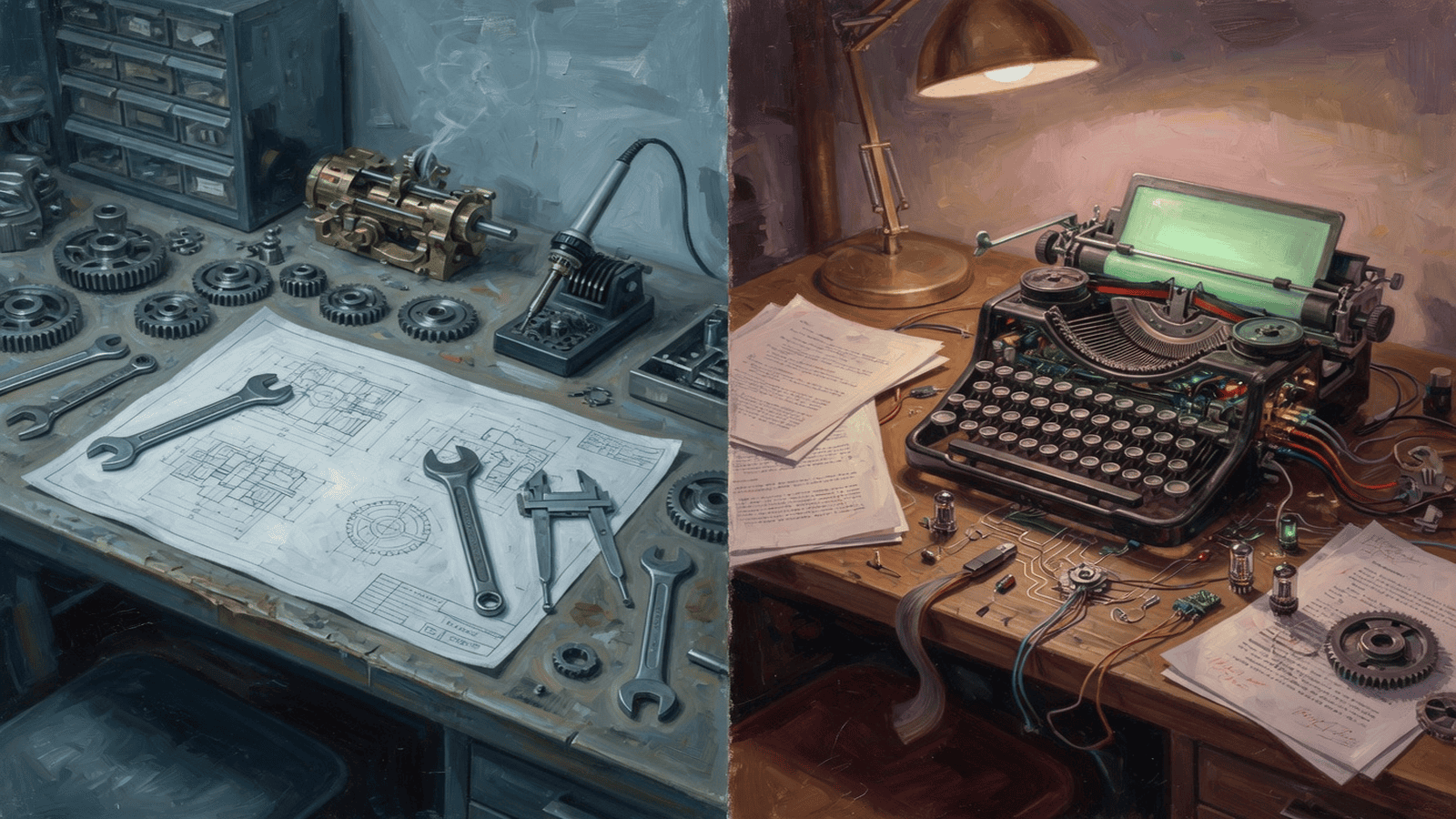
Some ideas are the wrong size for the forms available to hold them. A poem compresses too hard — you sketch the frame of a house you will never build. A book demands the opposite problem: not craft but infrastructure, a publisher, a grant, a sabbatical, a spouse able to carry the mortgage while you argue with chapter seven for two years. Montaigne solved this exact problem in the sixteenth century by inventing a form for it — the essai, literally an “attempt,” sized for an idea bigger than a stanza and smaller than a treatise, published in no particular order, revised across editions, admitting on the page that the writer had not finished thinking. It is, on paper, the perfect container for someone whose ideas don’t fit neatly anywhere else.
Having the right form didn’t save me. The essay still has to get written, and writing, unlike engineering, has no compiler. So the drafts piled up — half-finished, notes to self that never became notes to anyone else — and at some point, without a declaration, I stopped. I didn’t write today, then I didn’t write that week, and the muscle atrophied quietly enough that the silence started to feel like a decision instead of a drift.
I. The Shorter Path
Engineering was the shorter path back to solvency — not easier, shorter, because its feedback loop was honest. You build something and it works or it doesn’t; the compiler does not equivocate, does not wait for a reader who may never show up, does not require anyone’s taste to align with yours before it pays you. The skills transfer across companies, industries, and — for someone who has had to start over more than once — borders. Writing offers none of that discipline. You can spend six months on an essay and learn only that nobody read it, and the rent is still due on the first regardless.
None of this means I stopped having things to say. It means I stopped having a way of saying them that was compatible with staying alive. Engineering solved the survival problem cleanly. It left the expression problem exactly where it had been: unsolved, and quietly resented.
II. What Actually Came Back
What brought the essay back was not inspiration. It was a large language model taking over the part of the job that had nothing to do with having something to say.
The plumbing of an essay — the transition that gets you from one claim to the next, the outline that keeps five hundred words from wandering into a thousand, the first draft of a sentence whose shape you already know but not yet its words — used to cost as much time as the thinking itself. A model can hold that plumbing open across a full workday the way no notebook ever could: pick up a half-argument at lunch, set it down, come back that evening exactly where it was left. What it cannot do is supply the one thing that was never outsourceable — a position, arrived at by actually standing somewhere in the world the model has never been.
That distinction is not new; writers have farmed out the mechanics of composition to secretaries, speechwriters, and editors for as long as writing has existed as a profession. What is new is the price. The scaffold that used to require an institution — a magazine, a publisher, a staff — now requires a subscription.
III. The Chinese Room Risk
The danger is not subtle, and it has a name: AI slop. John Searle’s Chinese Room is the sharpest description of what it actually is — a system that manipulates symbols fluently enough to pass for understanding, correctly enough to fool a native speaker on the other side of the door, while nobody inside the room understands a word of what is being processed. That is what a generation pipeline is when there’s no seed behind it: syntax without a claim, fluency without a position, a room full of correct symbols and nobody home.
The test for whether I’ve become the room is simple, and unforgiving. If the essay says the same thing the model would have said unprompted — if there’s no seed, no specific claim only I could have supplied, no fact I actually checked — then I have added nothing a better prompt couldn’t have produced without me. I’ve become a pass-through instead of a source. The internet is already saturated with rooms like that; the marginal cost of fluent, confident, empty text dropped near zero years before I sat back down to write, and the marginal value dropped with it, exactly as fast.
IV. A Contributor, Not a Cathedral
I am not going to pretend to a shelf next to writers who earned it through years of craft. But open source already settled the question of whether contributors matter without being the project’s architect. Eric Raymond’s bazaar — many small, honest contributions accumulating in the open, instead of one cathedral built alone in silence — is the more honest model for what I’m attempting here. The clean README. The bug report that saves the next person an afternoon. The essay that untangles one idea for whoever hits the same wall.
What I have to put into that bazaar comes from three specific places I actually stand, none of them available to a model that has never stood anywhere: an engineer’s eye for how a system actually breaks under load, an immigrant’s eye for what it costs to survive inside rules you didn’t write, and the specific disappointment of someone who used to write, stopped, and is now finding out — in public, with the risk fully disclosed — whether there’s a way back that isn’t a lie.
V. The Bet
The bet is modest, and it’s the only honest one on the table: that the human angle and the machine scaffold produce, together, something neither one turns out alone — not because the model contributes genius, but because it removes the specific friction that used to convert I have something to say into silence. Not great literature. Not the book that needed a sabbatical I couldn’t afford. Something smaller, returned to on purpose, with the room’s risk priced in rather than denied.
If I have to apologize a thousand times because I increase the AI Slop of the world, so be it, but I rather ask for forgiveness and not for permission. Mea culpa.
Further reading
- Michel de Montaigne — The Complete Essays
- John Searle — “Minds, Brains, and Programs” — the Chinese Room argument
- Eric S. Raymond — The Cathedral and the Bazaar (1999)