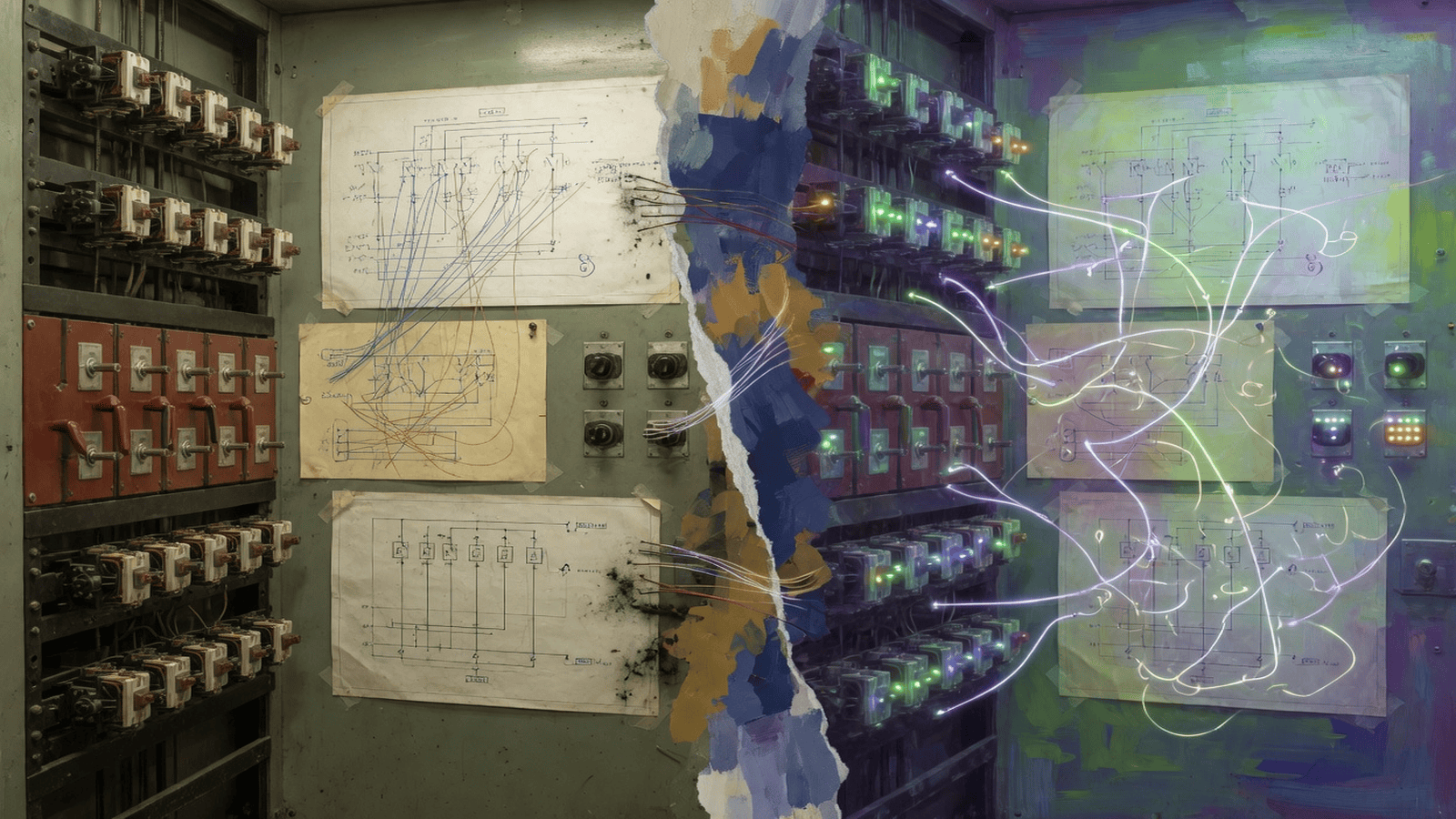
Picture the same elevator bank across three renovations, spread over fifteen years, though the elevator itself never seems to age: 1943, then 1949, then 1958. Nobody posts a sign explaining which era’s dispatch panel is running behind the doors, and for a stretch, riding it, you genuinely couldn’t tell. That’s the detail worth sitting with. A system that behaves intelligently doesn’t announce what kind of intelligence it has. You only find out what’s inside once it’s wrong, and you watch what it does next.
I. A Panel That Only Repeats Itself
The first version is not trying to learn anything. In 1943, Warren McCulloch and Walter Pitts published A Logical Calculus of the Ideas Immanent in Nervous Activity, a paper that has nothing to do with elevators and everything to do with what a neuron could, in principle, be reduced to: a unit that takes several inputs, sums them, and fires if the total clears a threshold — otherwise it stays silent. Wire enough of these together and you can build, provably, any function expressible in formal logic. AND, OR, NOT: all reachable with thresholds and the right connections.
The elevator this describes is a bank of relays, not a mind. If the button is pressed, and the car isn’t already stopped on this floor, and the load sensor reads under capacity, then halt. Every condition is fixed at installation. An engineer decided the thresholds; the machine just evaluates them, forever, the same way, until someone opens the panel and rewires it by hand. That is the whole of McCulloch and Pitts, and it is easy to read backward into it a claim about learning that isn’t there. Their neuron is a logic gate wearing biological language. The paper’s achievement was showing that a network of these gates could compute anything a Turing machine could — a proof about what’s expressible, not a mechanism for how a system might arrive there on its own.
II. The Corridor That Starts to Remember
Six years later the elevator gets an upgrade nobody asked it to notice. Donald Hebb’s 1949 book The Organization of Behavior proposed a rule for how connections between neurons might change with use: when one cell’s firing repeatedly helps fire another, the link between them should strengthen. Hebb’s own sentence is more careful than the slogan it later became — “cells that fire together, wire together” is a paraphrase, coined decades afterward by Siegrid Löwel, and it flattens a real hypothesis about correlated activity and synaptic growth into something crisper than Hebb ever claimed to have proven. But the underlying idea holds: a connection’s strength is no longer fixed at installation. It is a record of how often two things have happened together.
Extend the elevator, carefully, and you get something like this: the building notices that requests for floor 3 and floor 7 cluster every weekday morning, minutes apart, the same two names on the sign-in sheet. A Hebbian dispatch system would strengthen the pairing — start treating a request for one as weak evidence the other is coming — without anyone reprogramming the panel. Nothing here compares an outcome to a goal. There is no error term, no notion of a mistake. It is closer to habit than to judgment: two things that keep occurring together start to occur together more readily, which is a real kind of plasticity and a real distance short of learning from being wrong.
III. The Panel That Grades Its Own Mistakes
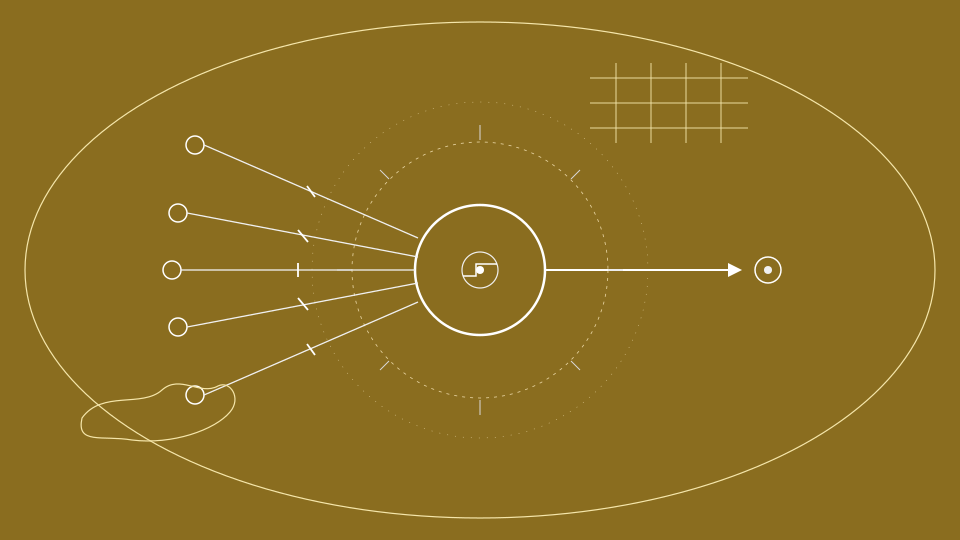
The 1958 version is the first one that would recognize the word “learning” the way a modern reader means it. Frank Rosenblatt’s perceptron took weighted, thresholded units — McCulloch and Pitts’s machinery — and gave them something neither prior model had: a rule for changing the weights in response to being wrong. Show the machine an input, let it guess, compare the guess to the right answer, and nudge every weight a little in whichever direction would have made the guess less wrong. Repeat. I’ve written before about how far that single idea eventually travels — through backpropagation, through GPUs, into everything now called a language model — but the detail that matters here is narrower and comes first: Rosenblatt’s rule needs a target to fail against. Correlation alone can’t produce it. Fixed logic can’t produce it. It requires a system built to notice the gap between what it did and what it should have done, and to treat that gap as instruction.
Give the elevator this upgrade and the story finally earns the word. The building logs complaints — floor 7 keeps waiting too long — and the dispatch system doesn’t just strengthen an association, it adjusts a specific weight in the direction the complaint implies, then checks whether the adjustment helped, then adjusts again if it overcorrects. That is a feedback loop closed against an outcome, not a rule wired in by an engineer and not a habit accumulated by repetition. It is the first of the three stages that could plausibly be sued for negligence, because it is the first one making decisions it can be shown, after the fact, to have gotten wrong.
IV. Three Words That Aren’t Synonyms
Lay the three side by side and the word “learning” splits into pieces that get collapsed together constantly, including by people who should know better. McCulloch-Pitts gave the field a device — a way to compute logical functions out of threshold units — with no adaptation at all. Hebb gave it a mechanism for change: connections that grow with correlated use, no error signal required, no notion that the correlation might be wrong. Rosenblatt gave it a criterion: a target, a comparison, and a rule for updating weights against the size and direction of the miss. Fixed logic, then correlation, then error correction — three different answers to “what should change, and why,” arriving fifteen years apart, from three people who were not in dialogue about a shared roadmap and had no way of knowing they were building one.
It is tempting, with sixty-odd years of hindsight, to read this as a planned ascent: crude rules, then better rules, then finally the right rule, each waiting patiently for its successor. That is not what happened. McCulloch and Pitts were not trying to build a learning machine and failing at it; they were answering a question about computability that had nothing to do with adaptation. Hebb was a psychologist proposing a physiological hypothesis about memory, decades before anyone could test it in real neural tissue. Rosenblatt built hardware — the Mark I, a room of motorized potentiometers — because the Navy was funding pattern recognition, not because he set out to complete someone else’s three-part outline. The arc is real. It is also something historians assembled afterward, out of three people solving three different problems who happen, in retrospect, to have handed each other exactly what the next one needed.
V. What the Building Actually Proves
None of this makes the elevator a documentary. Real dispatch systems were never built this way, and the later two stages are frank extensions of an analogy invented for the first one, not descriptions of anything an elevator company ever shipped. That’s fine — the analogy was never claiming to be elevator history. What it can do honestly is separate three things that get called “the machine learned” in casual conversation about AI, then and now: a system executing rules someone else wrote, a system whose structure drifts toward whatever keeps recurring, and a system that checks its own output against a target and revises itself when the two disagree. Only the third one is answerable to being wrong. The other two can be sophisticated, even useful, and still never once have to notice a mistake — which turns out to be the entire distance between a very elaborate lock and something that can be taught.
Further reading
- Warren McCulloch & Walter Pitts, A Logical Calculus of the Ideas Immanent in Nervous Activity (1943)
- Donald O. Hebb, The Organization of Behavior (1949)
- Frank Rosenblatt, The Perceptron: A Probabilistic Model for Information Storage and Organization in the Brain (1958)
- Marvin Minsky & Seymour Papert, Perceptrons (1969)
- The Perceptron — Why a Single Line Still Matters