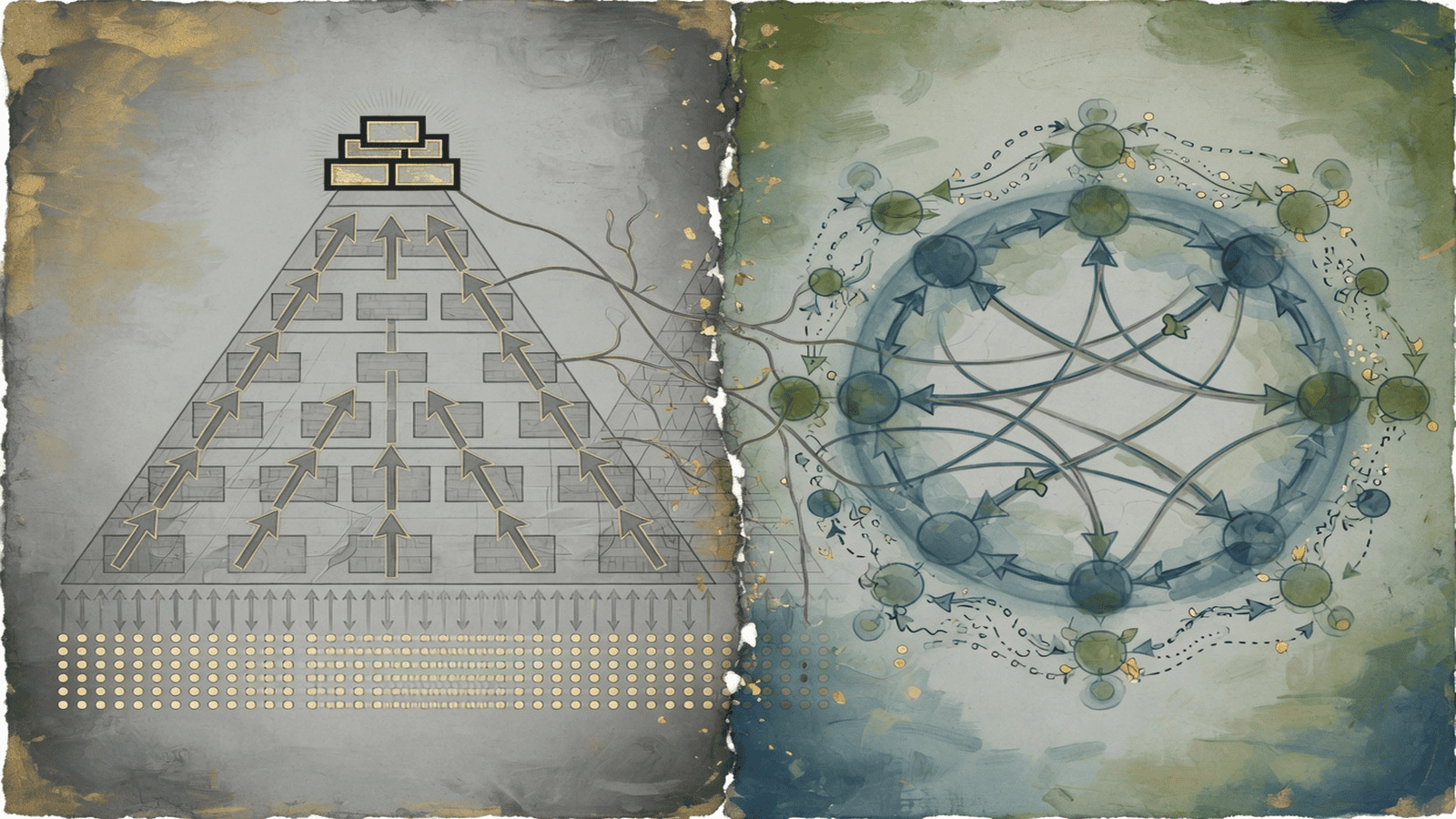
In 2012 the economist Daron Acemoglu and the political scientist James Robinson published Why Nations Fail, and gave a name to something most people had only felt: institutions built to funnel the wealth their workers create toward a narrow group that controls the gate. They called this extraction, and set it against its opposite — institutions built so that the people producing the value are also the people who keep it, which they called inclusion. The distinction sounds obvious once stated. What’s harder is finding the inclusive kind in the wild, sustained, at any size worth studying, rather than as a slogan painted over an extractive arrangement underneath.
I. Extraction as the Default
Most institutions extract, and they don’t need to be evil to do it. A corporation that returns value to shareholders before employees, a subway system whose fare structure quietly subsidizes a downtown business district, a professional title that decouples pay from function — the mechanism doesn’t require a villain, only a design where surplus has one direction to flow: up and away from the people who generated it. It is the same shape whether the surplus is money, attention, or trust, and it is the shape that keeps recurring wherever institutions meet the people they claim to serve.
The interesting cases are the ones where the flow reverses. Not charity, which is extraction with a rebate attached, but institutions engineered so the surplus never leaves the hands that made it in the first place.
II. Three Places It Actually Works
Medellín built one. Its metro system spent decades running a civic campaign — Este es su metro, this is your metro — that began before the first train ran and has held for thirty years, turning a subway into something riders police and protect rather than merely use. What made that campaign more than propaganda was sequencing and follow-through: citizens were told the system was theirs, and then they were actually allowed to keep it that way, generation after generation. The mechanism, and the fine line between civic narrative and propaganda that share the same three words, is the subject of an earlier piece on the metro.
Spain built another, out of steel and appliances instead of trains. The Mondragón Corporation, founded in the Basque town of the same name in 1956 by a Catholic priest and five engineering students, is today one of Spain’s largest industrial groups — and it has no external shareholders. Workers own the cooperatives they staff, elect the councils that govern them, and vote on how surplus gets reinvested or distributed, one member, one vote, regardless of capital contributed. William Foote Whyte and Kathleen King Whyte documented the model at length in Making Mondragón, and the striking thing about the case, seventy years on, is not that it worked once — it’s that it has kept working through recessions that killed conventional competitors, because a workforce that owns its factory does not lay itself off the way a distant shareholder lays off someone else’s job.
The third case never touches a factory floor. Linux, Wikipedia, the IETF, the Apache Foundation — the open-source and open-knowledge movements built institutions where governance sits with the people doing the work, contributors elect or earn their way into stewardship, and the surplus — the kernel, the encyclopedia, the protocol — is a public good available to anyone, including the institution’s own critics. The IETF’s founding ethos, “rough consensus and running code,” coined by the engineer David Clark, is as close to a constitution as the internet’s plumbing has, and it has produced standards used by billions of people who have never heard of it.
III. The Pattern Underneath
Line the three cases up and the same three design features appear in each. Governance sits with the governed — not democracy exactly, which majorities can capture, and not consensus exactly, which minorities can stall, but a structural minimization of the distance between the people making a decision and the people who live inside it. Surplus stays local — reinvested, distributed to members, or released as a public good, rather than skimmed toward an owner who never touches the thing being made. And exit is real and cheap — a cooperative member, a Wikipedia contributor, a Linux user unhappy with where a project is going can leave without forfeiting their stake, their data, or their access, which is precisely the credible threat that keeps governance honest between elections.
Elinor Ostrom spent a career formalizing a version of this pattern for shared physical resources — irrigation systems, fisheries, forests — and won the 2009 Nobel Memorial Prize in Economics for showing, against a century of theory predicting that shared resources are always overexploited, that communities routinely govern them sustainably when they can monitor use, sanction cheaters cheaply, and set their own rules rather than have them imposed from outside. Governing the Commons reads today less like an economics monograph and more like a blueprint that Mondragón, the IETF, and Medellín’s transit authority all arrived at independently, without citing her and in some cases without knowing her name.
IV. Why the Pattern Stays Marginal
None of this is inefficient. Mondragón outcompetes shareholder-owned firms in its own sector. Wikipedia is the most consulted reference work in human history. Linux runs most of the servers on earth. And yet all three remain exceptions rather than the norm — which is the part of the pattern that should trouble anyone tempted to treat it as a template rather than a fragile achievement.
The sociologist Robert Michels named the obstacle a century ago, studying the socialist parties and labor unions of his own time: even organizations founded explicitly to be governed by their members tend, as they grow, to concentrate power in an administrative class that outlasts and outmaneuvers the rank and file. He called it the iron law of oligarchy in Political Parties, and it is the shadow hanging over every one of these three institutions — Mondragón has had internal fights over exactly this drift, and Wikipedia’s own governance has grown a bureaucracy its early contributors would not recognize.
The deeper reason may be simpler than oligarchy, though: extraction can scale before it earns trust, and non-extraction cannot. A shareholder-owned firm can expand into a market with no relationship to the people it will employ there and sort out legitimacy later, or never. A cooperative, a commons, an open project needs the trust to already be present, or built face to face, before it can function at any size — the same mechanism that makes these institutions resistant to capture is what makes them slow, sometimes permanently slow, to grow.
V. What the Pattern Is Worth Anyway
That should sober anyone hoping for a blueprint that scales on command. But it doesn’t make the pattern decorative. Three institutions, on three continents, working from three completely different starting materials — trains, factories, code — arrived at the same three design rules without coordinating. That kind of convergence is itself evidence, the way three independent expeditions reaching the same mountain by different routes is evidence the mountain exists. The open question is not whether non-extractive institutions are possible. It’s whether trust can ever be manufactured at the speed extraction manages, or whether the two will always run on different clocks — one that can be switched on overnight, and one that has to be earned, slowly, by people willing to keep a thirty-year promise.
Further reading
- Daron Acemoglu & James Robinson, Why Nations Fail: The Origins of Power, Prosperity, and Poverty (2012)
- William Foote Whyte & Kathleen King Whyte, Making Mondragón: The Growth and Dynamics of the Worker Cooperative Complex (1988)
- Elinor Ostrom, Governing the Commons: The Evolution of Institutions for Collective Action (1990)
- Robert Michels, Political Parties: A Sociological Study of the Oligarchical Tendencies of Modern Democracy (1911)