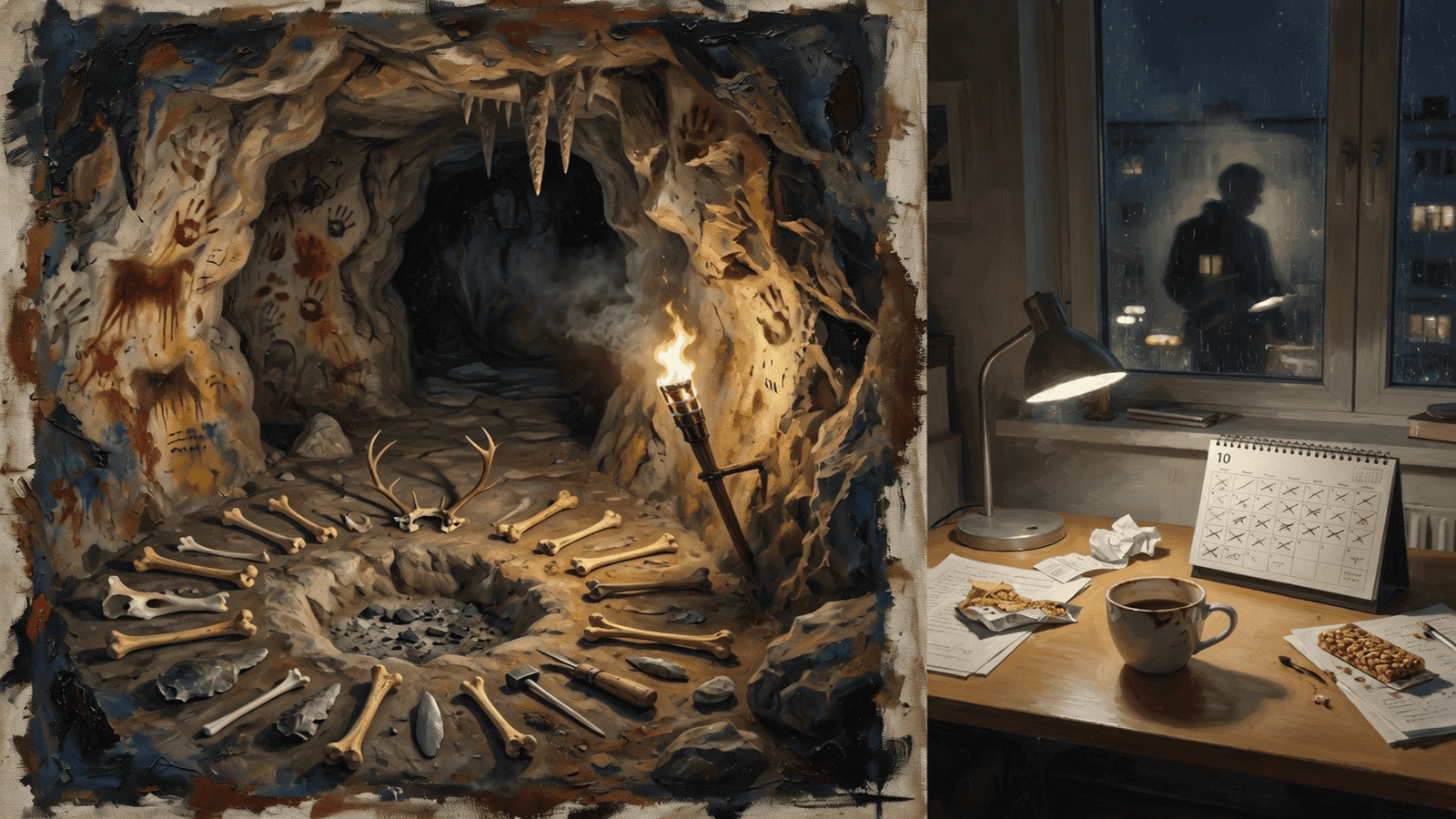
Homo naledi had a brain about a third the size of ours — closer to a chimpanzee’s than to a modern human’s — and yet, according to a team led by the paleoanthropologist Lee Berger, some of them may have carried their dead into the Rising Star cave system in South Africa, laid them out with what looks like intention, and possibly scratched geometric marks into the surrounding rock. The claim, restaged for a wide audience in the 2023 documentary Unknown: Cave of Bones, is still contested — peer reviewers have called the physical evidence for deliberate burial inadequate in its present form, and the debate has not settled. What has settled is the arithmetic around it. Those bones are somewhere between 236,000 and 335,000 years old. A human life, at generous best, is a hundred. The documentary does not insult the ego. It does something worse: it makes the ego statistically irrelevant.
I. The Violence of Scale
Two numbers collide and do not reconcile. On one side: a quarter of a million years of hominins entering caves, shaping stone, doing things to their dead that look deliberate even when we cannot be certain they were. On the other side: one life, one inbox, one calendar, one body that spends most of its waking hours behaving as though it were permanent. Deep time doesn’t argue with the ego. It just sits there, enormous and indifferent, until the ego notices how small its unit of measurement actually is. A century feels like an eternity from the inside of a Tuesday. Against a quarter-million-year backdrop it is a rounding error.
II. History’s Vanity
We flatter ourselves by privileging history over prehistory. The bias feels methodologically reasonable: history has documents, names, dates, signatures, institutions that outlive their founders. Prehistory has sediment, fragments, and inference — nothing that can footnote itself. But watch how the naledi debate actually unfolds and the vanity shows through. The resistance to Berger’s burial claim keeps circling back, explicitly or not, to brain size — as if intention, grief, and care for the dead require a skull of a particular volume before they count as real. Scientists rightly demand better evidence before accepting a claim released through preprints and a Netflix special rather than conventional peer review; that caution is sound method. But underneath the caution sits an older reflex: we grant interiority to what resembles our own skull. A species one-third our cranial capacity doing something we consider sacred is not just scientifically surprising. It’s insulting to the story we tell about what earned us the right to mourn.
III. What Counts as Human
The Rising Star system is not an easy place to leave a body. Reaching the chamber where the bones were found means squeezing through a passage so narrow that only a slender adult can pass, in total darkness, more than thirty meters underground. If naledi really did carry its dead that route, repeatedly, the act required memory of a path, a shared reason compelling enough to risk one’s own body for it, and something that functions like planning even without a modern cortex to run it. None of that needs correcting for brain size. It needs correcting for definition. If “what makes us human” still assumes a threshold of neural hardware, this fossil is the one that breaks the threshold. What it does not break is the older, vaguer criterion underneath: a relation to the dead that refuses to treat a body as disposable — a sense that life is not only biological duration but membership in a before and an after.
IV. The Transition Hypothesis
What if being human was never a finished state, only a permanent transition? Between animal immediacy and symbolic worlds. Between living and narrating the living. Between the body that ends and the group that keeps speaking your name after it does. Read this way, Rising Star is not a data point about an extinct side branch of the family tree. It is a scene from a long rehearsal — the species, or something adjacent to it, practicing how to inhabit time together, long before anyone had the vocabulary to call it that.
V. Ego as Closed Circuit
The ego does not like deep time. It is self-contained, local, near-sighted — built to protect coherence in the short run: this body, this biography, this Tuesday’s urgency. Ernest Becker’s The Denial of Death argues that almost all human culture is a heroic project built to manage the terror of exactly this fact — that we die, and know it, and cannot bear knowing it directly. Sheldon Solomon, Jeff Greenberg, and Tom Pyszczynski turned Becker’s claim into three decades of experimental psychology in The Worm at the Core, showing how reminders of mortality reliably push people toward tighter in-groups, stronger nationalism, harsher judgment of outsiders — the ego reaching for anything that promises to outlast the body. But naledi complicates the story in an interesting direction. Becker assumed this machinery required the kind of self-consciousness that comes with a fully modern mind. If a small-brained hominin was already carrying its dead into the dark with apparent care, the impulse toward ritual attention to mortality may predate the anxious, monument-building ego Becker describes. Ritual, in that reading, isn’t a defense thrown up against death-terror after the fact. It’s older and plainer than that: continuity-making, practiced before there was a self sophisticated enough to be terrified.
That reframes the discomfort of the documentary as something other than nihilism. It’s calibration. A smaller ego, sized correctly against two hundred and fifty thousand years instead of eighty, produces a larger ethics almost automatically — less obsession with personal monument, more attention to stewardship, to the communities and caves and libraries that carry meaning past any one body that helped build them. The bones in Rising Star didn’t leave a name. They left a gesture. Two hundred and fifty thousand years later, it’s still legible. Most inboxes will not do as well.
Further reading
- Unknown: Cave of Bones (2023), dir. Mark Mannucci
- Ernest Becker — The Denial of Death (1973)
- Sheldon Solomon, Jeff Greenberg, Tom Pyszczynski — The Worm at the Core: On the Role of Death in Life (2015)