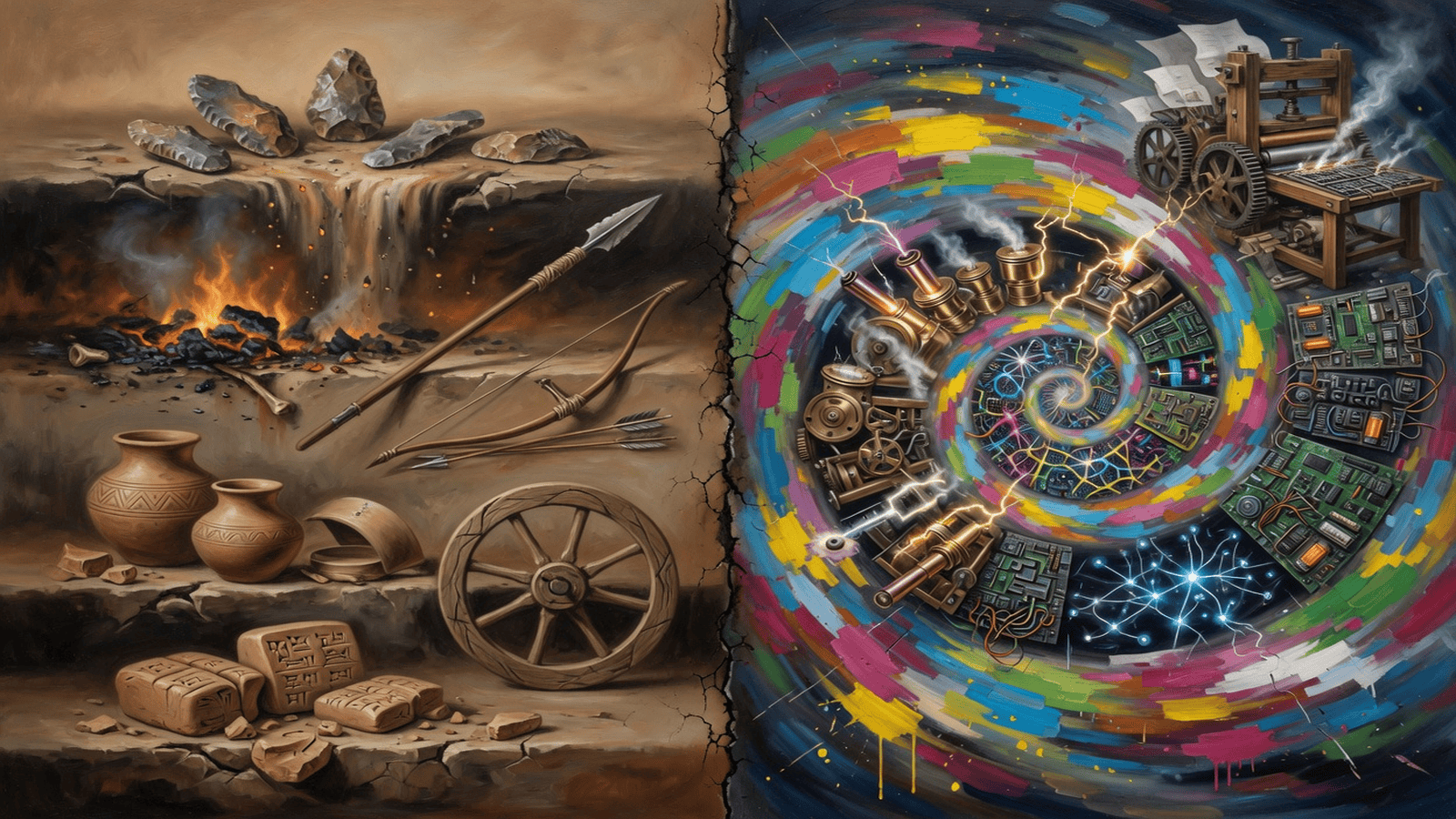
Two point six million years passed between the first deliberately chipped stone edge and the first controlled use of fire. Twenty-seven years passed between the public internet and a machine that drafts a legal brief on request. Somewhere in that arithmetic is the whole history of human invention, and it is not primarily a story about tools getting better. It is a story about the gap between tools shrinking, relentlessly, until the gap itself became the news. AI is not a rupture with that history. It is the newest point on a curve that has bent the same direction since a hominin first swung a rock with an edge on it — and the open question is whether a species built for millennium-scale change can now survive a decade-scale one.
I. The First Toolmakers, and the Silence After
Around 2.6 million years ago, in the East African Rift, early hominins — not yet Homo sapiens, not even yet Homo in some cases — began knocking flakes off cobbles to produce a cutting edge. Crude as they were, these Oldowan tools changed the relationship between body and world: hand plus stone became a new survival system, portable and repeatable in a way teeth and claws are not.
Then, for a very long time, nothing of that magnitude happens again. Controlled fire is conventionally placed around one million years ago, with sites like Wonderwerk Cave pushing the debate earlier. Richard Wrangham argues in Catching Fire that cooked food, not raw meat, is the actual engine of human brain growth — cooking predigests calories outside the body, letting the gut shrink and the skull’s energy budget go somewhere more interesting. It is a strong claim about why fire mattered. What is easy to miss is when: roughly 1.6 million years separate the stone edge from the hearth, a silence longer than the rest of hominin technological history put together.
II. Composite Engineering Before Engineering Had a Name
The next leaps are not new materials but new arrangements of existing ones. Hafted spears, evidenced at Kathu Pan in South Africa around 500,000 years ago, bind stone point to wooden shaft — a composite object requiring two materials, an adhesive or binding technique, and a plan for how the parts cooperate under stress. This is systems thinking with no word yet for “system.”
The bow and arrow, appearing at Sibudu Cave roughly 64,000 years ago, adds something more abstract still: stored energy, released on command, with tension and precision standing in for raw force. Then pottery, at sites like Xianrendong Cave in China around 20,000 years ago, arrives as a storage revolution — a way to hold surplus stable across seasons, quietly reordering settlement and diet a full eight thousand years before agriculture makes it official policy. Kevin Kelly’s case in What Technology Wants is that none of this is a series of isolated sparks; each invention becomes a platform the next one stands on, a compounding system he calls the technium — which is precisely why the gaps start closing even before anyone is writing the gaps down.
III. The Neolithic Stack
Agriculture and the plow, conventionally dated to around 10,000 BCE, trigger the Neolithic package: sedentary life, stored surplus, specialization, hierarchy, the state. James C. Scott’s Against the Grain complicates the celebration — he argues grain agriculture wasn’t chosen for its abundance but for its legibility: a cereal floodplain can be surveyed, taxed, and rationed by a state in a way a forager’s varied diet cannot, which is why the earliest states cluster around wheat and barley rather than richer, harder-to-administer landscapes. The stack was never just technical.
The wheel appears later than intuition suggests, around 3,500 BCE in Mesopotamia — and writing, in the form of cuneiform, arrives in the same window and region. Transport and inscription showing up together is not coincidence; each scales the other, moving goods and recording who owns them. Metallurgy compounds the shift: bronze by 3,000 BCE, iron by 1,200 BCE, each delivering harder, more durable tools and weapons to a wider population. Civilization starts running on cumulative technical layering — a stack in the software sense, centuries before there is software.
IV. From Centuries to Decades
After antiquity, the spacing between major leaps keeps shrinking, and it becomes measurable enough to tabulate.
| Breakthrough | Date | Years since previous |
|---|---|---|
| Printing press (Gutenberg) | 1440 | ~2,640 |
| Steam engine (Watt, practical) | 1776 | 336 |
| Electricity as infrastructure (Edison) | 1882 | 106 |
| Computer (ENIAC) | 1945 | 63 |
| Public internet (Mosaic) | 1993 | 48 |
| Large language models | ~2020 | 27 |
Ray Kurzweil’s The Singularity Is Near names this the law of accelerating returns: paradigm shifts don’t just happen faster, the rate at which they happen faster is itself increasing. Ian Morris turns the same intuition into an actual chart in Why the West Rules—For Now — his social development index, tracking energy capture, information technology, war-making capacity, and urbanization across sixteen thousand years, sits nearly flat for most of that span and then bends almost vertical after 1800. The timeline is not linear progress. It is compressed intervals, and for the first time in this story, we have the data to plot the compression rather than just narrate it.
V. What Compression Doesn’t Measure
The acceleration story is real, but it is not evenly real. Vaclav Smil spends How the World Really Works pointing at the parts of civilization the compression narrative quietly skips: cement, steel, plastics, and ammonia — the four material pillars everything else stands on — have not been fundamentally reinvented in over a century. The Haber-Bosch process, patented in 1909, still fixes the nitrogen that feeds roughly half the people alive today. Computation and communication accelerate on a curve steep enough to build a religion around; food, construction, and heavy energy infrastructure move at something closer to a nineteenth-century pace.
That unevenness is the actual bottleneck. Institutions, legal systems, and ethical frameworks were built for the slow half of that ledger — century-scale change, generational absorption — and are now asked to referee the fast half in real time. We inherited brains tuned by a species that took 1.6 million years to get from stone to fire, and we are asking those brains to metabolize a technology stack that reinvents itself every decade. The question a species that patient about fire now has to answer is not whether it can keep inventing. It is whether it can live inside its own inventions before the next one arrives.
Further reading
- Richard Wrangham — Catching Fire: How Cooking Made Us Human (2009)
- Kevin Kelly — What Technology Wants (2010)
- James C. Scott — Against the Grain: A Deep History of the Earliest States (2017)
- Ray Kurzweil — The Singularity Is Near: When Humans Transcend Biology (2005)
- Ian Morris — Why the West Rules—For Now (2010)
- Vaclav Smil — How the World Really Works (2022)