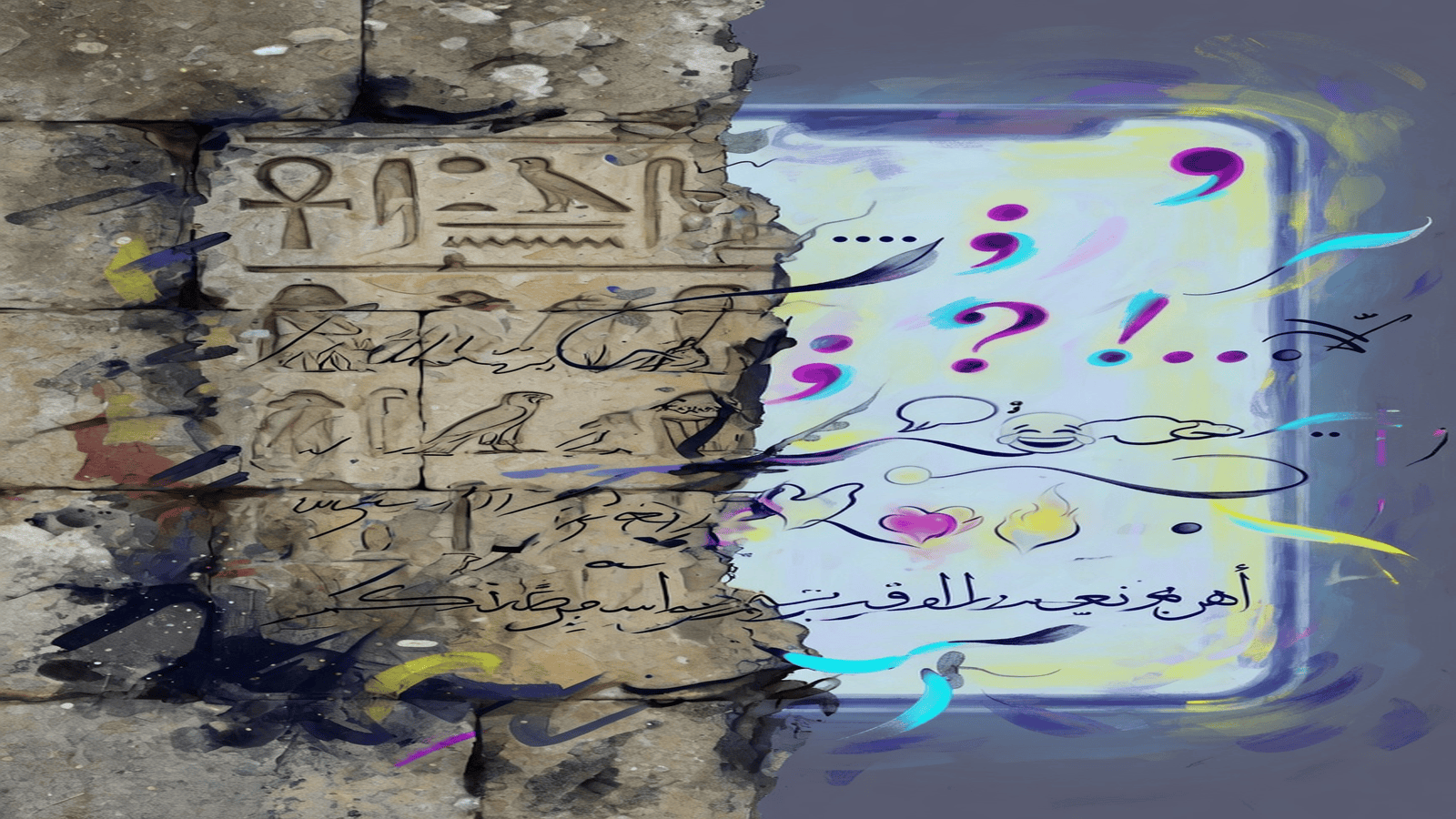
Send a text that says “fine” and the person on the other end will read anger. Send “fine 🙂” and they will read something closer to what was meant, though nothing about the word has changed. The little yellow face has done more grammatical work in one glyph than an adverb could manage in a sentence, which is a strange thing for a species that spent roughly five thousand years engineering its way out of pictures.
Civilizations do not move on a straight line from image to text and stay there. They oscillate. One era favors dense visual symbols that carry a worldview in a single glance; a later era invents abstract writing that can scale law, trade, bureaucracy, and science far beyond what any picture could hold. Then the abstraction goes cold for the ordinary business of being in a mood near another person, and gesture, tone, and face get smuggled back in through symbols. Emoji are not a childish detour from literacy. They are a structural return of imagery inside a civilization that never stopped needing it.
I. Before the Alphabet, Image as Thought
Egyptian hieroglyphs were never merely decorative pictures standing in for words, the way a rebus stands in for a sound. They were a layered system in which the same mark could function as a phonetic sound, a semantic idea, and a sacred icon simultaneously — a fact that defeated European scholars for over a millennium precisely because they assumed picture-writing had to be simple, and simple meant primitive. Mark Collier and Bill Manley’s How to Read Egyptian Hieroglyphs lays out just how much grammatical machinery hid inside those falcons and reeds — determinatives, phonetic complements, ideograms doing three jobs at once. A pharaoh’s name enclosed in a cartouche was not merely spelled; it was ritually protected by the act of enclosure, the writing itself understood as a technology with causal power in the world, not a passive record of one. This is worth sitting with, because it challenges a modern prejudice that abstraction is always the upgrade. Sometimes abstraction is capacity. Sometimes it is amputation.
II. The Alphabet Buys Scale by Selling Texture
The Phoenician innovation — roughly twenty-two signs, each tied to a sound rather than a thing — was one of the great compressions in the history of cognition. Walter Ong traces in Orality and Literacy how phonetic writing did not just record language more efficiently than image-systems; it restructured thought itself, making possible the kind of sustained, sequential, decontextualized argument that produces law codes, syllogisms, and eventually double-entry bookkeeping. A civilization that can write “the king owes the temple forty measures of grain” in a portable, teachable, endlessly recombinable script can run an empire that a civilization limited to sacred image-signs cannot. But the compression has a cost schedule attached, and the bill comes due in exactly the register hieroglyphs handled well: tone flattens, affect becomes something you have to describe rather than show, and ambiguity multiplies the moment the message gets short enough to travel fast. A love letter can survive the loss of texture because it has room to compensate in volume. A text message cannot.
III. Digital Writing Reinserts the Gesture
This is the gap emoji were built to close, and they close it with a precision that looks trivial only if you haven’t tried to send an ironic sentence over a medium with no face attached to it. Gretchen McCulloch documents in Because Internet how emoji function less like a vocabulary of stickers and more like paralinguistic gesture — the raised eyebrow, the half-smile, the roll of the eyes that a sentence alone cannot carry. Vyvyan Evans makes the stronger claim in The Emoji Code: emoji did not appear because literacy declined, but because a genuine functional gap opened up when writing moved into a channel — instant, informal, constant — that oral speech used to occupy, and only oral speech had ever supplied stance, warmth, and distance for free. Marshall McLuhan would have recognized the shape of the trade: in Understanding Media, his distinction between “hot” media, which arrive high-definition and demand little participation from the audience, and “cool” media, which arrive sparse and pull the audience in to complete the meaning, maps almost exactly onto plain text versus text-with-emoji. The paradox worth naming is that the more text a culture produces, the more of that text needs an image bolted on just to stay legible as human.
IV. An Archaeology of Symbol Migration
Trace the signs that have crossed between script, ledger, and screen and the oscillation stops being an abstraction:
| Symbol | English | Spanish | French | Origin / migration |
|---|---|---|---|---|
| & | Ampersand | Ampersand / y comercial | Esperluette | Latin ligature of et |
| @ | At sign | Arroba | Arobase | Commercial and accounting mark, tied in Iberia to the arroba unit of weight |
| # | Hashtag / number sign | Almohadilla / numeral | Dièse / croisillon | Printer’s and bookkeeper’s mark, repurposed by social media |
| % | Percent | Por ciento | Pourcent | Latin per centum, shorthand for a ratio |
| $ | Dollar sign | Signo de dólar | Signe dollar | Likely descended from the abbreviated peso mark |
| ¶ | Pilcrow | Calderón | Pied-de-mouche | Paragraph marker from manuscript and print culture |
| ¿ / ¡ | Inverted punctuation | Signos de apertura | Not used | Eighteenth-century Spanish readability innovation |
| 😀 | Grinning face | Cara sonriendo | Visage souriant | Unicode-era pictograph restoring tone and affect |
None of this is trivia. Every row is a fossil of the same repair operation performed by a different century — an abstract mark drifting back toward pictorial, functional urgency, then hardening into convention again until the next gap opens.
V. Narrative and Image Were Never at War
The usual framing insists on a winner: either civilization is drifting toward illiteracy through icons and memes, or textual seriousness must be defended against the encroaching image. Neil Postman’s Amusing Ourselves to Death made the sharpest version of the first case, arguing that a culture saturated in images loses the capacity for the kind of linear, skeptical argument that print discourse trained into it. The warning still has force against television and its descendants, but it maps poorly onto emoji, which do not replace text or compete with it for attention the way a broadcast image competes with a printed page — they sit inside the sentence, subordinate to it, doing exactly the narrow job punctuation has always done. Narrative supplies sequence, causality, argument. Image supplies salience, emotion, the pattern recognized before it can be explained. A culture loses depth when either side wins outright, and the healthier reading of the last five thousand years is not decline or triumph but braid: two modes of meaning-making that keep lending each other what the other one lacks, on a schedule longer than any single medium’s hype cycle.
The friend who read anger into a plain “fine” was not being oversensitive. They were reading a text-only channel with the same instincts a much older channel trained into all of us, instincts that the alphabet suspended but never actually retired. The emoji that fixed the misunderstanding was not a concession to a shorter attention span. It was Egypt, quietly, reasserting a claim it never really gave up.
This isn’t only historical curiosity for me lately. In the evenings I’ve been building caratul.ai, a small tool that takes the ontology underneath a piece of writing — its tags, its concepts, the shape of what it’s actually arguing — and renders that back as a single generated seal instead of a paragraph of labels. It is a modest experiment, nowhere near a cartouche or a properly designed icon system, but it sits on the same fault line this essay has been tracing: a small bet that connotation can sometimes carry what denotation would otherwise need a page to spell out.
Further reading
- Mark Collier and Bill Manley — How to Read Egyptian Hieroglyphs (1998)
- Walter Ong — Orality and Literacy: The Technologizing of the Word (1982)
- Marshall McLuhan — Understanding Media: The Extensions of Man (1964)
- Gretchen McCulloch — Because Internet: Understanding the New Rules of Language (2019)
- Vyvyan Evans — The Emoji Code: The Linguistics Behind Smiley Faces and Scaredy Cats (2017)
- Neil Postman — Amusing Ourselves to Death: Public Discourse in the Age of Show Business (1985)