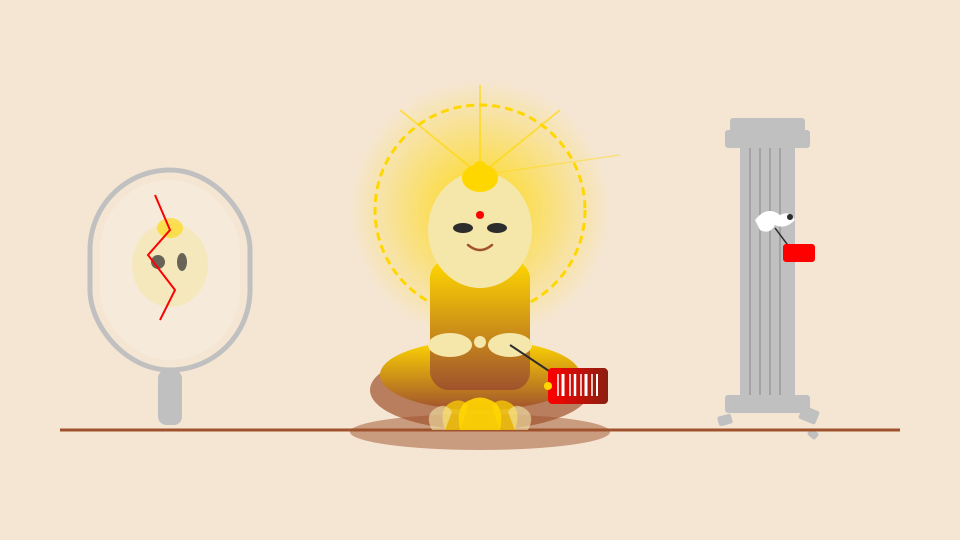
A stranger stopped me in the middle of the street a few days ago to offer, free of charge, peace — provided, they clarified, by a reputable third party. I don’t remember taking whatever was being handed out, but the pitch outlasted the moment: someone had made explicit what the rest of the culture usually only implies, that peace is a good somebody else already owns and is willing to pass along, if you’ll just stop long enough to hear the terms.
Ask someone what they want and a striking number will say, eventually, some version of “peace.” Not a raise, not a relationship, not an achievement — just to feel settled. It sounds like the most reasonable request a person could make. It is also, on inspection, one of the stranger requests, because the thing being asked for does not exist anywhere in the historical or biological record as a stable condition, and the asking itself tends to function less as a plan than as an excuse.
I. The Search That Refuses What It Finds
“Looking for peace” rarely means what it announces. Pressed on specifics, it usually decomposes into a list of things the person wants to stop feeling: discomfort, uncertainty, conflict, the low hum of mortality in the background of an ordinary afternoon. That is a coherent wish, but it is not a wish for peace — it is a wish for reality to stop doing what reality does. The search gets framed as a positive pursuit, a destination with a name, precisely because “I would like the volatile parts of existence to be quietly removed” sounds like a demand nobody is entitled to make. Calling it a search for peace disguises a refusal as an aspiration.
II. A World Never Built for Comfort
The refusal is aimed at something specific: a universe that was never designed for anyone’s comfort in the first place. Weather systems do not negotiate. Cell mutation does not pause for grief. Predation, scarcity, and entropy are not glitches in an otherwise serene cosmic architecture; they are close to the architecture itself. Human institutions, built by the same unstable material, inherit the instability rather than escaping it — markets crash, alliances dissolve, bodies fail on their own schedule regardless of what the calendar says. None of this is a special modern misfortune. It is closer to the baseline condition every generation has quietly renegotiated with, usually by pretending, for as long as the pretending holds, that this time will be the exception.
III. The Marketplace Sells the Symptom Back
Modern consumer culture has found the exception profitable to pretend on someone else’s behalf. It packages “peace” as a purchasable lifestyle: the retreat, the supplement stack, the productivity app that promises calm through better scheduling, the candle whose marketing copy is one part scent and nine parts implied serenity. Byung-Chul Han describes the mechanism precisely in The Burnout Society — a culture of relentless positivity and self-optimization that produces exhaustion as its main byproduct, then sells the treatment for the exhaustion it caused. The wellness industry doesn’t invent the anxiety of an unstable world; it monetizes the search for an exit from it, and because the search was never going to succeed, the customer returns for the next product in the line. Chögyam Trungpa had a name for the individual version of the same trap: spiritual materialism, the ego consuming enlightenment as another acquisition. The market simply industrialized it and put it on a subscription plan.
IV. Three Grammars for the Same Move
Strip away the branding and a genuinely useful move survives underneath, one that several traditions arrived at independently, in different vocabularies, for the same reason. Epictetus opens the Enchiridion with the dichotomy of control: some things are up to us, most things are not, and the entirety of a functioning life depends on sorting correctly between the two categories rather than expending effort trying to govern weather, other people’s opinions, or the eventual dissolution of the body. Buddhist teaching arrives at a structurally similar place from a different direction — not sorting what can be controlled from what can’t, but loosening the grip that assumes control was ever the right relationship to have. Pema Chödrön’s When Things Fall Apart takes groundlessness as the actual ground: not a problem to be solved before peace can begin, but the condition peace has to be found inside of, if it is found at all. Camus supplies the third grammar, the lucid one, in The Myth of Sisyphus — the refusal to look away from absurdity, and the argument that one must imagine Sisyphus happy not despite the boulder but because he has stopped waiting for a version of the hill without one. Stoic discipline, Buddhist non-attachment, existentialist lucidity: three unrelated traditions, converging on the same instruction, which is to stop treating contact with an unstable world as the failure state and start treating it as the only available terrain.
V. Peace as Residue
None of this is a case for passivity, and it is worth being precise about that, because “accept what you cannot control” slides easily into an alibi for not fixing what can, in fact, be fixed. The dichotomy of control was never a reason to stop building better institutions, treating curable disease, or reducing the specific, historically produced forms of violence that are not features of the universe but products of decisions someone made and someone else could unmake. The traditions above are unanimous that acceptance applies to the weather, not to injustice — the sorting itself, done honestly, is most of the work. What all three converge on is narrower and more useful than the wellness industry’s version: stop chasing peace as an object to be acquired, stop pursuing it as a state that a better routine will eventually deliver, and instead practice full contact with things as they actually are, including the parts that are volatile, contradictory, and beyond anyone’s authority to smooth out. Peace, on this account, is not a destination reached by better navigation. It is a byproduct that shows up, briefly and unreliably, whenever the navigating stops.
The stranger on the street was not selling anything exotic. Every culture keeps a narrative about where peace comes from and how to get it — a stoic discipline, a pamphlet, a candle with the right label, a cairn of stones balanced just so — and running on one of them is not, at the end of the day, a bad thing. We consume narratives the way we consume food; the point was never to stop. But every so often the fundamentals are worth pulling back out and questioning again, not because the narrative is false, but because the ones nobody re-examines are the ones most likely to end up managing you, instead of the other way around.
Further reading
- Epictetus — Enchiridion (c. 125 AD)
- Chögyam Trungpa — Cutting Through Spiritual Materialism (1973)
- Pema Chödrön — When Things Fall Apart (1996)
- Albert Camus — The Myth of Sisyphus (1942)
- Byung-Chul Han — The Burnout Society (2010)