Christopher Nolan’s Odyssey has already opened, and I still haven’t gone to see it. I probably won’t reread The Iliad or The Odyssey beforehand either, and I certainly won’t reread Ulysses — Joyce’s hundred-year-old rewrite of the same walk home — just because a director spent a reported quarter billion dollars and two years of 70mm IMAX film getting the wine-dark sea right. I’ll do what most adults do with the classics: let the adaptation take the first pass. But the more useful confession isn’t about the film. Even without a fresh reading, I already know what’s changed in how I encounter Troy. It isn’t the plot. It’s the algorithm I run over it.
I. The First Algorithm: Denotation
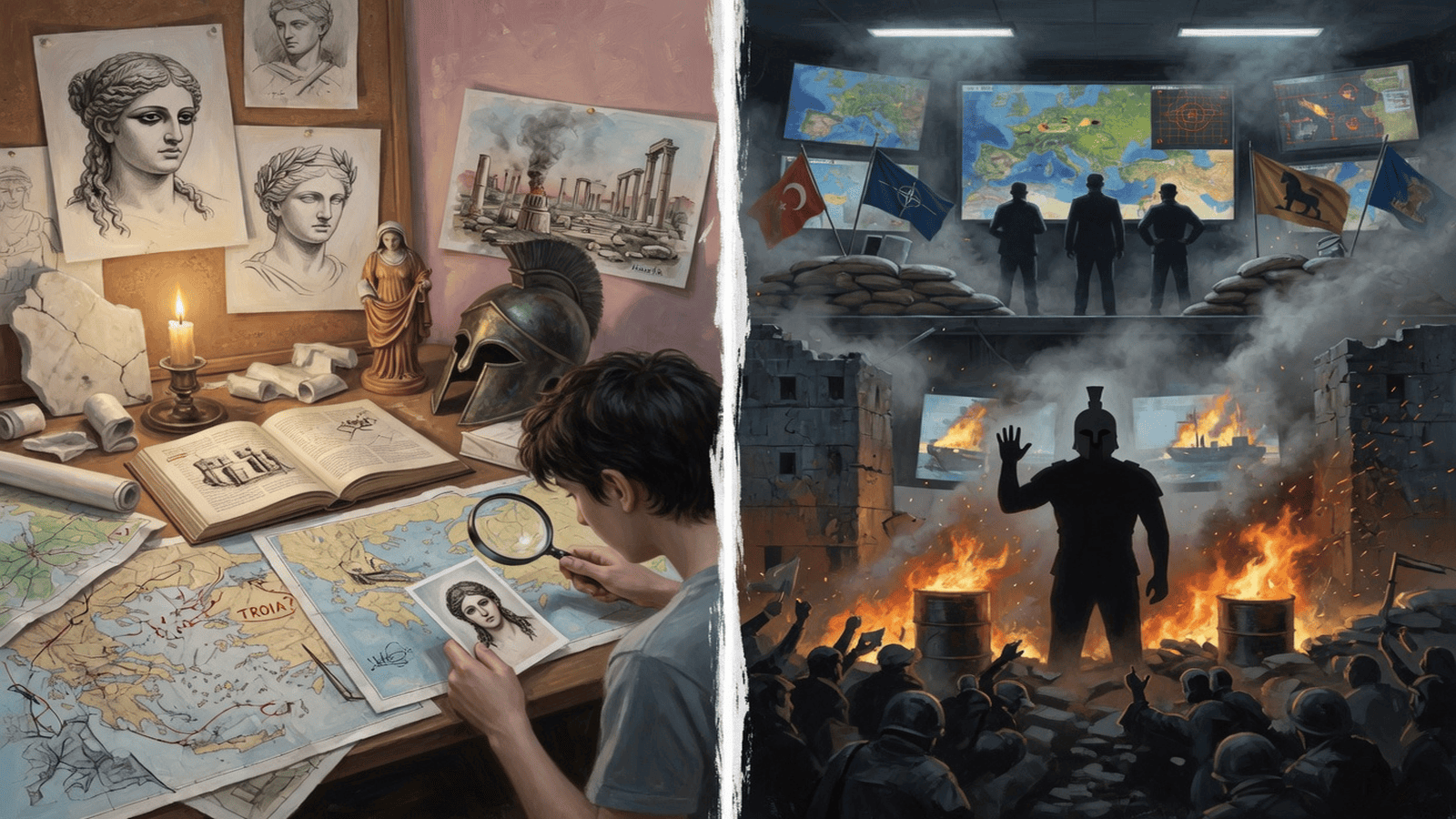
When I first read these stories, mythology behaved like journalism from a very distant century, and the job felt like fact-checking. Where exactly was Troy — the mound at Hisarlik that Schliemann dug into in the 1870s, on the Turkish coast, or the vaguer “Greece” a school map implied? Was Helen really beautiful enough to launch a thousand ships, or is that just what poets say about women who cause trouble for kings? Was Achilles actually the best fighter alive, or merely the one with the best publicist? At that age you read the epics as if the main task were verifying coordinates. That reading isn’t wrong. It’s just the stage props mistaken for the argument.
II. The Second Algorithm: Pattern Recognition
At some point the center of gravity shifts, and the question stops being where Troy was and becomes what kind of machine the war was. Who benefited from it. Who paid for it. Which vanities needed to be flattered, avenged, or immortalized before thousands of anonymous men could be fed into the furnace beneath the walls. Simone Weil made this shift explicit in 1939, writing “The Iliad, or the Poem of Force” while France waited for its own war to arrive. Her Iliad has almost no interest in glory; it is an anatomy of how force turns a person into a thing — first the enemy’s body, and eventually, just as reliably, the wielder’s own soul. Read that way, the quarrels in Troy are personal and the casualties are collective. Honor is the beautiful word power uses right before it asks somebody else to die.
III. Hector, or the Hero of Restraint
The older I get, the less the glamour of invincibility impresses me. Achilles is magnificent the way a wildfire is magnificent — he dominates the imagination because rage scales beautifully in narrative, loud, theatrical, unforgettable. Hector’s own epithet, φαίδιμος Ἕκτωρ (phaidimos Hektōr), also means shining, rooted in phaos, light: radiant, illustrious, glorious. But the shine sits on him differently. In the poem’s most quoted domestic scene, he takes off his horsehair helmet because it frightens his infant son, laughs with Andromache, and walks back to a war he already half-suspects he’ll lose. He is not the hero of pure conquest. He is the one who stays attached to the city, to continuity, to the unglamorous possibility that ordinary life should go on after the men of status finish performing themselves. Civilizations remember the dazzling destroyer. They survive, when they survive, because of the people who tried — imperfectly, and in Hector’s case fatally — to prevent total ruin.
IV. Why It Feels Familiar in 2026
This is why the epic refuses to stay ancient, whichever translation or IMAX format it arrives in. Read structurally instead of literally, Troy stops being a story about bronze armor and becomes a case study in a governance failure that keeps recurring: a handful of people inflate the stakes of their own identity, prestige, grievance, or destiny, and large populations get recruited into a narrative they never authored. The costumes change — Nolan’s are considerably more expensive than a bard’s lyre — and the media layer keeps getting more sophisticated. But the arrangement is recognizable on sight: ego at the top, abstraction in the middle, suffering at scale at the bottom, mostly unnamed. 2026 isn’t trapped in Homer for lack of technology. It’s trapped in Homer because nobody has yet solved the older problem of keeping private vanity from becoming public catastrophe.
V. A Hundred Years for One Microstep
Progress exists, but it moves with a humiliating slowness that only becomes visible on the second reading. We like to imagine modernity has outgrown Troy’s logic, then watch every century find a new way to restage it — not because people learn nothing, exactly, but because institutions learn more slowly than appetites do, and moral imagination matures more slowly than the tools we build for destroying each other. García Márquez needed a hundred years of solitude to get one family a single generation closer to understanding its own repetitions; civilization may need something on that order for its next microstep in coexistence. Not the next revolution. Not a final peace. Just the next microstep. That is what the classics reveal once youth’s denotations give way to age’s patterns: history is not only repetition. It is repetition under slightly revised management.
A closing note, unscholarly: to Héctor, a friend from way back in high school — “Preclaro Héctor” then, and still now. Here’s to those days, and to the shine.
Further reading
- Homer — The Iliad (trans. Robert Fagles, 1990)
- Homer — The Odyssey (trans. Robert Fagles, 1996)
- James Joyce — Ulysses (1922)
- Simone Weil — The Iliad, or the Poem of Force (1939)
- Gabriel García Márquez — One Hundred Years of Solitude (1967)
- Christopher Nolan, dir. — The Odyssey (2026)