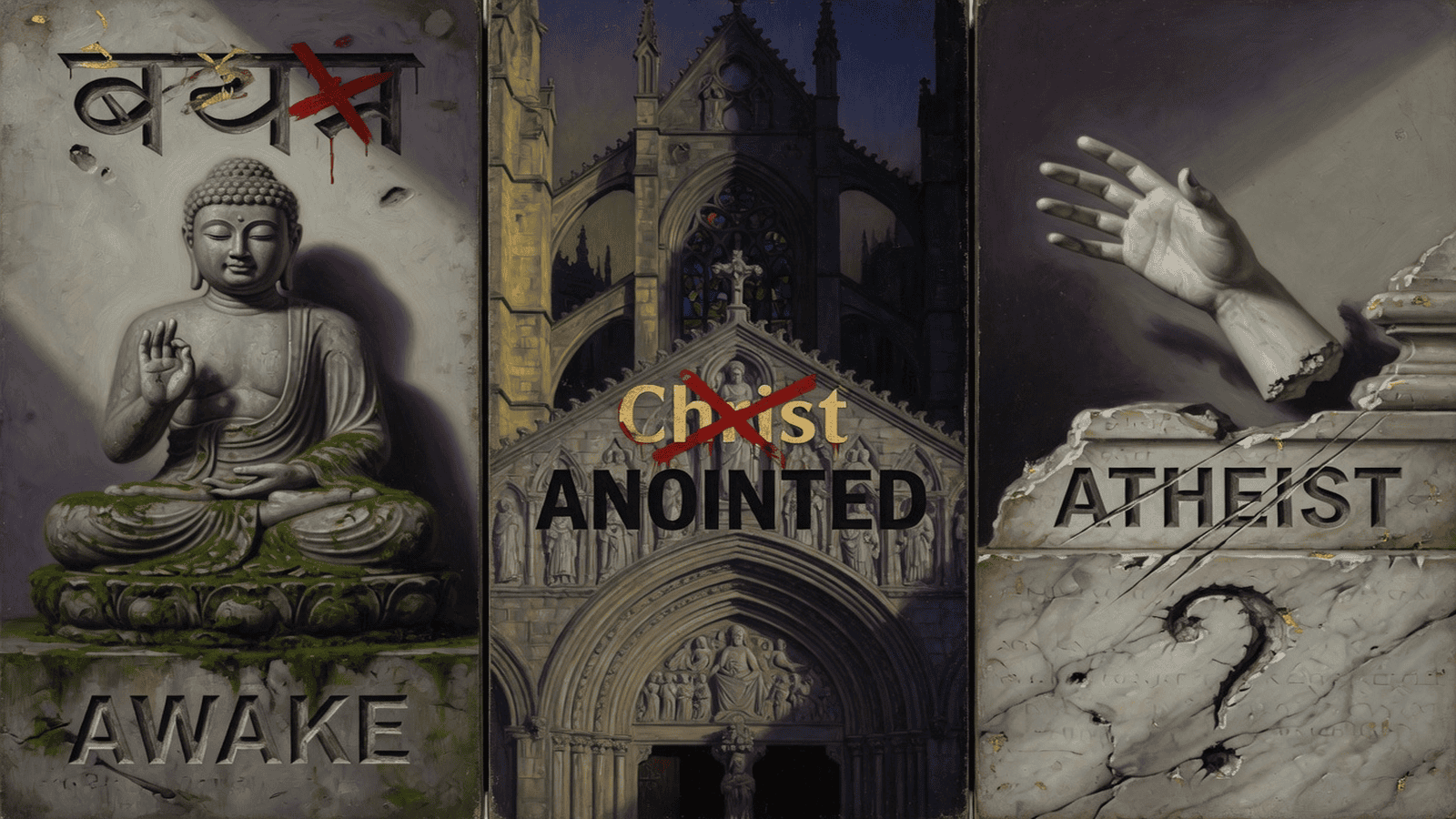
Run a simple substitution: everywhere the word “Buddhism” appears, write “Awakeism” instead. Everywhere “Christianity” appears, write “Anointedism.” Nothing about either religion has changed — only the name, translated instead of transliterated. And yet something breaks. Awakeism sounds like a wellness retreat. Anointedism sounds like a fringe sect. The exercise costs nothing and reveals a great deal: how much of a name’s authority comes not from what it means but from the fact that it doesn’t, to English ears, mean anything at all.
I. The Calque Thought Experiment
Most world religions reach English by transliteration, not translation. We say Buddhism, borrowed whole from Buddha; we say Christianity, borrowed whole from Christ. Neither name tells an English speaker what its root actually claims.
| Term | Root | Literal meaning | Calque |
|---|---|---|---|
| Buddha (बुद्ध) | Sanskrit budh — to wake, to know | “the awakened one” | Awakeism |
| Christ (Χριστός) | Greek chriō — to anoint, translating Hebrew Mashiach | “the anointed one” | Anointedism |
A calque is a loan translation: instead of importing the foreign word wholesale (as English did with sushi or Buddha), you translate it piece by piece into native material, the way skyscraper became gratte-ciel in French. Apply that same procedure to the founders’ titles and the two largest religions on earth turn into words that sound like they were invented last week by a branding consultant.
II. Foreignness as Prestige
“Buddhism” carries the weight of a civilization — centuries of scholarship, a lineage of monks and texts, an air of the ancient and untranslatable. “Awakeism” carries none of that. It sounds contemporary, thin, faintly ridiculous, the kind of word that belongs on a TEDx poster rather than a temple. Nothing about the underlying tradition changed; only its packaging did.
The same gap opens between Christ and the Anointed One. Christ is a proper name attached to a specific person and a specific history. “The Anointed One” is a description — one that could apply, structurally, to any messianic claimant in any tradition. The name is singular; the description is generic. This is the first thing the exercise reveals: an untranslated name functions as a container for prestige. Its very resistance to easy paraphrase signals that the thing it names belongs to a domain English cannot fully absorb, and that incommensurability is itself read as a form of authority.
III. The Doctrine Hidden in the Title
The calque isn’t just uglier — it’s more honest, in a specific and uncomfortable way. Buddha means “the awakened one,” and the entire founding claim of Buddhism — that ordinary waking consciousness is itself a kind of sleep, and that liberation consists of waking from it — is compressed into that single word. Say “Buddhism” to someone who has never encountered it and they learn nothing about what the tradition teaches. Say “Awakeism” and they learn the central thesis before you’ve said another word.
That transparency is not obviously a gain. Untranslated names preserve a kind of productive mystery: the tradition gets explained on its own terms, slowly, rather than pre-judged by an English gloss that may flatten or mislead. But the mystery has a cost too — it also preserves the possibility of never actually learning what the core claim is, of treating “Buddhism” as a cultural label rather than a specific, arguable thesis about consciousness.
IV. The Asymmetry of Translation
The inconsistency is the interesting part. English does translate some traditions and not others, and the pattern isn’t obviously about meaning at all. Zoroastrianism keeps the Greek rendering of Zarathustra rather than something like “Golden-Camel-ism,” one candidate calque under a debated etymology. Shinto is already a calque in its home language — 神道, “the way of the gods” — yet English kept the Japanese sound rather than translating it. Taoism sometimes gets rendered “the Way” in casual use, but the proper name survives every retelling.
Nobody decided this centrally. Every naming choice was made locally, by translators, missionaries, and colonial administrators operating one encounter at a time, and the sum is a pattern nobody designed: the traditions of politically dominant civilizations — Christianity above all, and to a lesser degree Buddhism, largely for the same reasons Sanskrit carries prestige in English that other classical languages do not — keep their foreign names, dignified by unfamiliarity, while others get folded into English description as if they hadn’t earned a proper noun. Which traditions get the prestige of an untranslated name and which get quietly domesticated is not a linguistic accident. It tracks who was doing the naming, and from what position.
V. Calque as Deliberate Critique
Not every calque is an accident of translation history — some are a chosen weapon. Viktor Shklovsky gave the technique a name in his 1917 essay on defamiliarization: art’s job, he argued, is to make the stone stony again, to interrupt the automatism by which familiar things stop being perceived at all. Nietzsche did something structurally similar when he insisted on Umwertung aller Werte — the revaluation of all values — rather than reaching for a comfortable Latinate synonym, forcing the reader to feel the strangeness of a claim that habit had worn smooth. Heidegger did it more systematically still, building German calques of Greek philosophical vocabulary rather than inheriting the scholastic Latin everyone else used, precisely so that concepts like aletheia would have to be encountered fresh rather than nodded past.
“Awakeism” and “Anointedism” work the same way, on a smaller scale. They are ugly on purpose. The ugliness is the mechanism: it forces the question of what, exactly, is being referred to when the familiar name is swapped out from under it.
VI. Atheism, the Name That Concedes the Frame
One case is stranger than the rest, because it fails at translation for a different reason: it was never anything but a translation to begin with. Atheism comes from the Greek a- (without) plus theos (god) — the alpha privative, a standard Greek negation prefix. There is no untranslated original hiding behind it, no Sanskrit or Hebrew root carrying prestige, because the English word already is the calque. “Atheism” translates as “without-god-ism,” which is exactly what it says in English, because that’s all it has ever said.
That makes it a purely negative term, definitionally parasitic on the thing it rejects. Theism does not need “atheism” to define itself; it stands on its own. Atheism cannot define itself without pointing back at theism first — which means the very act of adopting the label concedes that “god” is a coherent, meaningful category, and that the only live question is whether to affirm or deny it. A position that rejected the category itself, that treated “god” as an ill-formed concept rather than a false claim, would need an entirely different name — one that doesn’t cite what it’s arguing against in its own grammar.
The attempts to escape are instructive precisely because none of them stuck. Naturalism names a position (nature is all there is) rather than a negation. Secularism names a political arrangement, not a metaphysical one. Apatheism names indifference to the question, which is a different stance altogether. The Brights movement, launched in 2003 with early support from Richard Dawkins and Daniel Dennett, tried to rebrand nonbelief as something affirmative and was mocked into irrelevance within a few years, partly for implying that the unconvinced were simply smarter. None of them displaced “atheism,” and the persistence of the parasitic name is the real finding: even the position built to reject the theistic framework has never managed to name itself in terms that don’t run through it first.
Line the cases up and the pattern sharpens. Awakeism makes visible what Buddhism compresses. Anointedism makes visible what Christianity compresses. Atheism, translated into itself, makes visible that there was never anything to compress — only a negation standing where an independent claim should be. The names we refuse to translate are not neutral containers; they are doing rhetorical work every time they’re used, and the only way to see that work is to briefly, deliberately, break them.
Further reading
- Viktor Shklovsky — “Art as Technique” (1917), via Defamiliarization — Wikipedia
- Friedrich Nietzsche — Twilight of the Idols (1888)
- Martin Heidegger — Being and Time (1927)
- Alpha privative — Wikipedia
- Brights movement — Wikipedia
- Christ — etymology — Wikipedia