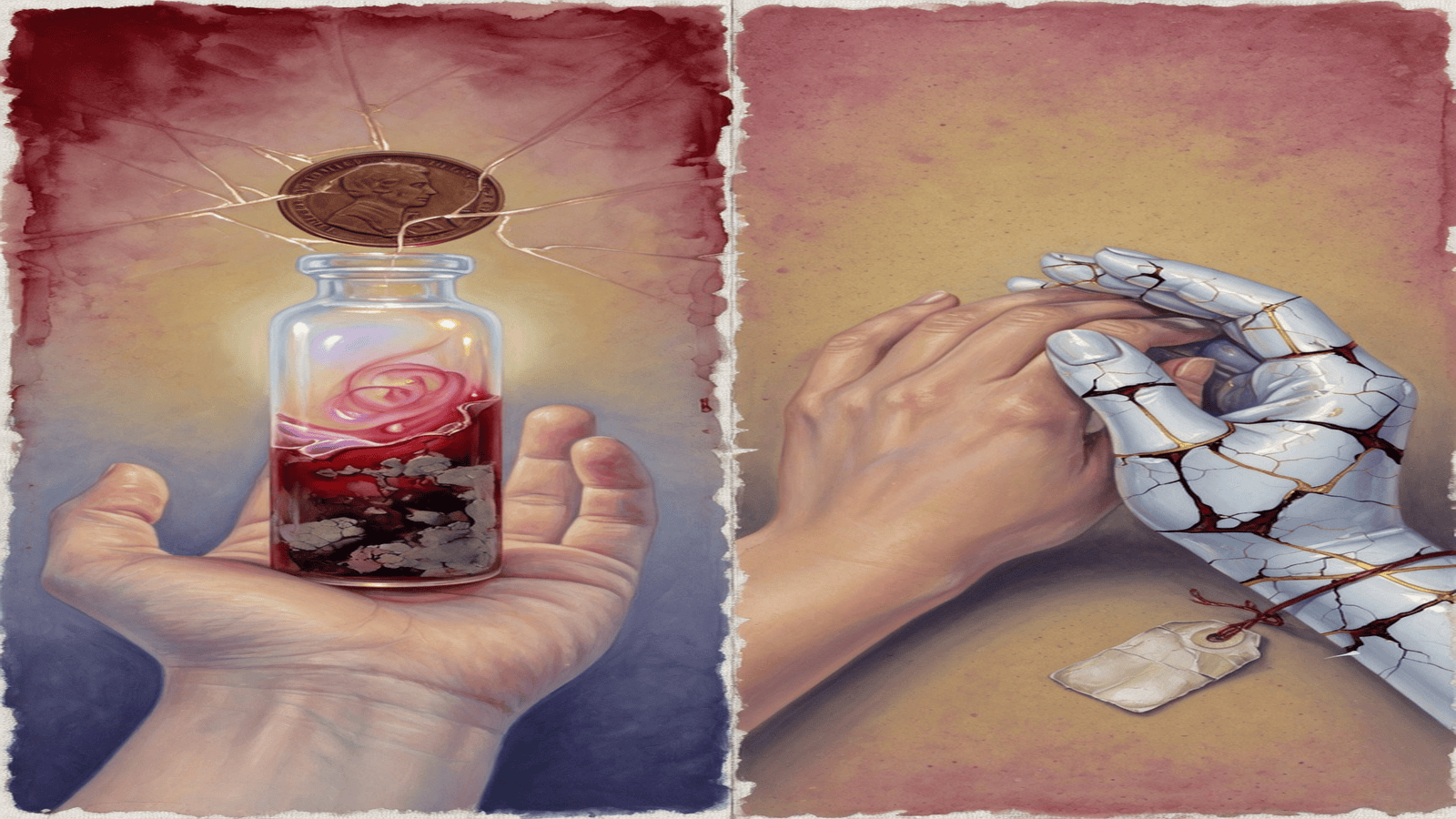
The cliché says the best things in life are free. That’s not quite right, and the imprecision matters. Trust, respect, a friend’s attention, a stranger’s blood freely given — none of these are free in the sense of costing nothing to produce; they cost reputation, time, restraint, years of behaving well when no one was checking. What they share is something sharper than “free”: they are goods whose value depends on their not being for sale. Attach a price, and the thing on the other side of the transaction stops being the thing you wanted.
I. The Blood That Went Bad
Richard Titmuss tested this directly, by accident of national policy, in The Gift Relationship (1970). Britain ran on unpaid blood donation; the United States, in large stretches of its supply chain, paid for it. Titmuss compared the two systems on the metric that should have settled the argument in favor of markets — efficiency — and found the opposite. American paid blood was measurably worse: more hepatitis, more contamination, more waste, because paying for blood changes who shows up to give it. A donor with nothing to gain has no reason to hide a health problem; a seller with rent to make has every reason to. The price did not just fail to improve the supply. It degraded the thing itself, by changing who the good selects for.
II. The Moral Limits of Markets
Michael Sandel generalized Titmuss’s finding into two distinct objections in What Money Can’t Buy (2012), and the distinction is the whole argument. The fairness objection says a market is unjust when it lets money buy what should be distributed by need or merit — the usual complaint about queue-jumping and pay-to-play. The corruption objection is stranger and more interesting: some goods are degraded by the very act of pricing them, independent of whether the transaction was fair to both parties. Paying children to read books gets them reading for the fee, not the story, and the habit collapses the moment the fee stops. Paying for a wedding toast produces sentences, not a friend’s sincerity. The market did not just fail to deliver the good efficiently. It manufactured a convincing counterfeit and destroyed the original in the process.
III. The Good Institutions Can Earn and Markets Cannot Manufacture
This is the same mechanism examined from the institutional side in Learning Convivence in an Abundant World: trust between strangers, the raw material of everything from lending to peace treaties, is not a commodity a wealthy society can simply buy more of. It has to be earned, slowly, through reciprocal restraint that survives the temptation of a one-time advantage — which is precisely why no amount of material abundance dissolves it on its own. Try to purchase trust directly — hired endorsements, manufactured testimonials, a reputation bought rather than built — and the market supplies something that looks like trust and functions like counterfeit currency: it works until the first person checks, and then it poisons every future claim, real or not, the way a single case of counterfeit bills makes a cashier suspicious of every bill afterward.
IV. Attention’s Race to Zero
The Photography That Disappeared traced a related but distinct failure mode: not a good destroyed by pricing, but a good destroyed by unlimited supply meeting a market built to price scarcity. Herbert Simon named the mechanism in 1971, decades before anyone needed it: “a wealth of information creates a poverty of attention.” Attention is a market good in the ordinary sense — rivalrous, allocable, tradeable for money via advertising — right up until supply becomes effectively infinite. Past that point, the price does not fall toward some efficient equilibrium; it falls toward zero along with the good’s meaning, because the whole reason a glance was worth anything was its scarcity. An infinite feed does not commodify attention successfully. It abolishes the conditions under which attention could be a signal of anything at all.
V. Why Pricing Kills the Signal
What connects blood, trust, and attention is that each was doing double duty: delivering a service and, simultaneously, carrying information about the giver that the service could not exist without. Unpaid blood said I have nothing to hide. Trust extended without a contract said I am willing to be vulnerable to you. A glance freely given said this, out of everything competing for me, earned it. A price is a universal solvent for that second layer. It does not merely add a cost; it makes the behavior available to anyone willing to pay regardless of whether the underlying fact — honesty, goodwill, genuine interest — was ever present. The good becomes cheap to fake, and once it is cheap to fake, the signal it used to carry is worthless to everyone, faker and honest alike.
VI. What This Doesn’t Mean
None of this is an argument against markets in general, or a case for treating every unpriced thing as sacred. Markets remain the best mechanism humanity has found for allocating rivalrous, substitutable goods — wheat, steel, a seat on a plane — where the point is exactly that any unit of the good will do. Jacque Fresco made a far more sweeping version of this argument — this essay’s own title is a deliberate echo of his — in The Best That Money Can’t Buy: Beyond Politics, Poverty, & War (2002): “Whenever money is involved, there is elitism.” Fresco’s prescription was not a narrow exception carved out for blood, trust, and attention; it was the abolition of pricing as an organizing principle altogether, replaced by a resource-based economy engineered to make scarcity itself obsolete. This essay doesn’t go there, and doesn’t need to. The claim is narrower and, for that reason, harder to argue away: for a specific class of goods, the sale is not incidental to the harm, it is the harm, because the value was never in the object changing hands but in what its non-sale proved about the person handing it over. Production keeps outrunning these goods for the same reason abundance never retired hunger and war on its own: some scarcities were never about supply, and no factory, and no price, can build a replacement for what was only ever going to be given.
“What will you have? quoth God; pay for it and take it.” — Ralph Waldo Emerson, Compensation
Emerson’s law of compensation is the sharper, older version of this whole essay: nothing is ever actually free, and the goods that can’t be bought are not exempt from that law, only paid in a currency money can’t touch. Money never got a discount on blood, trust, or attention. It just tried to pay the toll in the wrong currency, and the toll booth noticed.
Further reading
- Richard Titmuss — The Gift Relationship: From Human Blood to Social Policy (1970)
- Michael J. Sandel — What Money Can’t Buy: The Moral Limits of Markets (2012)
- Herbert A. Simon — the 1971 “poverty of attention” thesis, via Attention economy — Wikipedia
- Ralph Waldo Emerson — Compensation (1841)
- Jacque Fresco — The Best That Money Can’t Buy: Beyond Politics, Poverty, & War (2002)